Introduction
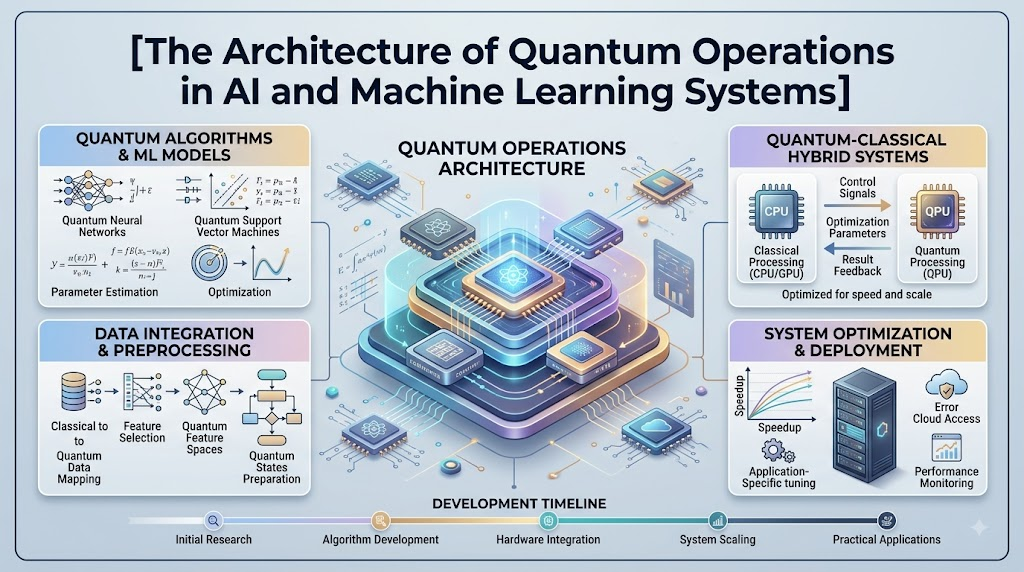
Artificial intelligence and quantum computing represent two of the most transformative computational paradigms of our era. In contrast, quantum computing leverages quantum mechanical principles—such as superposition, entanglement, and interference—to process complex mathematical states in novel ways. The future of advanced computing does not involve quantum processors outright replacing classical AI infrastructure. Quantum hardware is not a general-purpose replacement for classical computers; rather, it functions as a domain-specific accelerator. The real challenge and opportunity lie in uniting them. To bridge this divide, a structured discipline is needed to manage workloads, hardware access, testing, monitoring, and automation. This discipline is QuantumOps. Readers can explore educational frameworks for managing these operational workflows directly at QuantumOpsSchool.com. By establishing reliable operational pipelines, organizations can evaluate hybrid workflows objectively without succumbing to unwarranted hype.
What Is QuantumOps?
QuantumOps is the practical framework of tools, workflows, automation strategies, and monitoring practices required to build, test, deploy, and maintain quantum computing workloads reliably.
Just as DevOps standardizes traditional software delivery and MLOps manages machine learning lifecycles, QuantumOps addresses the unique operational realities of quantum hardware and software.
+----------------------------------------------------------------------+
|                      CORE QUANTUMOPS CAPABILITIES                    |
+----------------------------------------------------------------------+
|  1. Quantum Workflow Orchestration   |  6. Error Mitigation          |
|  2. Quantum Hardware Access Layer    |  7. Observability & Telemetry |
|  3. Circuit Versioning & Storage     |  8. Experiment Tracking       |
|  4. Dynamic Job Scheduling           |  9. Resource Management       |
|  5. Automated Verification & Testing | 10. Hybrid Integration Engine |
+----------------------------------------------------------------------+
Quantum computing introduces constraints that classical operations never encounter:
- Qubits are fragile and sensitive to ambient environmental noise.
- Execution time on physical devices is constrained by coherence windows.
- Measurement is inherently probabilistic, requiring repeated runs (shots) to build statistical distributions.
QuantumOps establishes the operational baseline needed to run quantum code efficiently while managing these physical realities.
Why AI Needs Quantum Operations
Simply securing API access to a quantum processing unit (QPU) does not make an AI system quantum-ready. Running AI-adjacent quantum tasks requires multi-step coordination across distinct systems.
+------------------+      +-------------------+      +-------------------+
|  1. AI Problem   | ---> | 2. Data Encoding  | ---> | 3. Job Scheduling |
|   Formulation    |      |    & Reduction    |      |    & Queuing      |
+------------------+      +-------------------+      +-------------------+
                                                               |
+------------------+      +-------------------+                |
| 6. Classical AI  | <--- | 5. Statistical    | <--- +-------------------+
|    Evaluation    |      |    Reconstruction |      | 4. Hardware Run   |
+------------------+      +-------------------+      |  & Mitigation     |
                                                     +-------------------+
Without a dedicated operations framework, teams encounter critical failure points:
- High-dimensional machine learning datasets cannot be directly ingested by today’s noisy quantum circuits without classical dimensionality reduction.
- Jobs submitted to shared cloud QPUs sit in public queues, breaking continuous training loops.
- Uncalibrated drift in quantum processors can invalidate experimental results over time.
- Output distributions contain physical readout noise that must be filtered before feeding back into classical AI optimizers.
QuantumOps supplies the operational layer that connects high-level AI applications, classical infrastructure, quantum software development kits (SDKs), and physical quantum hardware.
How AI and Quantum Computing Can Work Together
Hybrid quantum-classical systems do not execute an entire machine learning application on a quantum chip. Instead, computation follows a cyclical flow where each hardware architecture handles the tasks it is best suited for.
$$\text{AI Application} \xrightarrow{} \text{Classical Preprocessing} \xrightarrow{} \text{Quantum Software} \xrightarrow{} \text{Quantum Hardware} \xrightarrow{} \text{Measurement} \xrightarrow{} \text{Classical AI Analysis}$$
+-----------------------------------------------------------------------------+
|                          HYBRID INTERACTION PATTERNS                        |
+-----------------------------------------------------------------------------+
| Pattern A: AI Controls Quantum Workloads                                    |
|   Classical ML models analyze system telemetry to pick compilation passes.   |
+-----------------------------------------------------------------------------+
| Pattern B: Quantum Computing Supports Optimization                          |
|   A specialized quantum routine evaluates complex combinatorial subproblems.|
+-----------------------------------------------------------------------------+
| Pattern C: Quantum Results Feed Classical AI                                |
|   Measurement distributions from quantum states act as structured inputs.   |
+-----------------------------------------------------------------------------+
| Pattern D: AI Assists Hardware Operations                                    |
|   Predictive models monitor qubit drift and schedule recalibrations.        |
+-----------------------------------------------------------------------------+
It is essential to distinguish between active research explorations and production realities. While these interaction patterns are promising in laboratory and proof-of-concept settings, production AI systems today remain overwhelmingly classical.
The Role of QuantumOps in Hybrid AI Systems
Integrating a quantum co-processor into an AI data pipeline requires strict operational guardrails. QuantumOps provides the backbone for this hybrid architecture.
+-----------------------------------------------------------------------+
|                    QUANTUMOPS OPERATIONAL BACKBONE                    |
+-----------------------------+-----------------------------------------+
| Capability                  | Practical Function                      |
+-----------------------------+-----------------------------------------+
| Workflow Orchestration      | Syncs classical preprocessing & QPU     |
| Circuit Versioning          | Tracks gate layout, depth, & parameters |
| Dynamic Job Scheduling      | Routes circuits to optimal QPUs or sims |
| Experiment Tracking         | Logs shots, noise profiles, and seeds   |
| Continuous Telemetry        | Monitors queue latency and error rates  |
+-----------------------------+-----------------------------------------+
As hybrid setups grow from single scripts to multi-node pipelines, QuantumOps ensures that quantum executions are repeatable, observable, and systematically auditable.
AI-Assisted Quantum Workflow Automation
The relationship between AI and quantum computing is reciprocal: just as quantum systems can process AI subroutines, classical machine learning can automate critical QuantumOps tasks.
+-------------------------------------------------------------------------+
|                 AI-ASSISTED QUANTUM AUTOMATION DOMAINS                  |
+-------------------------------------------------------------------------+
|                                                                         |
|  [ Intelligent Scheduling ] ---> Selects QPUs based on queue & noise    |
|  [ Parameter Optimization ] ---> Tunes variational angles automatically |
|  [ Anomaly Detection ]      ---> Flags abnormal execution histograms    |
|  [ Predictive Maintenance ] ---> Forecasts qubit calibration drift      |
|  [ Dynamic Compilation ]    ---> Rewires circuits for real-time topology|
|                                                                         |
+-------------------------------------------------------------------------+
- Intelligent Job Scheduling: Machine learning models evaluate historical queue wait times, gate fidelity metrics, and circuit topologies to route tasks to the best available backend.
- Parameter Optimization: Classical reinforcement learning and Bayesian optimization algorithms accelerate the tuning of angles in Parameterized Quantum Circuits (PQCs).
- Anomaly Detection: Time-series models monitor execution metrics to detect anomalies caused by environmental fluctuations (e.g., thermal spikes in dilution refrigerators).
- Predictive Maintenance: Classifiers analyze drift patterns to alert engineers before gate errors exceed acceptable thresholds.
These capabilities represent active areas of engineering research designed to make quantum operations self-healing and autonomous.
QuantumOps and Quantum Machine Learning (QML)
Quantum Machine Learning (QML) investigates how quantum algorithms can be integrated into computational learning models. The foundational structure of many empirical QML pipelines relies on Variational Quantum Algorithms (VQAs).
$$\text{Classical Data} \xrightarrow{} \text{Feature Map} \xrightarrow{} U(\theta) \text{ [Parametric Circuit]} \xrightarrow{} \text{Measurement} \xrightarrow{} \text{Loss Function} \xrightarrow{} \text{Classical Optimizer} \xrightarrow{} \text{Update } \theta$$
+-------------------------------------------------------------------------+
|                         THE VARIATIONAL QML LOOP                        |
|                                                                         |
|        +-------------------------------------------------------+        |
|        |                                                       |        |
|        v                                                       |        |
|  [ Classical Data ] ---> [ Feature Encoding ]                  |        |
|                                 |                              |        |
|                                 v                              |        |
|                    [ Parameterized Circuit U(θ) ]              |        |
|                                 |                              |        |
|                                 v                              |        |
|                      [ QPU / Simulator Run ]                   |        |
|                                 |                              |        |
|                                 v                              |        |
|                      [ Expectation Values ]                    |        |
|                                 |                              |        |
|                                 v                              |        |
|                      [ Compute Cost Function ]                 |        |
|                                 |                              |        |
|                                 v                              |        |
|                      [ Classical Optimizer ] ------------------+        |
|                       (Updates Parameters θ)                            |
+-------------------------------------------------------------------------+
The operational challenge in QML is managing this iterative loop. A single training step may require thousands of circuit evaluations across varying parameter sets ($\theta$). If every step experiences cloud latency, unmanaged queue delays, or uncorrected noise, training becomes impractical. QuantumOps automates and streamlines this tight feedback loop.
QuantumOps for AI Model Optimization
Optimization is at the core of training modern AI architectures, from loss function minimization to hyperparameter exploration.
+------------------------------------------------------------------------+
|             OPTIMIZATION EXPLORATION AREAS IN QUANTUM AI               |
+------------------------------------------------------------------------+
| * Combinatorial Feature Selection   * High-Dimensional Clustering      |
| * Hyperparameter State Search       * Non-Convex Landscape Sampling    |
| * Large-Scale Workload Scheduling   * Neural Architecture Pruning      |
+------------------------------------------------------------------------+
While quantum approaches like QAOA (Quantum Approximate Optimization Algorithm) and Quantum Annealing are widely studied for these problems, broad quantum advantage has not yet been established over classical methods.
+-------------------------------------------------------------------------+
|                       BENCHMARKING REQUIREMENTS                         |
|                                                                         |
|   Quantum Approach [QPU / Sim]  <-- Compare -->  State-of-the-Art ML   |
|   - Compute Time & Cost                          - Classical Baselines  |
|   - Solution Quality                             - Scalability Limits   |
+-------------------------------------------------------------------------+
QuantumOps mandates that every quantum optimization experiment is benchmarked against optimized classical baselines (such as simulated annealing, genetic algorithms, or standard gradient descent) to ensure real-world utility.
Quantum Hardware Challenges for AI Workloads
Running AI workloads on present-day Noisy Intermediate-Scale Quantum (NISQ) systems involves clear physical and systemic constraints.
+-------------------------------------------------------------------------+
|                      PHYSICAL HARDWARE CONSTRAINTS                      |
+-------------------------------------------------------------------------+
|  [ Noise & Decoherence ]    Qubits lose quantum state rapidly           |
|  [ Limited Qubit Counts ]   Restricts scale of encoded AI problems      |
|  [ Gate & Readout Errors ]  Introduce statistical noise into outputs    |
|  [ Sparse Connectivity ]    Requires SWAP gates that increase depth     |
|  [ Calibration Drift ]      Hardware properties vary over operating runs|
|  [ Remote Queue Latency ]   Slows iterative hybrid training loops       |
+-------------------------------------------------------------------------+
+-------------------------------------------------------------------------+
|                     QUANTUMOPS MITIGATION MEASURES                      |
+-------------------------------------------------------------------------+
|  * Hardware-Aware Compilation & Routing                                 |
|  * Real-Time Calibration Tracking                                       |
|  * Automated Error Mitigation Pipelines (ZNE, Readout Calibration)      |
|  * Hybrid Queue Management & Local Simulation Caching                   |
+-------------------------------------------------------------------------+
QuantumOps tools help mitigate these physical bottlenecks by tailoring compilation strategies directly to the daily calibration state of target devices.
Error Mitigation vs. Error Correction
Understanding error handling is essential for building realistic quantum workflows.
+---------------------------------------------------------------------------+
|                   ERROR MITIGATION vs. ERROR CORRECTION                   |
+------------------------------------+--------------------------------------+
| Error Mitigation (Current Era)     | Fault-Tolerant Error Correction      |
+------------------------------------+--------------------------------------+
| * Post-processes noisy outputs     | * Encodes one logical qubit across   |
| * Extracts clean expectation values|   many physical qubits               |
| * No extra physical qubits needed  | * Detects & corrects errors live     |
| * Examples: ZNE, Clifford Data     | * Requires thousands of physical     |
|   Regression, Readout Calibration  |   qubits per logical qubit           |
| * Standard in NISQ workflows       | * Target for future fault tolerance  |
+------------------------------------+--------------------------------------+
Error mitigation does not eliminate quantum noise during execution; rather, it estimates clean expectation values from collections of noisy runs. QuantumOps automates the insertion of mitigation routines directly into execution pipelines.
Quantum Observability for AI Workloads
Observability in quantum computing requires tracking metrics across both classical computing infrastructure and specialized quantum processors.
+-------------------------------------------------------------------------+
|                   UNIFIED OBSERVABILITY ARCHITECTURE                    |
+------------------------------------+------------------------------------+
| Classical Metrics                  | Quantum Execution Telemetry        |
+------------------------------------+------------------------------------+
| * CPU / GPU Utilization            | * Circuit Depth & 2-Qubit Gate Count|
| * Pipeline Latency                 | * Physical QPU Calibration F社会的 |
| * Memory Bandwidth                 | * Shot Counts & Sampling Entropy   |
| * Ingestion Throughput             | * Readout & Coherence ($T_1, T_2$) |
+------------------------------------+------------------------------------+
$$\text{Classical Telemetry} + \text{Quantum Circuit Metrics} + \text{Calibration State} + \text{Execution History} \xrightarrow{} \text{Quantum Observability}$$
This end-to-end visibility ensures that drops in AI model performance can be accurately traced back to either classical data drift or physical quantum hardware fluctuations.
Data Management in Quantum-AI Workflows
Modern deep learning operates on terabytes of high-dimensional data. Contemporary quantum processors, however, can only encode small arrays of values per circuit run.
+-------------------------------------------------------------------------+
|                        DATA MANAGEMENT PIPELINE                         |
|                                                                         |
|  [ Classical Big Data ]                                                 |
|          |                                                              |
|          v                                                              |
|  [ Classical Preprocessing & Reduction ] (PCA, Autoencoders, SVD)       |
|          |                                                              |
|          v                                                              |
|  [ Compact Feature Vector ]                                             |
|          |                                                              |
|          v                                                              |
|  [ Quantum State Encoding ] (Angle, Amplitude, Basis Encoding)          |
|          |                                                              |
|          v                                                              |
|  [ QPU Circuit Execution & Measurement ]                                |
|          |                                                              |
|          v                                                              |
|  [ Classical Storage & Post-Processing ] (Histograms, State Vectors)    |
+-------------------------------------------------------------------------+
Because of this architectural reality, the vast majority of data management remains on classical infrastructure. QuantumOps coordinates data handoffs to ensure inputs are formatted for quantum execution without overwhelming processing pipelines.
Comparison: MLOps vs. QuantumOps vs. DevOps
QuantumOps builds upon the foundational principles of DevOps and MLOps, adapting them to the non-deterministic nature of quantum systems.
| Operational Dimension | DevOps | MLOps | QuantumOps |
| Primary Focus | Software applications & APIs | Machine learning lifecycles | Quantum & hybrid workflows |
| Core Workloads | Deterministic business code | Statistical models & weights | Quantum circuits & gates |
| Underlying Hardware | Classical CPUs & Servers | Classical GPUs & TPUs | Superconducting, Trapped-Ion, Photonics, Annealers |
| Testing Paradigm | Unit, Integration, & E2E tests | Model validation & data drift | Unit testing, unitary verification, & simulation |
| Error Handling | Exception handling & bug fixing | Loss functions & error bounds | Error mitigation & logical error tracking |
| Execution Nature | Deterministic logic | Stochastic model inference | Inherently probabilistic measurement ($N$ shots) |
| Hardware Coupling | Low (Containerized/OS abstraction) | Moderate (CUDA drivers, GPU memory) | High (Native gate sets, coupling maps, $T_1/T_2$ times) |
Hypothetical Walkthrough: A Quantum-AI Optimization Loop
To illustrate how QuantumOps works in practice, let us examine a hypothetical quantum-enhanced optimization pipeline.
+---------------------------------------------------------------------------+
|            HYPOTHETICAL QUANTUMOPS OPTIMIZATION WORKFLOW                  |
+---------------------------------------------------------------------------+
|                                                                           |
| [1. Classical AI Platform]                                                |
|     Formulates a combinatorial problem -> Checks parameter bounds.        |
|                                                                           |
| [2. QuantumOps Orchestrator]                                              |
|     Runs validation tests on circuit structure via local simulator.       |
|                                                                           |
| [3. Dynamic Scheduler]                                                    |
|     Checks cloud backends -> Picks QPU with lowest error & queue length.  |
|                                                                           |
| [4. Hardware Execution]                                                   |
|     Compiles to native gate set -> Transpiles -> Runs 5,000 shots.        |
|                                                                           |
| [5. Mitigation & Ingestion]                                               |
|     Applies readout error mitigation -> Records telemetry & results.      |
|                                                                           |
| [6. Classical Return]                                                     |
|     Passes processed expectation value back to classical AI optimizer.    |
|                                                                           |
+---------------------------------------------------------------------------+
This architectural example illustrates how operational controls ensure reliable execution across classical and quantum boundaries without relying on manual steps.
Key Challenges in Quantum Operations for AI
Implementing operational workflows across quantum hardware introduces several distinct challenges:
- Hardware Availability and Contention: Shared access to cloud QPUs creates variable queue times that disrupt real-time AI pipelines.
- Environmental Noise and Decoherence: Physical interference limits circuit depth, reducing the operational scale of algorithms.
- Hardware-Specific Transpilation: Every quantum provider uses distinct native gate sets and physical qubit connectivity maps.
- Benchmarking Difficulties: Proving that a quantum routine outperforms an optimized classical baseline requires rigorous, standardized testing.
- Data Encoding Bottlenecks: Mapping high-dimensional classical vectors to quantum states without loss of precision remains difficult.
- Integration Complexity: Connecting modern containerized CI/CD pipelines to specialized quantum cloud APIs requires custom glue code.
- Lack of Operational Standardization: The industry lacks universal formats for circuit versioning, execution telemetry, and metadata logging.
- Specialized Talent Shortage: Engineering teams require cross-disciplinary expertise in quantum physics, computer science, and machine learning operations.
- Execution Costs: Accessing physical QPUs remains expensive, requiring careful local simulation before submitting remote jobs.
- Nascent Business Value: Many enterprise workflows remain exploratory proofs-of-concept while hardware continues to mature.
Best Practices for QuantumOps in AI
+----------------------------------------------------------------------------+
|                       QUANTUMOPS BEST PRACTICES                            |
+----------------------------------------------------------------------------+
|  1. Start with a concrete mathematical problem formulation.                |
|  2. Establish a rigorous, state-of-the-art classical baseline.             |
|  3. Validate circuit structures on classical simulators before QPU runs.   |
|  4. Track all execution metadata (shots, calibration, compiler passes).    |
|  5. Version control quantum circuits alongside classical application code. |
|  6. Monitor queue latencies, coherence drift, and backend error rates.     |
|  7. Automate compilation, error mitigation, and result parsing.            |
|  8. Validate quantum outputs using clear statistical confidence intervals. |
|  9. Maintain loose coupling between classical AI code and quantum SDKs.    |
| 10. Profile compute costs against solution quality continuously.           |
| 11. Implement automated fallbacks to classical solvers during outages.     |
| 12. Keep up with daily QPU recalibration profiles.                        |
+----------------------------------------------------------------------------+
Roadmap: Building a QuantumOps Strategy for AI
For teams looking to integrate quantum computing exploration into their AI roadmap, a structured adoption process prevents wasted effort.
+-------------------------------------------------------------------------+
|                  ORGANIZATIONAL ADOPTION ROADMAP                        |
|                                                                         |
|  [ Stage 1: Assessment ]                                                |
|    - Identify optimization or sampling bottleneck                       |
|    - Verify theoretical relevance for quantum algorithms                |
|                                                                         |
|  [ Stage 2: Classical Benchmarking ]                                    |
|    - Establish baseline using standard ML/classical techniques          |
|    - Set quantitative performance and cost targets                      |
|                                                                         |
|  [ Stage 3: Simulated Development ]                                     |
|    - Model circuits using local state-vector & noise simulators         |
|    - Build automated unit tests and validation pipelines                |
|                                                                         |
|  [ Stage 4: Hardware Integration & QuantumOps ]                         |
|    - Connect CI/CD pipelines to target QPU backends                     |
|    - Deploy telemetry tracking, error mitigation, and monitoring        |
|                                                                         |
|  [ Stage 5: Evaluation & Scaled Rollout ]                               |
|    - Compare end-to-end metrics against classical baselines             |
|    - Scale QPU workloads only when justified by validated advantages    |
+-------------------------------------------------------------------------+
Measuring Success: Key QuantumOps Metrics
Evaluating a hybrid quantum-AI platform requires measuring both computational efficiency and technical execution quality.
| Metric | Measurement Focus | Operational Value |
| Job Success Rate | Ratio of successfully completed circuits to submissions | Identifies infrastructure and provider outages |
| Queue Latency | Time spent waiting in cloud scheduling queues | Highlights pipeline bottlenecks and scheduling delays |
| Circuit Execution Time | Active run time on quantum processors | Tracks actual device utilization and billing units |
| Fidelity and Error Rates | Gate error rates and readout noise metrics | Ensures executions meet required accuracy levels |
| Experiment Reproducibility | Consistency of output distributions across runs | Flags environmental drift and undocumented changes |
| Cost per Experiment | Financial cost across classical and QPU backends | Prevents cloud budget overruns |
| Hybrid Iteration Time | Round-trip duration for classical-quantum loops | Measures efficiency in variational training workflows |
| Baseline Relative Gain | Performance delta against best classical methods | Quantifies true algorithmic utility |
The Horizon: The Future of Quantum Operations in AI
As quantum computing matures from experimental prototypes into cloud infrastructure, QuantumOps will expand across several key areas.
+-------------------------------------------------------------------------+
|                          THE MATURITY HORIZON                           |
+-------------------------------------------------------------------------+
|                                                                         |
|  [ Today: Hybrid Orchestration ]                                        |
|    - Manual SDK integration, simple cloud queues, basic error mitigation|
|                                                                         |
|  [ Emerging: Autonomous Operations ]                                    |
|    - AI-assisted scheduling, dynamic compilation, automated mitigation  |
|                                                                         |
|  [ Long-Term: Fault-Tolerant Ecosystems ]                               |
|    - Logical qubit orchestration, standardized APIs, automated scaling  |
|                                                                         |
+-------------------------------------------------------------------------+
- Intelligent Orchestration: Classical AI agents will dynamically compile, schedule, and optimize quantum workloads based on real-time hardware telemetry and market pricing.
- Autonomous Error Management: Systems will analyze continuous calibration streams, automatically applying optimal error mitigation strategies without manual tuning.
- Standardized Cloud Interfaces: Specialized quantum hardware will increasingly be managed through unified cloud interfaces, abstracting provider-specific variations behind standardized APIs.
- AI-Assisted Quantum Programming: Classical language models trained on quantum SDKs will assist developers in structuring algorithms, validating unitaries, and optimizing circuit layouts for target topologies.
Essential QuantumOps Skills for Beginners
Building proficiency in QuantumOps requires an interdisciplinary foundation spanning physics fundamentals, software engineering, and machine learning infrastructure.
+-------------------------------------------------------------------------+
|                           LEARNING PATHWAY                              |
|                                                                         |
|  [ Level 1: Foundations ]                                               |
|    - Linear algebra, complex vectors, probability                       |
|    - Core quantum concepts: qubits, superposition, measurement          |
|                                                                         |
|  [ Level 2: Core Engineering ]                                          |
|    - Python programming & Quantum SDKs (Qiskit, Cirq, PennyLane)        |
|    - Circuit synthesis, unitaries, and state-vector simulation          |
|                                                                         |
|  [ Level 3: Modern Operations ]                                         |
|    - Linux fundamentals, Docker, Git, CI/CD pipeline automation         |
|    - Classical MLOps concepts & cloud architecture                      |
|                                                                         |
|  [ Level 4: Advanced QuantumOps ]                                       |
|    - Quantum error mitigation methods (ZNE, Readout calibration)        |
|    - Real-time QPU telemetry, job scheduling, and benchmarking          |
+-------------------------------------------------------------------------+
How QuantumOpsSchool.com Supports Your Journey
Mastering this evolving intersection of artificial intelligence, cloud operations, and quantum computing requires structured, practical education. QuantumOpsSchool.com provides foundational resources, conceptual guides, and practical architectural breakdowns covering:
- Core principles of QuantumOps and quantum computing operations.
- Architectures for hybrid quantum-classical workflows.
- Quantum software frameworks, SDKs, and automation strategies.
- Practical approaches to error mitigation and observability.
- Objective evaluation of quantum computing applications in AI.
Whether you are a DevOps engineer, data scientist, or software developer, exploring these resources can help you build the skills needed to design, monitor, and manage future quantum workloads.
Frequently Asked Questions
What is QuantumOps?
QuantumOps is the set of practices, tools, and operational workflows used to build, test, deploy, schedule, monitor, and maintain quantum computing workloads across classical and quantum hardware environments.
How is QuantumOps related to AI?
QuantumOps provides the operational infrastructure needed to connect classical AI platforms with specialized quantum processors, ensuring data formatting, job scheduling, error mitigation, and result validation run reliably.
What is the role of AI in quantum computing?
Classical AI can assist quantum operations by optimizing job scheduling, analyzing hardware calibration data, detecting system anomalies, and tuning parameters in variational quantum algorithms.
Can AI control quantum computers?
Classical AI systems can manage operational tasks around quantum computers—such as submitting jobs, selecting backend configurations, and scheduling recalibrations—while the quantum processor executes the underlying physical operations.
What is a hybrid quantum-classical workflow?
A hybrid workflow is a computing pattern where classical systems handle tasks like data ingestion, preprocessing, and optimization, while routing specific, mathematically intensive subroutines to a quantum processor.
How does QuantumOps support quantum machine learning?
Quantum machine learning often requires running thousands of iterative parameter updates between classical optimizers and quantum circuits. QuantumOps automates and monitors this loop to minimize queue latency and manage hardware noise.
Can AI help reduce quantum computing errors?
Machine learning models can analyze hardware telemetry to identify noise patterns, forecast calibration drift, and optimize error mitigation parameters, helping clean up measured results.
What skills are needed to learn QuantumOps?
Key skills include linear algebra, basic quantum mechanics, Python, quantum SDKs (such as Qiskit or PennyLane), software automation, CI/CD principles, and cloud infrastructure management.
What are the biggest challenges in QuantumOps today?
The primary challenges include hardware noise, limited qubit counts, long cloud queue times, lack of tooling standards, high access costs, and the difficulty of beating optimized classical baselines.
What is the future of QuantumOps in AI?
The field is moving toward intelligent workflow orchestration, autonomous error mitigation, unified cloud APIs, and deep integration where quantum processors act as specialized accelerators within standard AI data pipelines.
Conclusion
The convergence of artificial intelligence and quantum computing marks an exciting frontier in modern systems architecture. However, progress depends on engineering discipline rather than assumptions of automatic quantum advantage. Quantum processors represent specialized computational resources that must be carefully integrated, benchmarked, and maintained alongside high-performance classical infrastructure. As hybrid workflows transition from laboratory experiments into cloud-accessible services, QuantumOps will serve as the essential framework ensuring these systems remain reliable, observable, and cost-effective. Developing practical skills across both classical software operations and quantum fundamentals will prepare engineers and researchers to navigate the next generation of computational infrastructure.