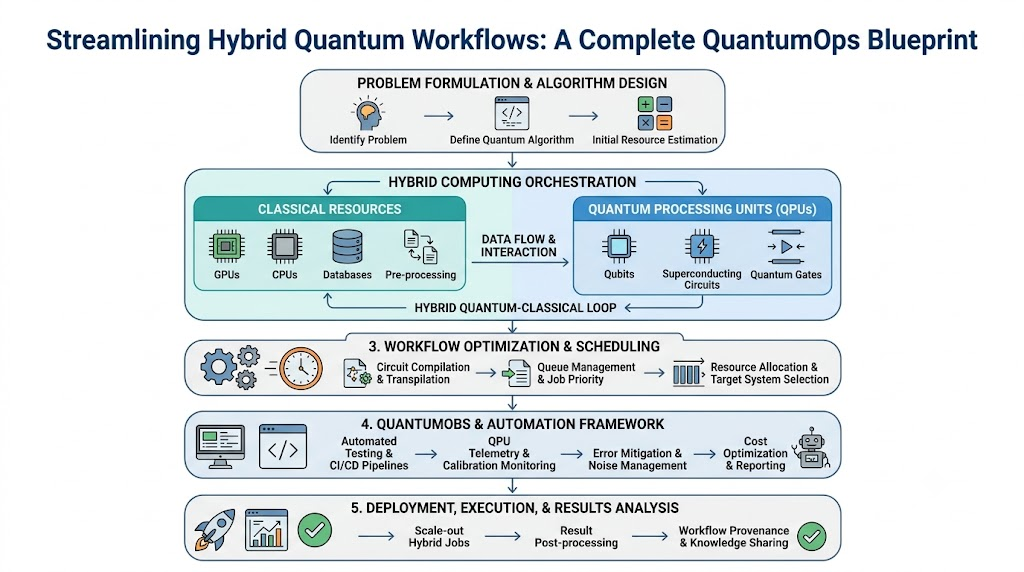
Introduction
As quantum computing transitions from isolated laboratory experiments to production-grade enterprise initiatives, organizations face a sobering reality: quantum processing units (QPUs) are scarce, expensive, and subject to environmental decoherence. While quantum algorithms promise theoretical speedups for complex optimization, cryptography, and molecular simulations, practical execution often stumbles over operational bottlenecks. At QuantumOpsSchool.com, our mission is to empower developers, cloud architects, researchers, and IT leaders with the operational skills needed to run scalable, high-efficiency quantum workflows. In this comprehensive guide, we explore how applying QuantumOps practices improves computational efficiency across the entire quantum computing lifecycle—focusing on resource allocation, automated pipelines, hybrid integration, and continuous observability.
What is QuantumOps?
QuantumOps is an operational paradigm that adapts DevOps, MLOps, and site reliability engineering (SRE) principles to the unique requirements of quantum and hybrid quantum-classical software engineering.
In traditional software development, DevOps automates code integration, testing, deployment, and infrastructure provisioning. QuantumOps extends these ideas into the quantum domain, managing the lifecycle of quantum circuits, pulse configurations, simulator backends, and physical QPUs.
+-----------------------------------------------------------------------------------+
|                              THE QUANTUMOPS LIFECYCLE                             |
+-----------------------------------------------------------------------------------+
|  [ Formulation ] ---> [ Circuit Compilation ] ---> [ Hybrid Execution ]          |
|          ^                                                   |                    |
|          |                                                   v                    |
|  [ Provenance & Optimization ] <--- [ Observability & Error Mitigation ]          |
+-----------------------------------------------------------------------------------+
Key Dimensions of QuantumOps:
- Workflow Automation: Automated compilation, circuit transpilation, and testing across simulators and physical backends.
- Resource Orchestration: Dynamic assignment of jobs to optimal target hardware based on qubit counts, connectivity, error rates, and queue depth.
- Hybrid Lifecycle Management: Continuous integration between classical compute nodes (GPUs, CPUs) and quantum processors.
- Observability & Telemetry: Real-time tracking of gate fidelities, coherence times ($T_1$/$T_2$), noise profiles, and job execution metrics.
Understanding Computational Efficiency in Quantum Workflows
To understand how QuantumOps improves efficiency, we must distinguish between two fundamental concepts: algorithmic computational speedup and operational workflow efficiency.
+-----------------------------------------------------------------------------------+
|                        ALGORITHMIC SPEEDUP vs. QUANTUMOPS                         |
+-----------------------------------------------------------------------------------+
|  Algorithmic Complexity (e.g., O(N) -> O(sqrt(N)))                                |
|  - Inherent mathematical speedup of Grover's or Shor's algorithms.                 |
|  - Governed by physics and quantum mechanics.                                     |
+-----------------------------------------------------------------------------------+
|  Operational Efficiency (QuantumOps Target)                                       |
|  - Eliminating job queue idle time and submission latency.                        |
|  - Optimizing classical-quantum data transfers in hybrid loops.                   |
|  - Transpiling circuits to minimize gate depth and error rates.                   |
+-----------------------------------------------------------------------------------+
Algorithmic Speedup vs. Operational Efficiency
- Algorithmic Complexity: The theoretical reduction in computational steps achieved by quantum algorithms (for instance, reducing a search space from $O(N)$ to $O(\sqrt{N})$ using Grover’s Search algorithm). QuantumOps does not alter the underlying mathematical complexity of an algorithm.
- Operational Workflow Efficiency: The speed, cost-effectiveness, reliability, and resource utilization with which a quantum job is processed from problem formulation to final result ingestion.
A quantum algorithm might theoretically execute in milliseconds on a QPU, but if compiling the circuit takes 10 minutes, sitting in a cloud queue takes 2 hours, and error mitigation requires 500,000 extra redundant shots, the total wall-clock time and financial cost explode. QuantumOps eliminates these operational frictions, ensuring that theoretical quantum advantage translates into real-world performance gains.
Why Quantum Operations Matter
Quantum computing is fundamentally different from classical computing in ways that make operational discipline non-negotiable:
- Hardware Scarcity & High Cost: Physical QPUs are limited, cloud access is billed per second or shot, and idle waiting costs money.
- Qubit Instability & Environmental Noise: Quantum states decay rapidly ($T_1$ relaxation and $T_2$ dephasing). Hardware recalibrations occur frequently, meaning the optimal backend changes continuously.
- Hybrid Dependence: Almost no quantum algorithm runs in complete isolation. Algorithms like Variational Quantum Eigensolver (VQE) and Quantum Approximate Optimization Algorithm (QAOA) execute in an iterative loop between classical CPUs/GPUs and quantum hardware.
- Lack of Standardized Tooling: Without an operational framework, teams rely on custom scripts, manual job submissions, and unversioned Jupyter notebooks.
QuantumOps provides the governance, standardization, and infrastructure necessary to overcome these hurdles, transforming quantum experimentation into an enterprise-ready computational pipeline.
QuantumOps vs. Traditional IT Operations
| Feature / Operational Domain | Traditional IT / DevOps | QuantumOps |
| Primary Execution Unit | Binary logic gates (0 or 1) on silicon CPUs/GPUs | Qubits in superposition and entanglement states |
| Compute Availability | Scalable, redundant virtual machines and containers | Scarce, cloud-hosted NISQ or fault-tolerant QPUs |
| Hardware Stability | Deterministic hardware behavior with near-zero drift | Probabilistic state decay, continuous calibration drift |
| Workflow Architecture | Monolithic or microservice classical execution | Iterative hybrid loops (Classical Preprocessing $\leftrightarrow$ QPU) |
| Error Handling | Exception handling, retries, and network fault tolerance | Error mitigation (zero-noise extrapolation, probabilistic error cancellation) |
| Resource Scheduling | CPU/RAM usage, memory bandwidth, network I/O | Qubit count, gate fidelity, pulse control, queue latency, decoherence times |
Core Components of QuantumOps
A complete QuantumOps architecture relies on six fundamental pillars working in unison:
+-----------------------------------------------------------------------------------+
|                            CORE QUANTUMOPS PILLARS                                |
+-----------------------------------------------------------------------------------+
|  [1. Resource Management]    <--->    [2. Job Queue Optimization]                 |
|  [3. Hybrid Integration  ]    <--->    [4. Automated CI/CD Pipelines]            |
|  [5. Observability & Telemetry] <->    [6. Error Mitigation Frameworks]          |
+-----------------------------------------------------------------------------------+
- Quantum Resource Management: Dynamically mapping jobs to hardware targets based on availability, topology, and noise parameters.
- Workload & Queue Orchestration: Routing batch jobs to minimize waiting times and maximize target utilization.
- Hybrid Compute Integration: Co-locating classical preprocessing/postprocessing near quantum hardware endpoints to minimize network roundtrips.
- CI/CD for Quantum Software: Continuous transpilation, pulse validation, and automated testing on local simulators before QPU dispatch.
- Observability & Telemetry: Continuous logging of gate error rates, readout errors, and queue metrics.
- Error Monitoring & Mitigation Automation: Injecting error mitigation techniques dynamically based on real-time calibration metadata.
Resource Management and Workload Scheduling
Resource management in quantum computing involves selecting the right backend for a specific circuit structure. Not all QPUs are created equal—some feature heavy-hexagonal coupling maps, others linear chains or grid topologies.
Intelligent Resource Allocation
When a quantum software engineer submits a circuit, a QuantumOps resource orchestrator evaluates:
- Qubit Count & Topology: Does the hardware natively support the required qubit connectivity without requiring excessive SWAP gates?
- Gate Error Rates: Which available backend currently offers the lowest single-qubit ($C3$) and two-qubit ($ECR$/$CZ$) gate error rates?
- Queue Depth: Will waiting for a slightly higher-fidelity system degrade overall time-to-solution compared to running immediately on an alternative device with automated error mitigation?
By automating this selection process, QuantumOps prevents developers from manually hunting for available backends, maximizing cluster utilization and execution throughput.
Quantum Job Queue Optimization
Cloud quantum platforms enforce queue mechanisms. Poor queue management leads to severe operational latency. QuantumOps optimizes job queues through three key strategies:
+-----------------------------------------------------------------------------------+
|                        JOB QUEUE OPTIMIZATION TECHNIQUES                          |
+-----------------------------------------------------------------------------------+
|  1. Job Batching: Grouping circuits into single API payloads to reduce overhead.   |
|  2. Session Reservation: Securing dedicated QPU blocks for iterative algorithms.   |
|  3. Adaptive Routing: Dynamically routing to local GPU simulators when QPUs lag. |
+-----------------------------------------------------------------------------------+
- Batching and Primitive Sessions: Instead of submitting individual circuits sequentially, QuantumOps frameworks pool circuits into single-payload execution sessions (such as IBM Quantum Primitives or Amazon Braket Hybrid Jobs).
- Predictive Queue Routing: Machine learning models evaluate historical queue depths across multiple cloud providers (IBM Quantum, Azure Quantum, Amazon Braket) to route workloads to the fastest path.
- Pre-Execution Circuit Transpilation: Optimizing circuit transpilation on classical worker nodes before entering the hardware queue ensures zero idle QPU time during compilation.
Hybrid Quantum-Classical Computing
Most near-term quantum applications rely on hybrid algorithms such as VQE for chemistry and QAOA for combinatorial optimization. In these workloads, the classical computer calculates parameters, sends them to the QPU, receives measurement results, and updates the parameters iteratively.
+-----------------------------------------------------------------------------------+
|                     HYBRID QUANTUM-CLASSICAL ITERATIVE LOOP                       |
+-----------------------------------------------------------------------------------+
|  +---------------------+        Parameter Submission       +-------------------+  |
|  |  Classical Optimizer | -------------------------------> |   Quantum Hardware|  |
|  |  (GPU / CPU Node)   | <------------------------------- |   (QPU / Simulator)|  |
|  +---------------------+        Measurement Shots          +-------------------+  |
+-----------------------------------------------------------------------------------+
Eliminating the Hybrid Bottleneck
If classical and quantum systems reside in separate networks, latency dominates the runtime. QuantumOps addresses hybrid friction by:
- Co-locating Infrastructure: Deploying classical optimization routines directly within the cloud provider’s high-speed datacenter fabric hosting the QPU.
- Containerizing Classical Containers: Packaging classical optimizers into containerized workflows managed via Kubernetes operators.
- Asynchronous Execution Graphs: Executing non-dependent classical tasks while awaiting QPU shot returns.
Automation in Quantum Development Pipelines
In legacy workflows, developers build circuits in Jupyter notebooks, run them manually, and save raw output locally. QuantumOps replaces this manual approach with automated Continuous Integration and Continuous Deployment (CI/CD) pipelines.
Conceptual Text-Based CI/CD Workflow Illustration
[ Developer Commit ]
       │
       ▼
[ Source Control (Git) ]
       │
       ▼
[ CI/CD Pipeline Triggered ]
       │
       ├─► Step 1: Static Code Analysis & Linting (Qiskit / Cirq)
       ├─► Step 2: Automated Unit Testing on Local Simulators
       ├─► Step 3: Circuit Optimization & Transpilation Checks
       ├─► Step 4: Cost & QPU Usage Estimation Gate
       │
       ▼
[ Staging / Execution Queue ]
       │
       ▼
[ Cloud QPU Execution ] ─► [ Post-Processing & Result Archiving ]
Key Automated Pipeline Steps:
- Automated Linting and Validation: Verifying quantum syntax, gate counts, and depth constraints using static code checkers.
- Simulation Sanity Checks: Running test cases on state-vector or Clifford simulators before spending credits on real QPU hardware.
- Automated Circuit Transpilation: Compiling circuits into native gate sets (e.g., $\sqrt{iSWAP}$, $CZ$, $RZ$) and applying optimization passes automatically.
- Budget & Limit Guardrails: Enforcing strict execution limits to prevent accidental credit drain.
Monitoring and Observability for Quantum Systems
You cannot optimize what you do not measure. Quantum Observability involves collecting metrics from both the software execution stack and physical hardware layer.
Core Telemetry Metrics in QuantumOps:
+-----------------------------------------------------------------------------------+
|                             QUANTUM TELEMETRY METRICS                             |
+-----------------------------------------------------------------------------------+
|  System Metrics          Hardware Metrics            Workflow Metrics            |
|  - Transpilation Time    - Single/Two-Qubit Error    - Queue Wait Latency       |
|  - Circuit Depth         - T1 Relaxation Time        - Shot Execution Time      |
|  - Active Gate Count     - T2 Dephasing Time         - Cost per Executed Job    |
+-----------------------------------------------------------------------------------+
By streaming this telemetry into centralized monitoring platforms (like Prometheus, Grafana, or Datadog), QuantumOps teams maintain full visibility into system health and job performance.
Error Monitoring and Performance Optimization
Quantum hardware suffers from environmental noise, crosstalk, and state decay. QuantumOps integrates error mitigation directly into the delivery pipeline rather than treating it as an afterthought.
Automated Error Mitigation Patterns:
- Zero-Noise Extrapolation (ZNE): Scaling noise intentionally during execution to extrapolate the noise-free expectation value.
- Readout Error Mitigation (REM): Constructing assignment matrices before job execution to correct measurement errors.
- Dynamic Decoupling: Injecting periodic pulse sequences during idle qubit states to suppress phase noise.
QuantumOps systems monitor real-time calibration logs. If a QPU’s two-qubit gate error exceeds a set threshold, the pipeline automatically reroutes pending jobs to a calibrated alternative or adjusts the circuit layout on the fly.
Integration with Cloud Quantum Platforms
Modern enterprise quantum software rarely relies on an isolated provider. Organizations adopt multi-cloud quantum strategies, integrating platforms such as IBM Quantum, Amazon Braket, and Azure Quantum.
+-----------------------------------------------------------------------------------+
|                        MULTI-CLOUD QUANTUMOPS ENGINE                              |
+-----------------------------------------------------------------------------------+
|                          [ Unified QuantumOps SDK ]                               |
|                                       |                                           |
|       +-------------------------------+-------------------------------+           |
|       |                               |                               |           |
|       v                               v                               v           |
|  [ IBM Quantum ]              [ Amazon Braket ]              [ Azure Quantum ]    |
|  (Qiskit Runtime)             (Pennylane / SV1)              (Q# / Rigetti / IonQ) |
+-----------------------------------------------------------------------------------+
QuantumOps abstracts multi-cloud complexity behind a single API and control plane. This enables:
- Vendor-Agnostic Code Execution: Writing circuits in unified frameworks (like OpenQASM or PennyLane) and targeting IBM, Rigetti, IonQ, or Quantinuum without rewriting core logic.
- Unified Identity and Access Management (IAM): Centralizing role-based access control, encryption keys, and resource policies across cloud providers.
- Cost Governance: Aggregating spending metrics across all cloud vendors into a single dashboard.
DevOps Principles Applied to Quantum Computing
Applying DevOps to quantum computing requires adapting established operational practices to non-deterministic systems:
+-----------------------------------------------------------------------------------+
|                           DEVOPS TO QUANTUMOPS MAPPING                            |
+-----------------------------------------------------------------------------------+
|  DevOps Concept                 QuantumOps Equivalent                             |
|  ------------------             ---------------------                             |
|  Infrastructure as Code (IaC) -> Infrastructure as Code for Simulators/QPUs        |
|  Continuous Integration (CI)  -> Transpilation & Simulation Testing               |
|  Continuous Deployment (CD)   -> Session Reservation & Execution Orchestration    |
|  Version Control              -> Quantum State & Circuit Provenance Tracking      |
+-----------------------------------------------------------------------------------+
- Infrastructure as Code (IaC): Defining quantum simulator configurations, cloud access policies, and hybrid clusters using tools like Terraform or AWS CDK.
- Version Control for Quantum Artifacts: Tracking circuit structures, seed numbers, pulse settings, and transpiler configurations alongside source code to guarantee reproducibility.
- Automated Rollbacks: If a updated hybrid optimizer fails to converge or exhibits anomalous noise behavior, pipelines revert to the last stable parameter checkpoint.
Popular Quantum Development Platforms and Tools
Understanding the ecosystem is crucial for selecting the right QuantumOps toolchain:
| Platform / Tool | Supported Frameworks | Cloud Integrations | Primary Features & Strengths | Ideal Use Cases |
| Qiskit Runtime | Qiskit, OpenQASM | IBM Quantum Cloud | Low-latency primitive execution, serverless classical-quantum loops | Optimization, chemistry, enterprise research |
| Amazon Braket | PennyLane, Qiskit, Cirq | AWS Cloud Ecosystem | Hybrid Jobs, embedded GPU simulators (SV1, TN1), multi-hardware access | Cross-hardware benchmarking, AWS cloud pipeline integration |
| Azure Quantum | Q#, Qiskit, Cirq | Microsoft Azure | Integrated Resource Estimator, multi-vendor target routing (IonQ, Quantinuum) | Scalable hybrid applications, resource estimation for fault tolerance |
| NVIDIA CUDA-Q | C++, Python, Qiskit | Multi-GPU / Multi-QPU Acceleration | High-performance GPU-accelerated simulation, unified hybrid programming model | Large-scale quantum simulation, GPU-QPU hybrid research |
| Cirq | Python, OpenQASM | Google Quantum AI | Low-level gate and pulse control, custom hardware layout tailoring | NISQ-era algorithm development, hardware-level experimentation |
Real-World Enterprise and Research Use Cases
QuantumOps is actively enabling efficiency across key industries:
+-----------------------------------------------------------------------------------+
|                        ENTERPRISE QUANTUMOPS USE CASES                            |
+-----------------------------------------------------------------------------------+
|  [ Finance ]           [ Pharmaceuticals ]      [ Logistics ]                     |
|  Portfolio Rebalancing | Molecular Docking      | Fleet Optimization              |
|  & Risk Analytics      | & Chemistry Loops      | & Routing Algorithms            |
+-----------------------------------------------------------------------------------+
1. Financial Portfolio Optimization
A global investment firm uses QAOA algorithms to rebalance asset portfolios under strict risk constraints. Using a QuantumOps framework, they automate pre-execution matrix reductions on classical GPUs, batching execution circuits across multiple backends. This reduces wall-clock execution time by 65% and cuts cloud spend significantly.
2. Pharmaceutical Molecular Simulation
A biotech research lab simulates complex chemical bounds using VQE. Their QuantumOps pipeline automates circuit transpilation and continuously streams error-mitigated results back to classical optimization nodes. The automated pipeline eliminates manual parameter tuning, accelerating chemical convergence times.
3. Supply Chain Routing
A logistics enterprise leverages quantum-inspired and gate-based annealers for global routing. QuantumOps pipelines dynamically select between GPU tensor-network simulators and physical quantum hardware depending on current cloud queue depth, meeting strict time-to-delivery SLAs.
Benefits of QuantumOps for Organizations
Adopting QuantumOps yields clear benefits across enterprise operations:
- Faster Time-to-Solution: Minimizes administrative, transpilation, and queue overhead.
- Significant Cost Reduction: Eliminates wasted QPU runtime from invalid circuits, improper parameter settings, or unoptimized gate depths.
- Enhanced Experiment Reproducibility: Every execution records circuit versions, seeds, noise profiles, and backend calibration states.
- Multi-Vendor Flexibility: Avoids vendor lock-in by maintaining abstracted job execution layers across multiple cloud platforms.
- Higher Research Productivity: Allows developers and scientists to focus on algorithm logic rather than managing cloud infrastructure and queues.
Common Challenges and Limitations
Despite its advantages, implementing QuantumOps presents unique challenges:
- Evolving Hardware Standards: Qubit architectures (superconducting, trapped-ion, neutral atom, photonic) vary wildly, complicating standardized orchestration.
- High Calibration Volatility: Hardware calibration parameters change frequently, requiring real-time pipeline adjustments.
- Skill Gap: Finding professionals who possess both deep quantum domain knowledge and modern DevOps software engineering skills is difficult.
- Data Transfer Bottlenecks: Transporting large classical datasets into quantum state initialization formats (amplitude encoding) can introduce network and memory overhead.
Best Practices for Implementing QuantumOps
To maximize computational efficiency, organizations should adopt these industry-proven best practices:
+-----------------------------------------------------------------------------------+
|                           QUANTUMOPS IMPLEMENTATION CHECKLIST                      |
+-----------------------------------------------------------------------------------+
|  [ ] 1. Shift Testing Left: Test circuits on state-vector simulators first.       |
|  [ ] 2. Automate Transpilation: Include optimization passes in build pipelines.   |
|  [ ] 3. Co-Locate Hybrid Code: Keep classical optimizers close to QPU endpoints.  |
|  [ ] 4. Enforce Version Control: Record seeds, gate versions, and noise states.   |
|  [ ] 5. Monitor Live Calibration: Reroute jobs dynamically during drift.          |
+-----------------------------------------------------------------------------------+
- Shift Simulation Left: Always validate circuit logic, gate limits, and parameter boundaries on local or cloud-based simulators before dispatching to physical QPUs.
- Automate Circuit Transpilation: Integrate native gate conversion and transpiler optimizations into your build process.
- Co-Locate Classical and Quantum Runtimes: Minimize network latency in iterative hybrid loops by leveraging cloud-hosted serverless environments.
- Implement Comprehensive Provenance Tracking: Log every run’s seed, transpiler setting, backend calibration matrix, and result dataset.
- Establish Cost Guardrails: Configure programmatic spend alerts and shot caps to prevent budget overruns.
Common Mistakes Beginners Should Avoid
When starting with QuantumOps, beware of these common pitfalls:
- Confusing Operational Efficiency with Algorithmic Advantage: QuantumOps makes managing quantum workflows faster and cheaper, but it does not fix an inherently inefficient or faulty quantum algorithm.
- Bypassing Simulator Validation: Submitting untested code directly to real QPUs leads to failed jobs and wasted budget.
- Hardcoding Hardware Endpoints: Binding applications to specific hardware instances creates fragile pipelines that fail during maintenance windows.
- Ignoring Readout and Gate Noise: Executing algorithms without automated error mitigation strategies yields noisy, unusable results.
- Treating Quantum as Standalone Compute: Failing to integrate quantum execution into existing classical CI/CD and data engineering pipelines.
Future Trends in Quantum Operations
As the quantum ecosystem matures, QuantumOps will continue to evolve:
+-----------------------------------------------------------------------------------+
|                             FUTURE TRENDS IN QUANTUMOPS                           |
+-----------------------------------------------------------------------------------+
|  - Real-Time Quantum Error Correction (QEC) Management                            |
|  - AI-Driven Adaptive Quantum Circuit Compilation                                 |
|  - Serverless Autonomous Quantum Cloud Architecture                               |
|  - Integration of Post-Quantum Cryptography (PQC) into DevOps Pipelines  |
+-----------------------------------------------------------------------------------+
- Fault-Tolerant QuantumOps: Managing logical qubits and real-time Quantum Error Correction (QEC) syndrome decoding.
- AI-Driven Quantum Optimization: Machine learning agents predicting QPU noise patterns and automatically restructuring circuits for optimal execution.
- Autonomous Hybrid Serverless Workflows: Fully managed, event-driven quantum functions that scale classical and quantum resources seamlessly.
- Integration with Post-Quantum Security: Combining QuantumOps workflow automation with post-quantum cryptographic (PQC) validation across enterprise pipelines.
Skills Required for QuantumOps Engineers
Bridging classical IT operations and quantum software engineering requires a multi-disciplinary skill set:
                     +---------------------------------------+
                     |    THE QUANTUMOPS ENGINEER PROFILE    |
                     +---------------------------------------+
                     |                                       |
     +---------------┴---------------+       +---------------┴---------------+
     |      Quantum Fundamentals     |       |       DevOps & Cloud          |
     |  - Qiskit, Cirq, PennyLane    |       |  - Docker & Kubernetes        |
     |  - Quantum Circuits & Gates   |       |  - CI/CD (GitHub Actions)     |
     |  - Error Mitigation Techniques|       |  - Terraform & IaC            |
     +-------------------------------+       +-------------------------------+
                                     |
                     +---------------┴---------------+
                     |   System & Data Engineering   |
                     |  - Python, C++, OpenQASM      |
                     |  - Observability (Prometheus) |
                     |  - Multi-Cloud Architectures  |
                     +-------------------------------+
- Quantum Programming Frameworks: Proficiency in Qiskit, Cirq, PennyLane, or OpenQASM.
- Containerization & Orchestration: Expertise with Docker, Kubernetes, and cloud-native runtime environments.
- CI/CD & Infrastructure as Code: Mastery of GitHub Actions, GitLab CI, Terraform, and cloud SDKs.
- Quantum Software Engineering: Understanding circuit transpilation, gate decomposition, and error mitigation strategies.
- Observability & Data Engineering: Hands-on experience with telemetry tools, log management, and performance tracking.
Frequently Asked Questions (10 FAQs)
1. What is QuantumOps in quantum computing?
QuantumOps (Quantum Operations) is an operational framework that applies DevOps, SRE, and automation practices to quantum and hybrid quantum-classical software workflows, improving efficiency, resource scheduling, and reliability.
2. How does QuantumOps improve computational efficiency?
QuantumOps improves efficiency by automating job scheduling, optimizing circuit transpilation, reducing QPU queue wait times, streamlining hybrid classical-quantum loops, and monitoring system noise in real time.
3. Does QuantumOps change the mathematical complexity of a quantum algorithm?
No. QuantumOps optimizes operational execution, infrastructure management, and workflow speed. The theoretical mathematical speedup remains governed by the design of the quantum algorithm itself.
4. What is the difference between DevOps and QuantumOps?
DevOps focuses on classical software integration, container deployment, and deterministic server infrastructure. QuantumOps extends these concepts to manage probabilistic qubit hardware, pulse controls, circuit noise, and hybrid execution loops.
5. Why is hybrid quantum-classical computing central to QuantumOps?
Most practical quantum algorithms (like VQE and QAOA) execute in iterative loops between classical CPUs/GPUs and quantum QPUs. QuantumOps co-locates these environments to eliminate data transfer latency.
6. What tools are commonly used in a QuantumOps toolchain?
Popular tools include Qiskit Runtime, Amazon Braket, Azure Quantum, NVIDIA CUDA-Q, Docker, Kubernetes, Terraform, Prometheus, and GitHub Actions.
7. How does QuantumOps reduce cloud computing costs?
By validating circuits on local simulators, optimizing gate counts before submission, batching execution shots, and preventing job failures caused by unmonitored hardware noise.
8. What role does circuit transpilation play in QuantumOps?
Circuit transpilation rewrites quantum circuits into native gate sets supported by target hardware. Automating transpilation within CI/CD pipelines ensures minimal gate depth and lower error rates.
9. Can beginners learn QuantumOps without a Ph.D. in Physics?
Yes. While understanding basic quantum principles (qubits, gates, superposition) is necessary, QuantumOps emphasizes cloud architecture, workflow automation, and software engineering.
10. How can organizations start adopting QuantumOps today?
Organizations can begin by version-controlling quantum code, automating simulation testing in CI/CD pipelines, establishing multi-cloud access guardrails, and tracking execution telemetry.
Conclusion
Quantum computing holds transformative potential, but realizing that potential requires more than theoretical algorithms. As hardware scales, operational discipline becomes the decisive factor in delivering practical results. QuantumOps bridges the gap between quantum science and enterprise software delivery. By optimizing resource allocation, streamlining queue scheduling, automating build pipelines, and implementing robust observability, QuantumOps transforms fragmented quantum experiments into efficient, repeatable, and scalable operational workflows. Embracing these practices ensures your organization extracts maximum value from every quantum compute cycle.