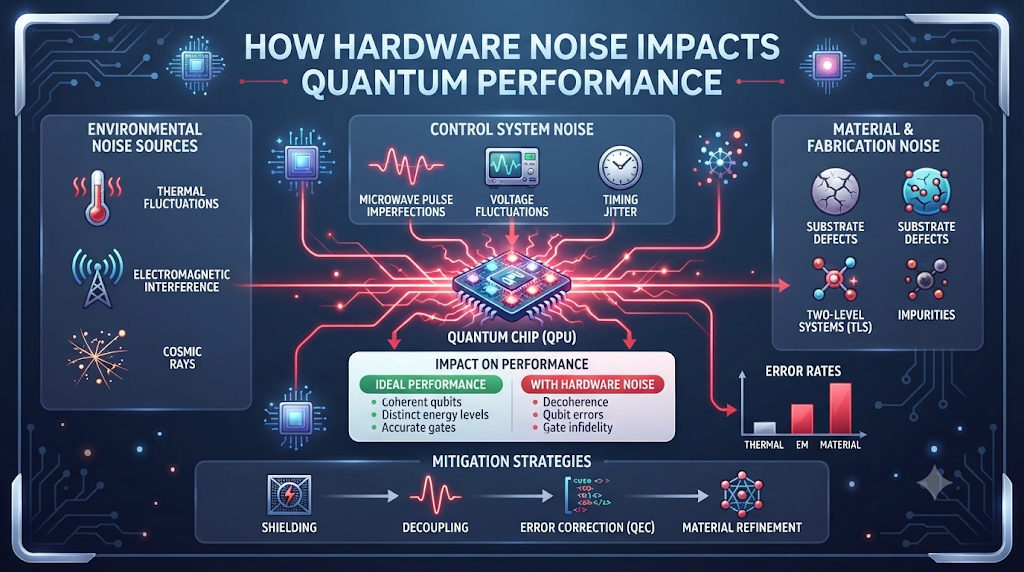
In the era of Noisy Intermediate-Scale Quantum (NISQ) computing, hardware imperfection remains the defining bottleneck standing between theoretical quantum advantage and production-grade utility. For engineers, algorithm developers, and system architects navigating platforms like those explored in foundational resources at QuantumOpsSchool, understanding how physical noise manifests and degrades computational output is critical. Noise is not merely an inconvenience to be patched over; it is an active disturbance vector that governs the boundaries of what a quantum processor can successfully compute. This guide breaks down the physics of hardware noise, its direct impact on circuit performance, and the strategies practitioners use to mitigate its consequences.
Understanding Quantum Noise: The Fundamental Barrier to Execution
In classical computing, transistors are protected by massive noise margins. A classical bit running on a standard CMOS microprocessor can execute billions of operations per second for years without encountering a hardware fault caused by ambient electromagnetic interference. Quantum processors operate under entirely different physical constraints. Qubits leverage superposition and entanglement—delicate wave-like properties that are exceptionally sensitive to external environments.
When quantum bits are exposed to thermal fluctuations, stray electromagnetic fields, or microscopic material defects, the encoded information begins to degrade. This transition from active disturbance to systemic data loss is known as decoherence. Unlike classical errors, which are typically discrete bit flips that can be caught with basic parity checks, quantum noise introduces continuous errors in both amplitude and phase. As a result, the computational state gradually drifts away from its intended trajectory, transforming structured quantum interference into randomized noise.
Core Physical Sources of Hardware Noise
To manage hardware noise effectively, practitioners must isolate its primary physical drivers across different modalities, whether dealing with superconducting circuits, trapped ions, or neutral atoms.
Relaxation (T1) and Dephasing (T2) Mechanisms
Energy relaxation, quantified by the T1 time, measures how long a qubit can maintain an excited state before losing its energy to the environment and decaying back to the ground state. Dephasing, quantified by T2, measures how long the phase relationship between the superposition states remains intact. Superconducting qubits typically feature fast gate speeds but suffer from relatively short coherence times (often measured in microseconds). Conversely, trapped ion systems provide much longer coherence times but incur slower operational gate speeds. If a quantum algorithm takes longer to execute than these coherence windows, the calculation collapses.
Crosstalk and Inter-Qubit Interference
Crosstalk occurs when operations performed on one qubit unintentionally affect its neighbors. This can manifest as capacitive, inductive, or microwave coupling in superconducting architectures. When multi-qubit gates like CNOT or CZ are executed in parallel across a dense processor grid, stray electromagnetic fields bleed into adjacent control lines. Research demonstrates that multi-programming and active circuits can severely degrade energy relaxation times (T1) of neighboring idle qubits—sometimes dropping performance metrics significantly due to localized heating and phase disruption.
State Preparation and Measurement (SPAM) Errors
Before a circuit runs, qubits must be initialized into a known baseline state (typically ∣0⟩). At the conclusion of the algorithm, their final states must be read out. Imperfections in initialization pulses and readout resonators introduce State Preparation and Measurement (SPAM) errors. Even if an algorithm executes flawlessly, a high SPAM error rate will distort the final probability distribution, masking the true computational result.
How Noise Directly Destroys Quantum Circuit Performance
The accumulation of hardware noise imposes a strict ceiling on circuit depth—the number of sequential gate layers a quantum processor can execute before the signal-to-noise ratio drops to zero.
[Clean Quantum State] ---> [Gate Operations + Ambient Noise] ---> [Decoherence / Phase Scrambling] ---> [Randomized Classical Output]
When a quantum circuit runs, every gate operation introduces a minor infidelity. If a single-qubit gate has an error rate of 0.1% and a two-qubit gate has an error rate of 1%, a circuit containing thousands of gates will quickly accumulate errors that completely overwhelm the signal. Phase randomization disrupts the precise constructive and destructive interference required to amplify correct answers and cancel out incorrect ones. Consequently, noisy processors output probability distributions heavily skewed toward random guessing, rendering deep algorithms useless without active intervention.
Mitigation Strategies vs. Full Quantum Error Correction (QEC)
Bridging the gap between NISQ hardware and fault-tolerant quantum computing requires a two-pronged approach: immediate error mitigation and long-term quantum error correction (QEC).
- Error Mitigation: Hybrid quantum-classical techniques such as Zero-Noise Extrapolation (ZNE) and Probabilistic Error Cancellation (PEC) allow practitioners to run circuits at artificially inflated noise levels and extrapolate backward to estimate zero-noise results. These methods require no extra physical qubits, but they scale exponentially with circuit depth. Qblox
- Quantum Error Correction (QEC): True fault tolerance requires encoding a single logical qubit across dozens or thousands of physical qubits. By continuously monitoring syndromes (measuring error types without destroying the superposition), surface codes can detect and correct bit-flips and phase-flips in real time. However, the physical resource overhead is immense—current estimates point to ratios of roughly 1,000 physical qubits per error-corrected logical qubit. Q-CTRL
Verification, Benchmarking, and Success Metrics
To determine whether a hardware optimization or compilation strategy is working, quantum engineers rely on rigorous benchmarking protocols rather than running arbitrary application code.
- Randomized Benchmarking (RB): By running sequences of random Clifford gates of varying lengths, engineers can isolate the average gate error rate independent of SPAM errors.
- Quantum Volume (QVQVQV): A holistic metric developed by IBM that measures the largest random circuit of equal width and depth that a processor can successfully execute. QV accounts for gate errors, crosstalk, qubit connectivity, and decoherence simultaneously.
- Process Tomography: Used primarily for small subsystem analysis to reconstruct the complete quantum channel map, identifying specific directional noise matrices.
Summary Checklist for System Architects
When designing algorithms or deploying workloads to quantum cloud infrastructure, keep the following engineering practices in mind:
- Minimize Circuit Depth: Restructure algorithms to use the fewest possible multi-qubit gates before coherence decay sets in.
- Optimize Qubit Mapping: Take hardware topology into account; route logical swaps efficiently to avoid routing through high-noise physical junctions.
- Leverage Dynamical Decoupling: Insert optimized idle-pulse sequences to actively suppress low-frequency environmental noise during qubit idle periods. QuantumOps
- Deploy Error Mitigation Pipelines: Integrate post-processing mitigation layers into your compilation toolchain to clean up expectation values before final readout.
Frequently Asked Questions
Q1. What is the primary difference between quantum noise and classical noise?Classical noise typically causes discrete bit flips that are easily managed with standard redundancy, whereas quantum noise continuously corrupts delicate phase and amplitude relationships across superposition states.
Q2. Why can’t we simply shield quantum computers from all external noise? While magnetic shielding, cryogenic dilution refrigerators, and vacuum chambers reduce environmental interference, microscopic material defects and control-line electronics will always generate intrinsic internal noise that cannot be completely isolated.
Q3. How does crosstalk affect multi-qubit gate fidelity? Crosstalk introduces unintended physical interactions between neighboring qubits when control pulses are active, leading to accelerated dephasing and lowered gate fidelities across the array.
Q4. What is the difference between T1T_1T1 and T2T_2T2 times?T1 measures energy relaxation (how long a qubit retains its excited state energy), while T2 measures dephasing (how long the phase alignment of the quantum state remains coherent).
Q5. Can quantum error correction completely eliminate hardware noise? No, error correction does not eliminate physical noise; instead, it detects and corrects the resulting errors faster than they accumulate, allowing logical qubits to operate reliably despite noisy underlying hardware.
Q6. What is the current physical qubit overhead required for fault-tolerant QEC?Current theoretical and experimental estimates indicate a requirement of roughly 1,000 physical qubits to construct a single stable, error-corrected logical qubit.
Q7. What is Zero-Noise Extrapolation (ZNE)?ZNE is an error-mitigation technique where a circuit is intentionally executed at higher-than-normal noise levels, allowing classical post-processing to extrapolate what the zero-noise result would have been.
Q8. Why do quantum algorithms have strict circuit depth limits?Because hardware noise continuously degrades qubit states, calculations must finish before the cumulative error rate exceeds the signal threshold, restricting the number of sequential operations a processor can perform.
Q9. What is Quantum Volume and why does it matter? Quantum Volume is a composite benchmark metric that evaluates overall processor capability—including gate fidelity, qubit connectivity, and crosstalk—providing a realistic measure of how complex an algorithm a machine can handle.
Q10. How do software compilers help mitigate hardware noise? Compilers optimize quantum code by minimizing SWAP operations, mapping logical qubits to physical qubits with superior coherence times, and scheduling gate executions to avoid congested, high-noise hardware regions.
Conclusion
Hardware noise remains the defining engineering hurdle of modern quantum computing, dictating the practical limits of circuit depth, algorithm design, and system scalability. By understanding the underlying physics of relaxation, dephasing, and crosstalk—and by aggressively deploying error mitigation alongside future fault-tolerant architectures—engineers can maximize the utility of available hardware. Review your current compiler mapping strategies and benchmark your target hardware’s operational error profile to optimize your quantum workflows today.