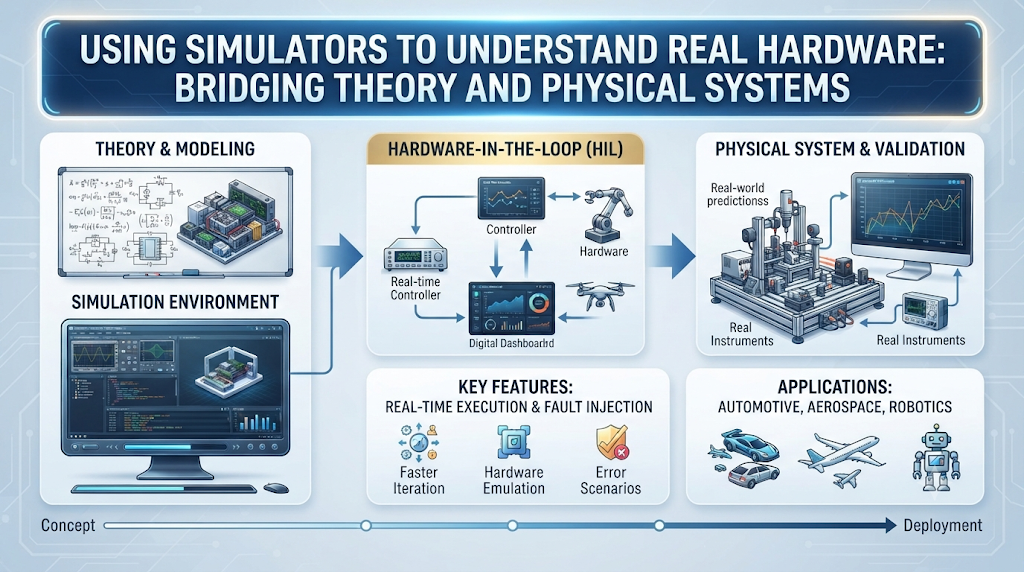
Designing and operating complex physical systems—whether dealing with quantum processors, high-performance computing clusters, or specialized robotic hardware—presents a fundamental engineering paradox. Building physical prototypes is capital-intensive, slow, and prone to catastrophic failure when edge cases collide with real-world noise. Conversely, relying purely on mathematical abstraction leaves teams blind to thermal drift, signal crosstalk, and manufacturing tolerances.
Simulators serve as the critical bridge between theoretical design and physical reality. By modeling system behavior under controlled software environments, engineers can test control logic, evaluate error resilience, and optimize performance before touching expensive physical components. This article examines how practitioners use hardware simulators, the architectural trade-offs involved, and how to navigate the inevitable fidelity gap between simulation and the physical world.
The Role of Simulation in Hardware Engineering
In traditional and advanced hardware engineering, simulation is not merely a convenience; it is a primary risk-mitigation tool. Physical hardware introduces immediate constraints: component degradation, limited accessibility for debugging, and high financial costs for iterative revisions.
Simulators allow engineers to simulate complex state dynamics, input-output behaviors, and environmental noise variables at scale. However, a simulation is only as reliable as its underlying assumptions. Treating a simulator as an absolute oracle rather than a probabilistic estimation tool is one of the most common pitfalls in systems design. Effective engineering teams use simulation to bound the problem space, weed out flawed control algorithms, and establish baseline expectations before physical commissioning.
The Fidelity Gap: Understanding Where Simulators Fall Short
Every simulation operates under simplified physical models. Recognizing the limitations of your simulation environment prevents costly deployment surprises.
[ Idealized Mathematical Model ]
       │ (Assumes zero latency, perfect calibration, zero noise)
       ▼
[ Real-World Physical Hardware ]
       │ (Introduces thermal drift, jitter, manufacturing variance, crosstalk)
       ▼
[ The Fidelity Gap ]
       │ (Requires error mitigation, calibration routines, and noise modeling)
1. Environmental and Thermal Noise
Simulators often assume clean, stable operating conditions. Real hardware operates in environments subject to electromagnetic interference, ambient temperature fluctuations, and mechanical vibration. These factors degrade signal integrity and cause subtle drift in sensor readings or control loops.
2. Unmodeled Parasitic Effects
In electronic and quantum systems, parasitic capacitance, stray inductance, and crosstalk between adjacent channels are difficult to simulate exhaustively. While a simulator might show an instantaneous gate transition or signal switch, physical wiring and substrate physics introduce propagation delays and signal reflections.
3. Latency and Real-Time Constraints
Software simulators run on conventional operating systems where execution time depends on CPU scheduling and thread allocation. Real hardware often demands deterministic, hard real-time execution. An algorithm that performs flawlessly in a simulated environment may fail timing constraints when deployed to physical microcontrollers or field-programmable gate arrays (FPGAs).
Architecting a Simulation-to-Hardware Workflow
To extract maximum value from simulators, engineering teams adopt a structured pipeline that systematically increases environmental complexity before hardware deployment.
1. Abstract Modeling and Algorithm Design
The process begins with high-level functional simulation. At this stage, engineers validate core logic, data structures, and mathematical algorithms without worrying about physical constraints. The primary objective is verifying that the conceptual design produces correct logical outcomes under ideal conditions.
2. Introducing Stochastic Noise and Error Models
Once the logical baseline is established, engineers inject realistic noise models into the simulation. This involves adding Gaussian noise to sensor inputs, simulating packet loss or transmission latency in communication buses, and modeling component-level drift. Testing algorithms against degraded inputs exposes structural weaknesses in error-handling routines.
3. Hardware-in-the-Loop (HIL) Testing
Before full physical deployment, Hardware-in-the-Loop testing connects actual physical controllers or partial hardware modules to a real-time simulator. The simulator emulates the physical plant, sensors, and actuators, allowing engineers to test physical interfaces, voltage levels, and communication protocols safely.
4. Physical Calibration and Validation
The final stage transfers the validated control software to the physical system. Discrepancies observed during this phase are fed back into the simulator to refine its noise models and parameter weights for future design iterations.
Practical Implementation: A Simulation Validation Checklist
When moving from a simulated model to physical hardware execution, structured validation prevents systemic failures:
- Define Baseline Metrics: Establish clear, quantifiable performance thresholds in simulation (e.g., maximum allowable latency, convergence time, or error rate) that must be met before physical testing.
- Isolate Subsystems: Test individual subsystems (such as power distribution, sensor polling, or actuation loops) in isolation rather than bringing up the entire integrated system at once.
- Run Monte Carlo Stress Tests: Execute thousands of simulation runs with randomized initial conditions and extreme input variations to identify edge-case instability.
- Implement Failsafes: Ensure hardware watchdogs, emergency stop circuits, and software tripwires are fully operational before executing the first physical test.
Advantages, Limitations, and When NOT to Simulate
Advantages
- Cost Efficiency: Eliminates the expense of physical prototyping for flawed designs.
- Safety: Allows engineers to test dangerous failure modes (such as over-voltage conditions or runaway feedback loops) in software without risking physical injury or equipment destruction.
- Speed: Enables parallelized testing across multiple virtual instances simultaneously.
Limitations
- Model Bias: If the simulation model lacks critical physical parameters, engineers gain a false sense of security.
- Computational Overhead: High-fidelity physics or quantum state simulations require immense computational power and time.
When NOT to Rely Solely on Simulation
- Novel Physics Exploration: If you are operating at the bleeding edge of material science or hardware architecture where governing equations are unknown or poorly understood, simulations based on legacy assumptions will mislead you. Empirical physical experimentation must take precedence.
- Interference-Heavy Deployments: In environments with unpredictable, highly complex electromagnetic or physical interference that cannot be accurately parameterized, simulation results serve only as rough approximations.
Risks, Failure Modes, and Prevention
- Overfitting to the Simulator: Tuning control parameters until they perform perfectly on a specific simulator can result in brittle performance on real hardware. Prevention: Introduce randomized environmental perturbations during simulation training to force robust generalization.
- Ignoring Calibration Drift: Assuming that a simulator configuration remains valid indefinitely as physical components age. Prevention: Periodically update simulation parameters using telemetry and calibration data gathered from deployed hardware.
- Neglecting Scale Disparities: Testing a simulation with small-scale data inputs that do not reflect the massive throughput and memory constraints of production hardware. Prevention: Perform stress testing under maximum anticipated load conditions.
Frequently Asked Questions
Q1. Why do algorithms that work in simulation often fail on real hardware?
Simulations rely on mathematical abstractions that typically omit real-world variables such as thermal drift, component manufacturing tolerances, electromagnetic interference, and unmodeled latency. These hidden factors can destabilize sensitive control loops or algorithms.
Q2. How much fidelity is necessary in a hardware simulator?
Fidelity should match the specific objective of the test phase. Early algorithm development requires only logical and functional accuracy, whereas late-stage integration testing demands high-fidelity noise, timing, and environmental modeling.
Q3. What is Hardware-in-the-Loop (HIL) testing?
Hardware-in-the-Loop testing is a technique where physical controllers or specific hardware components are connected to a real-time simulator that emulates the surrounding environment, sensors, and actuators, allowing safe validation of physical interfaces.
Q4. Can simulation completely replace physical prototyping?
No. While simulation drastically reduces the number of physical iterations required, physical prototyping remains essential for validating unmodeled environmental interactions, structural integrity, and manufacturing feasibility.
Q5. How do engineers model noise in hardware simulators?
Engineers typically inject stochastic processes—such as Gaussian white noise, Poisson processes for discrete events, or bounded drift parameters—into sensor inputs and control outputs to mimic environmental uncertainty.
Q6. What causes the “reality gap” in robotic and hardware simulations?
The reality gap stems from the difficulty of perfectly modeling complex physical phenomena, friction coefficients, fluid dynamics, and micro-scale electrical interactions in software within reasonable computational timeframes.
Q7. How often should simulation models be updated based on physical data?
Simulation models should be updated iteratively whenever physical deployment reveals consistent systematic errors or whenever underlying hardware components are upgraded or replaced.
Q8. Is high-performance computing required to run hardware simulators?
It depends entirely on the complexity of the system. Simple linear control models run on standard laptops, while advanced multi-body physics engines, high-resolution electromagnetic simulations, or multi-qubit quantum simulators require dedicated clusters or GPU acceleration.
Q9. What is the biggest mistake engineers make when using simulators?
Treating simulation success as a guarantee of physical success without accounting for worst-case environmental extremes or unmodeled edge cases.
Q10. How do domain-specific simulators differ from general-purpose simulators?
Domain-specific simulators are built with pre-compiled physical equations and constraints tailored to a particular field—such as circuit analysis, quantum state evolution, or mechanical kinematics—allowing for faster and more accurate modeling than generalized physics engines.
Conclusion
Simulators are indispensable instruments for navigating the complexity of modern hardware engineering. By exposing design flaws, testing control logic under stress, and mitigating physical risks, they accelerate development cycles. However, recognizing the boundaries of the fidelity gap and maintaining rigorous physical validation ensures that simulation serves as a reliable stepping stone rather than a misleading illusion.