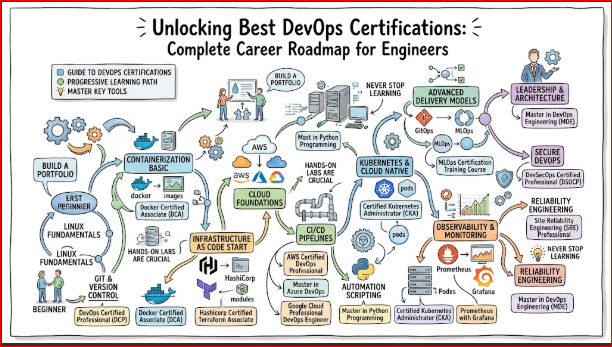
Navigating the cloud-native ecosystem can feel like trying to map the ocean while swimming in a storm. With hundreds of open-source tools, competing cloud giants, and rapidly changing engineering methods, deciding where to invest your precious learning time is tough. A major pitfall is collecting Best DevOps Certification like digital badges without a clear plan. Let’s be real: a piece of paper won’t get you hired. But the intense, hands-on grit required to pass a top-tier exam? That completely re-wires your technical brain and fast-tracks your career. This guide skips the fluff, targets high-value tools like Kubernetes and Terraform, and lays out step-by-step career tracks to take you from configuration confusion to infrastructure mastery.
Why DevOps Certifications Matter
In production-grade enterprise environments, certifications are more than a line item on a resume—they validate tactical, hands-on competence under fire. As organizations scale microservices, verified expert authority is in massive demand.
[Targeted Study] ➔ [Brute-Force Lab Practice] ➔ [Exam Validation] ➔ [High-Impact Production Control]
A deliberate certification path delivers immense practical value:
- Eliminating Blind Spots: It forces you out of your comfort zone. If you deploy to the cloud daily but have never touched automated infrastructure or deep logging pipelines, a structured path fills those gaps.
- Architectural Guardrails: You stop guessing. You learn global standards for high availability, security controls, and disaster recovery instead of patching bugs on the fly.
- Consulting & Partner Leverage: Enterprise consulting firms and Managed Service Providers (MSPs) need certified engineers to lock in their elite tier partnerships with major cloud providers. Your credential makes the entire company look good.
Best DevOps Certifications at a Glance
| Certification | Best For | Level | Main Focus | Difficulty | Recommended Role | Link |
| DevOps Certified Professional (DCP) | Core Lifecycle Automation | Foundational | CI/CD, Git, Jenkins, Core Workflows | Low | Junior DevOps Engineer | View Course |
| DevSecOps Certified Professional (DSOCP) | Pipeline Vulnerability Scanning | Advanced | Shift-Left Security, SAST/DAST, Compliance | High | DevSecOps Engineer | View Course |
| Site Reliability Engineering (SRE) | System Resiliency & Observability | Advanced | SLOs, Error Budgets, Chaos Engineering | High | Site Reliability Engineer | View Course |
| Master in DevOps Engineering (MDE) | End-to-End Enterprise Strategy | Expert | Architecture Design & Production Release | High | Senior DevOps Architect | View Course |
| Master in Azure DevOps | Microsoft Ecosystem Specialists | Advanced | Azure Pipelines, Boards, Repos Setup | Medium | Azure Cloud Engineer | View Course |
| AWS Certified DevOps Professional | Amazon Web Services Architecture | Advanced | AWS Developer Tools, CloudFormation, Auto Scaling | High | AWS Infrastructure Engineer | View Course |
| Master in Python Programming | Infrastructure Automation Scripting | Intermediate | Scripting, Custom CLI Tools, API Automation | Medium | Automation Engineer / Developer | View Course |
| Certified Kubernetes Administrator (CKA) | Production Container Orchestration | Advanced | Cluster Architecture, Networking, Troubleshooting | High | Kubernetes Specialist | View Course |
| Docker Certified Associate (DCA) | Application Containerization | Intermediate | Image Optimization, Container Runtimes, Volumes | Medium | Systems Administrator | View Course |
| Google Cloud DevOps Engineer | Google Cloud Native Platforms | Advanced | GKE Administration, GCP Operations Suite | High | GCP Cloud Engineer | View Course |
| Master in Data Science | Enterprise Data Engineering | Advanced | Statistical Analytics, Scalable Data Pipelines | High | Data Infrastructure Engineer | View Course |
| Hashicorp Certified Terraform Associate | Multi-Cloud Infrastructure as Code | Intermediate | Declarative State Files, Module Management | Medium | Cloud Automation Specialist | View Course |
| Master in Artificial Intelligence | Intelligent System Automation | Advanced | Neural Networks, Automated Model Training | High | AI Operations Specialist | View Course |
| Master in Deep Learning | Advanced Model Topologies | Advanced | Complex Layer Compute, Topology Deployments | High | Deep Learning Engineer | View Course |
| GitOps Certified Professional (GOCP) | Declarative Continuous Delivery | Intermediate | ArgoCD, Flux, Git-Driven Cluster State | Medium | Platform Engineer | View Course |
| Envoy ISTIO Certification Training | Microservices Service Mesh | Advanced | Traffic Splitting, mTLS Encryption, Sidecars | High | Network Infrastructure Architect | View Course |
| Prometheus with Grafana | Cloud-Native Systems Monitoring | Intermediate | Time-Series Metrics, Dashboard Visuals, Alerting | Medium | Monitoring & Operations Engineer | View Course |
| MLOps Certification Training Course | Machine Learning Pipeline Scale | Advanced | Model Lifecycle Automation, Data Versioning | High | MLOps Engineer | View Course |
| Master in Machine Learning | Predictive Operational Algorithms | Advanced | Supervised/Unsupervised Modeling Deployments | High | ML Infrastructure Engineer | View Course |
| Master in AppDynamics | Enterprise Performance Tracking | Intermediate | APM Dashboards, JVM/CLR Code Diagnostics | Medium | Application Support Engineer | View Course |
Detailed Certification Analysis
1. Certified Kubernetes Administrator (CKA)
The CKA is an elite credential in the cloud-native world. Forget multiple-choice guessing games—this exam drops you directly into a live, broken terminal cluster and tasks you with fixing real infrastructure problems in real time.
- Who Should Take It: Systems engineers, cloud developers, and platform professionals managing containerized architectures.
- Difficulty Level: Advanced.
- Skills You Will Learn: Troubleshooting dead nodes, fixing cluster network issues, handling persistent volume claims, configuring ingress routing, and locking down role-based access control (RBAC).
- Tools Covered: Kubernetes,
kubectl,kubeadm, CoreDNS, etcd. - Real-World Application: Picture an e-commerce backend crashing during a massive flash sale due to a misconfigured network policy. A CKA holder doesn’t panic. They dive straight into the YAML, isolate the faulty selector, and restore traffic flow instantly.
Pros: Highly respected by engineering leads because it cannot be passed through rote memorization; builds elite terminal speed.
Cons: Steep learning curve; completely overwhelming if you lack strong Linux system navigation basics.
2. HashiCorp Certified: Terraform Associate
As companies embrace multi-cloud strategies, defining infrastructure by clicking buttons in a web console is an operational liability. This track certifies your ability to provision, modify, and version complex infrastructure safely via code.
- Who Should Take It: Anyone managing cloud resources across AWS, Azure, or GCP who wants to treat infrastructure like software.
- Difficulty Level: Intermediate.
- Skills You Will Learn: Writing crisp HashiCorp Configuration Language (HCL), managing remote state locking, building reusable modules, and handling environment variables.
- Tools Covered: Terraform, Terraform Cloud, Git.
- Real-World Application: Instead of spending hours manually configuring networks, subnets, and compute instances for a new testing environment, you run a single module that tears up an identical sandbox environment in minutes.
Pros: Portable, multi-cloud relevance that prevents tool and vendor lock-in.
Cons: Features questions on enterprise commercial offerings that open-source engineers might not run into daily.
3. AWS Certified DevOps Engineer – Professional
This heavy-hitter credential validates your ability to automate, secure, and monitor large-scale distributed systems specifically built on the Amazon Web Services platform.
- Who Should Take It: Experienced AWS engineers who want to master continuous integration, complex delivery pipelines, and automated system compliance.
- Difficulty Level: Advanced.
- Skills You Will Learn: Designing blue/green and canary release models, standing up multi-region failover architectures, and enforcing automated security logging.
- Tools Covered: AWS CodePipeline, CloudFormation, Systems Manager, CloudWatch, IAM.
- Real-World Application: Designing a zero-downtime deployment engine that instantly routes user traffic to green environments while running automated rollback loops if performance metrics drop by even a fraction.
Pros: Massive corporate recognition; commands immediate authority in global enterprise markets.
Cons: Hyper-focused on proprietary cloud services rather than open-source tools.
The DevOps Certification Roadmap
Sustaining a high-trajectory engineering career means building your skills in order. Trying to master advanced container mesh routing before you understand standard server traffic is a shortcut to burnout.
Stage 1: The Foundations (Beginner)
Before writing automation scripts, you must master the target operating systems and code-tracking systems.
- Core Targets: Linux command-line fluency, networking essentials (SSH, DNS, routing), and Git branch collaboration.
- Recommended Starting Points: CompTIA Linux+ or Linux Foundation fundamentals.
Stage 2: Provisioning & Isolation (Intermediate)
Once you can configure a single server manually, learn how to isolate applications and script the platform foundation.
- Core Targets: Containerization workflows and declarative cloud infrastructure provisioning.
- Action Plan: Dive straight into the HashiCorp Certified: Terraform Associate roadmap while packaging custom software configurations inside Docker containers.
Stage 3: Scale & Continuous Delivery (Advanced)
This is where you tie individual machines into a unified, self-healing orchestration matrix.
- Core Targets: Microservices clustering, automated continuous deployment, and enterprise monitoring.
- Action Plan: Target the Certified Kubernetes Administrator (CKA) alongside professional cloud engineering paths to secure high-tier platform authority.
Strategic Paths by Specialized Role
Align your study tracks directly to your specific operational destination:
The Platform / DevOps Engineer Track
[Linux System Basics] ➔ [Terraform Automation] ➔ [CKA (Kubernetes)] ➔ [Cloud Expert Tier]
- Strategy: Build a rock-solid system foundation, automate the underlying cloud footprint, orchestrate applications via Kubernetes, and wrap everything in enterprise security controls.
The Site Reliability Engineering (SRE) Track
[Linux Internals] ➔ [CKA (Kubernetes)] ➔ [Advanced Observability Frameworks]
- Strategy: Prioritize cluster inner workings, operating system resource optimization, real-time logging, and deep system troubleshooting.
Pitfalls to Avoid completely
- Jumping to Kubernetes Early: If you don’t know how basic system networks function, debugging a Kubernetes proxy or storage volume mount will be deeply frustrating. Own the basic primitives first.
- Prioritizing Certificates Over Code Portfolios: Passing an exam shows you know how to study. Putting an active, clean GitHub repository on your profile shows you can build. Never sacrifice coding for test prep.
- Ignoring Network Mechanics: Security boundaries, VPC routing tables, subnets, and name resolution issues cause the vast majority of infrastructure outages. Master networking to become a truly elite engineer.
High-Impact Portfolio Projects to Build
Solidify your exam studies by launching these real projects and documenting them in a public repository:
- The Code-Driven Infrastructure Base: Write a Terraform module that provisions a hardened network, sets up clean routing, launches an instance, and configures an app engine using bootstrap scripts.
- The Immutable Container Pipeline: Build an automated pipeline that checks your code for bugs on every git push, packages it into a minimal Docker container, scans for security flaws, and hosts it on a registry.
- The Auto-Scaling Kubernetes Cluster: Spin up a multi-node sandbox cluster. Deploy a scalable application, configure a horizontal pod auto-scaler, and unleash a load-testing script to watch the platform self-heal and expand under heavy traffic pressure.
Frequently Asked Questions
- Which DevOps certification is best for absolute beginners?
If you are completely new to infrastructure, your first target should be a foundational track that validates essential development lifecycles and infrastructure terminology, such as the DevOps Certified Professional (DCP). This establishes core architectural knowledge before you jump into heavy command-line tools.
2. Is the Kubernetes CKA certification worth it?
Yes, absolutely. Because the CKA is a 100% performance-based exam where you fix real-time cluster errors in a live terminal rather than answering multiple-choice questions, hiring managers and platform leads view it as concrete proof of hands-on technical competence.
3. Which cloud platform certification should a DevOps engineer choose first?
The choice depends entirely on your enterprise target market. AWS holds the largest overall cloud market share, making its certifications highly versatile, while Azure is dominant in classic corporate environments and Google Cloud is preferred for bleeding-edge Kubernetes-native architectures.
4. Is a Terraform certification useful if our team only uses one cloud provider?
Yes, because multi-cloud architectures are becoming the standard for modern business continuity. Learning HashiCorp Terraform keeps your career agile, your automation scripts portable, and protects your entire engineering organization from vendor lock-in.
5. Do DevOps engineers need to understand software coding?
Yes, you must be comfortable with scripting languages. While you do not need to build complex application algorithms or front-end user interfaces, you must write automation tasks, build clean configurations (YAML, JSON), and read application source code to optimize continuous integration pipelines.
6. How long does it typically take to prepare for an advanced certification like the CKA?
For an IT professional who already understands basic containerization primitives and possesses solid Linux command-line navigation skills, it typically requires 6 to 12 weeks of consistent, daily hands-on laboratory practice to pass comfortably.
7. Is Docker certification still relevant with the rise of Kubernetes?
Yes, because containers remain the fundamental packaging mechanism for modern cloud-native systems. Understanding container engines, image optimization, and local runtime constraints through tracks like the Docker Certified Associate (DCA) is vital before managing them at a massive scale.
8. Which certification path is best suited for Site Reliability Engineering (SRE) roles?
The ideal track focuses heavily on system resilience, automation, and system observability. Combining the Site Reliability Engineering (SRE) Professional course with deep monitoring toolsets like Prometheus and Grafana creates the exact troubleshooting mindset required for SRE positions.
9. What is the core difference between DevOps and DevSecOps certifications?
Standard DevOps tracks focus primarily on the speed, efficiency, and automation of application delivery. DevSecOps tracks inject security controls, vulnerability scanning, compliance monitoring, and automated secret management directly into every stage of that automated delivery pipeline.
10. Should absolute beginners start their learning journey directly with Kubernetes?
No, this is a very common pitfall. Trying to learn complex cluster orchestration before mastering basic Linux system configuration, network routing, and fundamental container assembly will lead to extreme confusion and steep learning frustration.
11. Is obtaining a DevOps certification enough to guarantee a high-paying job?
No, a certification acts as an elite invitation to an interview by passing initial resume filters. To secure the actual engineering offer, you must back up your credential with a public code repository portfolio, strong systems architectural reasoning, and real problem-solving communication.
12. Which DevOps certification roadmap provides the highest long-term career growth?
The most sustainable path combines a strong foundation in cloud ecosystems (AWS or Azure) with vendor-neutral automation dominance (Terraform for infrastructure provision and CKA for scaling applications). This balance ensures you can adapt to any enterprise environment seamlessly.
Final Strategy
The absolute best certification track is the one that solves your immediate production problems today. Do not spend time memorizing advanced enterprise architecture manuals if you haven’t yet built an automated pipeline or secured a basic server cluster from the command line.
Pick a tool—whether that is Terraform for managing your infrastructure or the CKA path for container orchestration—and start writing configurations, breaking environments intentionally, and learning how to piece them back together.