Introduction
DevOps has become one of the fastest-growing technology careers because modern companies rely heavily on cloud infrastructure, automation, and scalable software delivery. Businesses want faster deployments, stable systems, secure applications, and reduced operational costs. That demand has significantly increased the need for skilled DevOps professionals. The growth of AWS, Azure, and Google Cloud has also changed salary trends. Companies now prefer engineers who can manage cloud infrastructure efficiently while improving security, scalability, and deployment speed. This has created strong demand for Cloud DevOps engineers, Site Reliability Engineers, and Platform Engineers. However, Best DevOps Salary growth in DevOps depends more on real-world skills than certifications alone. Employers value hands-on experience with automation, Kubernetes, Terraform, Linux, Docker, monitoring tools, and cloud platforms. Engineers who can solve production problems and improve infrastructure reliability often receive better compensation.
Why DevOps Salaries Are Growing
Several industry trends are increasing DevOps engineer salary levels globally.
Cloud Adoption
Most companies are moving applications from traditional data centers to cloud platforms like AWS, Azure, and Google Cloud. This migration requires professionals who understand cloud automation, deployment pipelines, and infrastructure management.
Kubernetes Growth
Kubernetes has become a standard platform for container orchestration. Businesses use it to manage scalable applications, making Kubernetes engineer salary trends particularly strong.
Automation Demand
Organizations want faster deployments and fewer manual operations. Engineers who can automate infrastructure, testing, deployment, and monitoring are highly valued.
Infrastructure as Code
Tools like Terraform and Ansible allow companies to manage infrastructure programmatically. Infrastructure automation skills now directly influence salary growth.
DevSecOps Expansion
Security has become a critical part of software delivery. DevSecOps engineers who integrate security into CI/CD pipelines often receive higher compensation.
SRE and Platform Engineering
Site Reliability Engineering and Platform Engineering are rapidly growing because businesses need reliable systems with minimal downtime. These specialized roles usually offer better salary progression.
AI-Driven Operations
AI-powered monitoring and automation tools are transforming infrastructure management. Engineers who understand observability, automation, and intelligent alerting systems are becoming increasingly valuable.
Shortage of Skilled Engineers
The biggest reason behind strong DevOps salaries is the global shortage of experienced professionals. Many companies struggle to hire engineers with practical Kubernetes, cloud, and automation expertise.
Factors Affecting DevOps Salary
Several practical factors influence DevOps career growth and salary potential.
Experience Level
Experience remains one of the strongest salary drivers. Engineers who have managed production infrastructure and solved real operational challenges typically earn more.
Cloud Expertise
AWS DevOps salary and Azure DevOps salary trends remain strong because cloud adoption continues to grow across industries.
Kubernetes Knowledge
Kubernetes skills significantly increase salary opportunities because container orchestration is now widely used in enterprise environments.
Automation Skills
Engineers skilled in CI/CD pipelines, scripting, Terraform, and Infrastructure as Code are often preferred over professionals with only theoretical knowledge.
Linux and Networking
Strong Linux administration and networking fundamentals remain essential for high-paying DevOps jobs.
Certifications
Certifications can improve interview opportunities, especially for beginners, but they work best when combined with practical projects.
Location
DevOps salary by country varies depending on local demand, cost of living, and cloud adoption rates.
Industry Type
Finance, healthcare, SaaS, cybersecurity, and large enterprise companies usually offer higher compensation packages.
Real Project Experience
Employers highly value engineers who have deployed Kubernetes clusters, built CI/CD systems, automated cloud infrastructure, or handled production incidents.
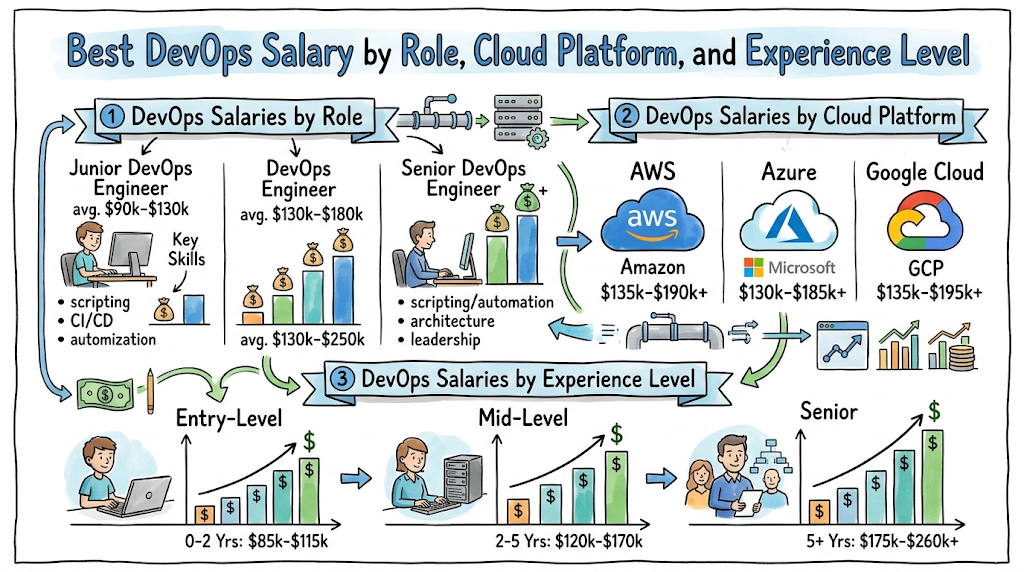
DevOps Salary by Experience Level
Fresher DevOps Engineer Salary
Entry-level DevOps engineers typically focus on learning Linux, Git, Docker, basic cloud services, and CI/CD pipelines.
Skills Required
- Linux fundamentals
- Git and GitHub
- Basic Docker usage
- Jenkins or GitHub Actions
- Networking basics
- Basic cloud knowledge
Common Beginner Mistakes
- Ignoring Linux fundamentals
- Focusing only on certifications
- Avoiding hands-on projects
- Memorizing tools without understanding concepts
Freshers with practical projects often perform better during interviews than candidates with only theoretical learning.
Mid-Level DevOps Engineer Salary
Mid-level professionals usually work with production infrastructure and cloud automation systems.
Key Skills
- Kubernetes
- Terraform
- CI/CD automation
- Monitoring tools
- Cloud networking
- Infrastructure security
At this stage, engineers who can independently manage deployments and infrastructure automation often experience strong salary growth.
Senior DevOps Engineer Salary
Senior engineers focus on architecture, reliability, scalability, and leadership responsibilities.
Advanced Responsibilities
- Multi-cloud architecture
- Platform engineering
- Reliability engineering
- Incident management
- Security integration
- Cost optimization
- Team leadership
Senior Site Reliability Engineers and Platform Engineers often receive some of the highest compensation packages in the DevOps ecosystem.
DevOps Salary by Role
DevOps Engineer
This role focuses on automation, deployment pipelines, infrastructure management, and collaboration between development and operations teams.
High-Demand Skills
- CI/CD
- Docker
- Linux
- Terraform
- Cloud infrastructure
Cloud DevOps Engineer
Cloud DevOps engineers manage scalable cloud infrastructure across AWS, Azure, or Google Cloud environments.
Career Growth Potential
Cloud migration projects continue increasing globally, making Cloud DevOps engineer salary trends very strong.
Kubernetes Engineer
Kubernetes engineers specialize in container orchestration, scaling, networking, and cluster management.
Why Demand Is High
Kubernetes is now widely used for enterprise application deployment, making this one of the highest paying DevOps jobs.
Site Reliability Engineer (SRE)
SRE professionals focus on system reliability, monitoring, performance, and incident response.
Salary Growth Potential
SRE salary levels are often higher because these roles require deep operational expertise.
DevSecOps Engineer
DevSecOps engineers integrate security practices into software delivery pipelines.
Important Skills
- Security scanning
- Compliance automation
- Container security
- Identity management
Platform Engineer
Platform engineers build internal developer platforms that simplify deployments and infrastructure management.
This role has gained major importance in large-scale cloud-native organizations.
Infrastructure Automation Engineer
These professionals focus on Terraform, Ansible, scripting, and Infrastructure as Code practices.
Automation skills continue to improve salary opportunities significantly.
Cloud Architect
Cloud architects design enterprise-scale cloud infrastructure and migration strategies.
This is usually one of the highest-paying cloud engineering career paths.
DevOps Salary by Country
United States
The United States remains one of the strongest markets for DevOps professionals due to heavy cloud adoption and enterprise-scale infrastructure requirements.
India
India has rapidly growing demand for Kubernetes engineers, SREs, and cloud automation specialists, especially in SaaS and fintech sectors.
Canada
Canadian companies actively hire cloud and DevOps professionals, particularly for hybrid cloud environments.
Germany
Germany continues investing heavily in cloud modernization and industrial automation systems.
United Kingdom
The UK market shows strong demand for DevSecOps and cloud-native engineering roles.
Australia
Australia has increasing opportunities in cloud infrastructure and platform engineering.
Singapore
Singapore remains a major technology hub with strong demand for cloud and DevOps talent across finance and enterprise sectors.
Important Factors Influencing Regional Salaries
- Cost of living
- Remote work opportunities
- Cloud adoption maturity
- Local talent shortages
- Enterprise digital transformation
DevOps Salary by Cloud Platform
AWS
AWS remains the dominant cloud provider globally. AWS DevOps salary opportunities are strong because many enterprises use AWS infrastructure extensively.
Valuable AWS Skills
- EC2
- EKS
- IAM
- CloudFormation
- Lambda
- Monitoring
Azure
Azure DevOps salary growth is particularly strong in enterprise organizations using Microsoft ecosystems.
Strong Azure Areas
- Azure Kubernetes Service
- Azure DevOps pipelines
- Active Directory
- Enterprise networking
Google Cloud
Google Cloud demand is growing steadily, especially in data engineering, Kubernetes, and AI infrastructure.
Valuable GCP Skills
- GKE
- Cloud Run
- Anthos
- Infrastructure automation
Highest-Paying DevOps Skills
The following skills consistently improve DevOps engineer salary potential:
- Kubernetes
- Terraform
- AWS
- Azure
- Google Cloud
- CI/CD automation
- Infrastructure as Code
- Monitoring and observability
- Security automation
- GitOps
- Platform engineering
- Reliability engineering
These skills matter because businesses want scalable, secure, automated, and reliable infrastructure systems.
Certifications That Can Increase Salary
Kubernetes Certifications
Kubernetes certifications are highly respected because container orchestration skills remain in high demand.
AWS DevOps Engineer Certification
This certification is valuable for professionals working in AWS-heavy environments.
Azure DevOps Engineer Certification
Useful for enterprise cloud engineering careers.
Terraform Associate
Demonstrates Infrastructure as Code expertise.
Docker Certification
Helpful for containerization fundamentals.
DevSecOps Certifications
Useful for security-focused cloud engineering roles.
SRE Certifications
These certifications help engineers move toward reliability-focused career paths.
Important Reality Check
Certifications improve credibility, but employers still prioritize hands-on projects and production experience more heavily.
DevOps Salary Comparison Table
| Role | Experience Level | Main Skills | Cloud Focus | Career Growth |
| DevOps Engineer | Beginner to Mid | CI/CD, Docker, Linux | AWS/Azure | Strong |
| Kubernetes Engineer | Mid to Senior | Kubernetes, Helm | Multi-cloud | Very High |
| SRE | Senior | Monitoring, Reliability | Multi-cloud | Very High |
| DevSecOps Engineer | Mid to Senior | Security Automation | AWS/Azure | High |
| Platform Engineer | Senior | Internal Platforms | Multi-cloud | Very High |
| Cloud Architect | Senior | Architecture Design | AWS/GCP/Azure | Excellent |
DevOps Career Roadmap for Higher Salary
Beginner Path
Start with foundational technical skills.
Focus Areas
- Linux
- Git
- Networking basics
- Docker
- CI/CD pipelines
These skills help beginners qualify for entry-level DevOps roles.
Intermediate Path
The next stage focuses on automation and orchestration.
Important Skills
- Kubernetes
- Terraform
- Cloud fundamentals
- Jenkins
- Monitoring tools
This stage usually creates major salary growth opportunities.
Advanced Path
Senior-level engineers focus on scalability and reliability.
Advanced Skills
- SRE practices
- Platform engineering
- Multi-cloud architecture
- DevSecOps
- Reliability engineering
These specialized areas often lead to leadership and architect-level compensation.
Specialized Path
Specialization can further improve earning potential.
High-Growth Areas
- GitOps
- MLOps
- AIOps
- Observability
- FinOps
These domains are becoming increasingly important in enterprise cloud environments.
Real-World Career Scenarios
Fresher Entering DevOps
A beginner learns Linux, Docker, Git, and CI/CD basics before building cloud deployment projects.
Career Growth
Practical projects improve interview performance and increase hiring opportunities.
Sysadmin Transitioning into Cloud Automation
A system administrator learns Terraform, AWS, and Kubernetes to move into automation-focused infrastructure roles.
Salary Improvement Potential
Automation and cloud skills often improve long-term salary growth significantly.
Developer Becoming Kubernetes Engineer
A software developer learns containerization and orchestration to manage scalable production environments.
Growth Opportunity
Kubernetes specialization remains highly valuable.
Cloud Engineer Moving into SRE
A cloud engineer focuses on reliability, monitoring, incident response, and observability.
Career Advantage
SRE roles usually offer excellent long-term compensation growth.
Security Engineer Entering DevSecOps
A security professional learns CI/CD security integration and cloud-native security tooling.
Market Demand
DevSecOps demand continues increasing across regulated industries.
Common Mistakes That Limit Salary Growth
- Ignoring Linux fundamentals
- Skipping Kubernetes learning
- Avoiding cloud platforms
- Collecting certifications without projects
- Weak networking knowledge
- Ignoring automation practices
- Depending only on tutorials
- Not building GitHub projects
- Avoiding monitoring and observability tools
- Failing to understand production troubleshooting
These mistakes reduce practical expertise, which directly affects salary growth potential.
Hands-On Skills Employers Actually Want
Modern employers prioritize practical engineering abilities.
Most Valuable Hands-On Skills
- CI/CD pipeline setup
- Docker containerization
- Kubernetes deployments
- Terraform infrastructure automation
- Monitoring and alerting
- GitOps workflows
- Cloud automation
- Infrastructure security
- Incident management
- Troubleshooting production systems
Real projects matter because companies want engineers who can solve operational problems effectively.
FAQs
1. What is the average DevOps engineer salary?
DevOps salaries vary by country, experience, cloud expertise, and specialization, but demand remains consistently strong globally.
2. Which DevOps role pays the highest salary?
Cloud Architects, Senior SREs, and Platform Engineers often receive the highest compensation.
3. Is Kubernetes good for salary growth?
Yes. Kubernetes remains one of the most valuable DevOps skills today.
4. Which cloud platform pays the highest salary?
AWS currently dominates many enterprise environments, but Azure and Google Cloud also offer strong opportunities.
5. Do DevOps certifications increase salary?
Certifications help, especially for beginners, but practical experience matters more.
6. Is AWS or Azure better for DevOps careers?
Both are valuable. AWS has broader adoption, while Azure is highly popular in enterprise organizations.
7. Which DevOps skill is most in demand?
Kubernetes, Terraform, cloud automation, and Infrastructure as Code remain highly demanded.
8. Is DevOps a high-paying career?
Yes. DevOps continues to be one of the better-paying technology career paths.
9. Can beginners get high DevOps salaries?
Beginners can grow quickly by building practical cloud and automation skills.
10. How long does it take to become a high-paid DevOps engineer?
Most professionals need several years of practical experience and continuous learning.
11. Is Terraform important for salary growth?
Yes. Infrastructure as Code skills are widely valued across cloud environments.
12. Which certification is best for DevOps salary growth?
AWS DevOps Engineer and Kubernetes certifications are highly respected in the industry.
Final Recommendation
The best DevOps salary opportunities usually come from strong practical experience rather than theoretical learning alone. Engineers who understand cloud infrastructure, Kubernetes, automation, monitoring, and reliability engineering often achieve stronger long-term career growth. Instead of trying to learn every tool at once, focus on a structured roadmap. Start with Linux and networking fundamentals, move into Docker and CI/CD, then gradually learn Kubernetes, Terraform, cloud platforms, and observability tools. Hands-on projects remain one of the most important factors for salary improvement. Building real deployment pipelines, automating infrastructure, troubleshooting production systems, and managing Kubernetes environments provide experience that employers value highly. Cloud computing and automation technologies will continue evolving rapidly. Continuous learning and practical experimentation are essential for staying competitive in the DevOps market.