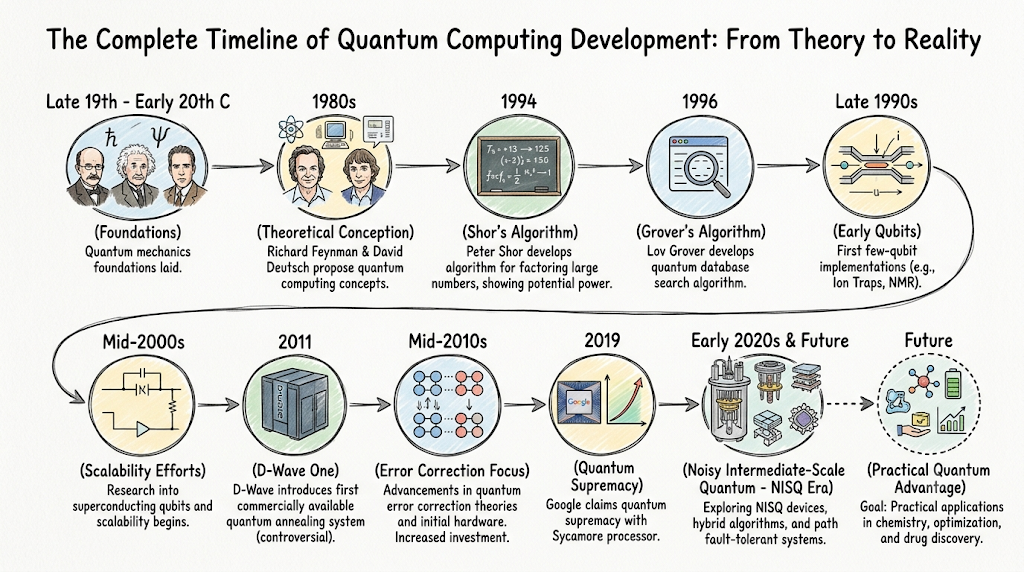
Introduction
Understanding this historical trajectory is not just an exercise in memorizing names and dates. It is essential for anyone looking to navigate the modern technological landscape. By studying how these groundbreaking scientific ideas evolved over decades, students, software engineers, and technology professionals can better understand the current capabilities and future trajectory of quantum hardware and software. In this comprehensive historical guide, curated by QuantumOpsSchool, we will trace the complete evolutionary path of quantum technology. You will explore the theoretical physics foundations laid by early twentieth-century pioneers, discover the visionary insights of researchers who first conceptualized a quantum machine, track the creation of ground-breaking algorithms, and examine the engineering milestones that brought quantum processors into the modern cloud era.
Quantum Computing Before Computers Existed
The intellectual architecture of quantum computing was constructed long before the first digital computer ever hummed to life. To understand how we arrived at modern quantum processors, we must first look at the foundational revolution in physics that occurred during the early decades of the 1900s.
Max Planck’s Contributions
In 1900, German physicist Max Planck sought to solve a persistent problem in classical physics known as the “ultraviolet catastrophe,” which incorrectly predicted that an ideal black body at thermal equilibrium would emit infinite energy at short wavelengths. Planck solved this by proposing a radical mathematical assumption: energy is not emitted or absorbed in a continuous, unbroken stream, but rather in discrete, finite packets he called “quanta.”
$$E = h\nu$$
This elegant equation established that energy ($E$) is directly proportional to frequency ($\nu$), bound by a fundamental constant ($h$), now known as Planck’s constant. This marked the official birth of quantum mechanics, demonstrating that at the microscopic scale, nature operates in distinct steps rather than a smooth slide.
Albert Einstein and Quantum Theory
Building directly upon Planck’s discrete packets, Albert Einstein published a paper in 1905 explaining the photoelectric effect. Classical physics could not explain why shining low-frequency light on a metal plate failed to eject electrons, no matter how intense or long the light was applied. Einstein showed that light itself is composed of localized packets of energy, which we now call photons. If an individual photon does not possess enough energy to displace an electron, increasing the number of photons changes nothing. Einstein’s insight proved that the quantum nature of reality was not just a mathematical trick for calculations, but a physical property of light and energy, earning him the Nobel Prize in Physics.
Niels Bohr’s Atomic Model
In 1913, Danish physicist Niels Bohr applied quantum concepts to the structure of the atom. Classical electromagnetic theory predicted that electrons orbiting a nucleus should continuously radiate energy, lose momentum, and spiral inward, causing all matter to collapse. Bohr solved this by proposing that electrons can only occupy specific, quantized orbits around the nucleus. When an electron shifts between these fixed orbits, it absorbs or emits a photon corresponding exactly to the energy difference between those levels. This conceptualized matter itself as an entity operating on distinct, discrete states.
Werner Heisenberg and the Uncertainty Principle
By 1927, German physicist Werner Heisenberg introduced a principle that permanently shattered the classical ideal of perfect measurement. The Uncertainty Principle states that it is fundamentally impossible to simultaneously determine both the exact position and momentum of a subatomic particle with absolute certainty.
$$\Delta x \cdot \Delta p \ge \frac{\hbar}{2}$$
The more precisely you measure where a particle is ($\Delta x$), the less precisely you can know its momentum ($\Delta p$), and vice versa. This mathematical reality proved that subatomic systems are inherently probabilistic, replacing deterministic paths with fields of probability waves.
In Simple Terms
Before the 20th century, scientists thought everything in the universe moved smoothly and could be measured perfectly. Pioneers like Planck, Einstein, Bohr, and Heisenberg proved that at the microscopic level, nature moves in tiny packets called “quanta” and is ruled by probability, not absolute certainty. This shift from certainty to probability is what makes quantum computing possible today.
Key Takeaways
- Energy is Discrete: Energy exists in individual, measurable packets rather than continuous streams.
- Light acts as both Wave and Particle: Einstein proved that light behaves like individual packets of energy, laying the groundwork for wave-particle duality.
- Probability Rules the Core of Matter: Heisenberg showed that subatomic systems cannot be measured with absolute certainty, establishing a probabilistic framework.
The Birth of Modern Computing
As the mid-20th century approached, the mathematical principles of quantum mechanics remained confined to physics laboratories, while a separate technological revolution was unfolding: the birth of classical digital computing.
Classical Computing Emerges
During the 1930s and 1940s, mathematical visionaries like Alan Turing and engineers like John von Neumann established the conceptual framework for modern digital computers. They built systems where information is processed using binary states called bits. A classical bit represents a single electrical state: it is either off (0) or on (1). By combining millions of these binary switches, engineers created machines capable of performing complex arithmetic, automation, and data processing.
Limitations of Traditional Computing
For decades, classical computing scaled at an exponential pace, a trend famously captured by Moore’s Law, which noted that the number of transistors on a microchip doubles roughly every two years. However, as classical transistors shrink toward the size of single atoms, they run into insurmountable physical barriers. At that microscopic scale, electrons begin to slide through closed gates due to a phenomenon called quantum tunneling, rendering classical switches unreliable. Furthermore, classical computers process information sequentially or through limited parallel processing. When faced with combinatorially explosive problems—where the number of possible solutions grows exponentially with each added variable—classical systems run out of memory and time.
The Need for New Computational Models
To model complex molecular structures, optimize global logistics networks, or crack intricate mathematical puzzles, a completely different approach was required. Classical machines struggle to simulate quantum mechanics because calculating the interacting states of even a few dozen subatomic particles requires more classical memory than there are atoms in the observable universe. Scientists realized that instead of fighting against quantum effects at the subatomic level, they needed to build a new kind of computer that weaponized those very effects as a computational resource.
Theoretical Foundations of Quantum Computing
The transition from quantum physics to quantum computing began in the early 1980s, when a handful of forward-thinking theoreticians suggested that a computer built out of quantum components could radically outperform any possible classical machine.
+-------------------------------------------------------------+
| Theoretical Foundations Timeline                            |
+-------------------------------------------------------------+
| 1980: Yuri Manin proposes quantum bits in his book.        |
| 1981: Richard Feynman declares nature must be simulated     |
|       using quantum mechanical computers.                   |
| 1985: David Deutsch defines the Universal Quantum Computer. |
+-------------------------------------------------------------+
Richard Feynman’s Vision
In 1981, at the First Conference on the Physics of Computation held at MIT, legendary physicist Richard Feynman delivered a keynote address titled “Simulating Physics with Computers.” Feynman pointed out that classical computers are fundamentally unsuited to simulate quantum systems because the mathematics required scales exponentially.
He famously declared: “Nature isn’t classical, dammit, and if you want to make a simulation of nature, you’d better make it quantum mechanical, and by golly it’s a wonderful problem, because it doesn’t look so easy.” Feynman wasn’t just proposing a new gadget; he was proposing a brand-new way to process information using the laws of quantum mechanics.
Yuri Manin’s Early Ideas
Though Feynman’s speech is widely celebrated as the spark that ignited the field, Soviet mathematician Yuri Manin actually proposed the concept of quantum computing a year earlier. In his 1980 book Computable and Noncomputable, Manin outlined the initial mathematical ideas of using quantum states to represent information. He recognized that the state space of a quantum system possesses vastly more computational capacity than a classical system of equivalent physical size, providing the earliest formal suggestion of quantum bits.
David Deutsch and the Universal Quantum Computer
In 1985, David Deutsch, a physicist at the University of Oxford, took these conceptual ideas and formalized them into a rigorous mathematical reality. Deutsch published a groundbreaking paper describing a “Universal Quantum Computer,” providing a quantum analogue to Alan Turing’s classical universal machine.
Deutsch proved that a quantum computer could execute any computational task that a classical computer could, but could solve certain classes of problems far more efficiently by utilizing quantum gates.
Quantum Parallelism Emerges
Deutsch’s work formally demonstrated the power of quantum parallelism. Unlike a classical computer that evaluates four possibilities sequentially (00, then 01, then 10, then 11), a quantum system utilizing qubits can hold all four states simultaneously in a single quantum superposition.
As you add more qubits ($n$), the number of states a quantum computer can hold simultaneously grows exponentially as $2^n$. This allows a quantum machine to evaluate an astronomical number of possibilities at the exact same time.
In Simple Terms
In the 1980s, scientists realized that classical computers get bogged down trying to simulate the complex behavior of atoms. Physicists like Richard Feynman and David Deutsch suggested a radical solution: if you want to understand or simulate nature, you need to build a computer out of the same quantum parts nature uses, allowing it to look at millions of possibilities at once.
Key Takeaways
- Simulation of Nature Requires Quantum Tools: Classical computers cannot efficiently process the exponential math of the subatomic world.
- The Universal Quantum Computer is Formalized: David Deutsch provided the definitive mathematical framework for quantum logic and computation.
- Exponential Scaling: Quantum systems scale their processing power exponentially ($2^n$) with each added qubit.
The Evolution of Quantum Algorithms
With the theoretical framework of a quantum computer established, the next critical hurdle was software. Scientists needed to prove that these theoretical machines could run specific algorithms that solved valuable problems faster than classical hardware.
Deutsch Algorithm (1992)
- What happened: David Deutsch and Richard Jozsa expanded on early ideas to create the Deutsch-Jozsa algorithm.
- Why it mattered: It was the first mathematical proof showing a quantum algorithm could definitively outperform a classical algorithm.
- The problem it solved: It evaluated whether a hidden function (a black-box or “oracle”) was either constant (returning the same output for all inputs) or balanced (returning 0 for half the inputs and 1 for the other half).
- Impact on future research: A classical computer would require multiple evaluations to determine the function’s nature with certainty. The Deutsch-Jozsa algorithm solved it in a single step, demonstrating the practical validity of quantum parallelism.
- Long-term significance: It shifted quantum computing from an interesting physics theory into an active field of computer science research.
Shor’s Algorithm (1994)
- What happened: American mathematician Peter Shor published a quantum algorithm for integer factorization.
- Why it mattered: This was the definitive “killer app” for quantum computing, instantly drawing widespread attention and funding from governments and military agencies globally.
- The problem it solved: It solved the problem of finding the prime factors of a large integer in polynomial time, a task that takes classical computers billions of years for incredibly large numbers.
- Impact on future research: Because modern encryption methods like RSA rely on the extreme difficulty of factoring large prime numbers, Shor’s algorithm proved that a sufficiently large quantum computer could break modern digital security infrastructure.
- Long-term significance: It triggered a global race to build quantum hardware and launched the modern field of post-quantum cryptography.
Grover’s Algorithm (1996)
- What happened: Lov Grover, a computer scientist at Bell Labs, invented a quantum database search algorithm.
- Why it mattered: It proved that quantum computing could provide a speedup for broad, everyday computer science problems, not just specialized mathematical puzzles like factoring.
- The problem it solved: Searching through an unsorted database of $N$ items. A classical computer must look through an average of $N/2$ items, requiring $O(N)$ time. Grover’s algorithm searches the database in roughly $\sqrt{N}$ steps, achieving a quadratic speedup.
- Impact on future research: This quadratic speedup applied to a massive array of optimization problems, pattern matching, and brute-force searches, broadening the commercial appeal of quantum software.
- Long-term significance: It demonstrated how quantum amplitude amplification can manipulate quantum states to isolate correct answers within an unstructured data pool.
Quantum Error Correction Concepts (1995)
- What happened: Peter Shor and Andrew Steane independently developed the first protocols for Quantum Error Correction (QEC).
- Why it mattered: Qubits are fragile and easily corrupted by environmental noise, which leads to computational errors. Many believed this made physical quantum computers impossible to build.
- The problem it solved: QEC solved the problem of protecting quantum information from decay without directly measuring the qubits, which would collapse their delicate quantum states.
- Impact on future research: By spreading the quantum information of a single “logical qubit” across multiple entangled “physical qubits,” researchers found a way to detect and correct errors silently in the background.
- Long-term significance: This breakthrough proved that fault-tolerant, large-scale quantum computing was physically and mathematically viable, providing the roadmap for modern hardware development.
+-------------------------------------------------------------+
| Algorithm Evolution Summary                                 |
+-------------------------------------------------------------+
| 1992: Deutsch-Jozsa Algorithm proves quantum speedup is     |
|       mathematically possible.                              |
| 1994: Shor's Algorithm threatens modern RSA encryption      |
|       via prime factorization.                              |
| 1995: Shor & Steane introduce Quantum Error Correction.     |
| 1996: Grover's Algorithm accelerates database searching     |
|       quadratically.                                        |
+-------------------------------------------------------------+
In Simple Terms
Algorithms are instructions for computers. In the 1990s, brilliant mathematicians proved that quantum computers could use unique tricks to crack complex puzzles infinitely faster than classical machines. Peter Shor showed a quantum computer could dismantle global digital security, while Lov Grover showed it could search through messy data piles in a fraction of the time.
Key Takeaways
- Quantum Speedup is Proven: Algorithms proved that quantum systems aren’t just faster because of better hardware; they use fundamentally shorter mathematical paths.
- Encryption is Vulnerable: Shor’s algorithm made quantum computing a matter of national security and enterprise urgency.
- Error Correction is the Key: The discovery of quantum error correction proved that fragile quantum systems could be stabilized and scaled.
Hardware Development Timeline
While theorists and mathematicians designed algorithms on paper, experimental physicists faced the daunting task of building physical machines to run them. Over the decades, multiple competing hardware architectures emerged, each attempting to isolate, control, and scale qubits.
Ion Trap Research
In 1995, physicists Juan Ignacio Cirac and Peter Zoller proposed a theoretical method to implement a quantum gate using trapped ions. Shortly after, the research group led by David Wineland at the National Institute of Standards and Technology (NIST) successfully demonstrated the first two-qubit controlled-NOT (CNOT) gate using trapped ions.
This architecture uses individual atoms that have been stripped of an electron to give them an electric charge. These ions are suspended in mid-air inside a vacuum chamber using electromagnetic fields and manipulated using highly precise lasers. Ion trap qubits feature exceptionally high fidelity and long coherence times, making them a leading hardware methodology.
Superconducting Qubits
By the late 1990s and early 2000s, researchers began building qubits out of artificial electronic structures. In 1999, Yasunobu Nakamura and his team in Japan demonstrated the first working superconducting qubit. This approach utilizes tiny microchips with electrical circuits fabricated from superconducting materials like niobium or aluminum.
When cooled down to temperatures colder than deep space, electricity flows through these circuits without resistance. The key component is a Josephson junction, which acts as a non-linear inductor, allowing scientists to isolate two specific energy levels to serve as a qubit. Superconducting architecture scales quickly because it leverages existing semiconductor manufacturing techniques.
Photonic Quantum Computing
Photonic quantum computing uses individual particles of light (photons) as qubits. Photons are directed along miniature paths carved into optical microchips, using mirrors, beam splitters, and phase shifters to perform computations.
The major historical advantage of photonic systems is that light particles do not easily interact with their surroundings, meaning they do not require massive dilution refrigerators to operate and can maintain their quantum states at room temperature. However, getting photons to reliably interact with each other to perform logic gates remains an ongoing engineering challenge.
Quantum Annealing Systems
In 1998, Tadashi Kadowaki and Hidetoshi Nishimori proposed the theory of quantum annealing. Unlike universal gate-model quantum computers, quantum annealers are specialized hardware systems designed explicitly to solve optimization problems.
The system initializes a set of qubits in their lowest-energy state and slowly evolves the underlying physics of the chip. The qubits naturally settle into the absolute lowest energy configuration possible, which corresponds to the optimal solution of a complex mathematical problem.
+-------------------------------------------------------------+
| Hardware Comparison Matrix                                  |
+-------------------------------------------------------------+
| Modality         | Core Mechanism      | Major Advantage    |
+------------------+---------------------+--------------------+
| Trapped Ion      | Laser-held atoms    | High accuracy      |
| Superconducting  | Chilled circuits    | Fast manufacturing |
| Photonic         | Light beams         | Room temperature   |
| Quantum Annealer | Magnetic evolution  | Optimization focus |
+------------------+---------------------+--------------------+
Silicon-Based Quantum Computing
Silicon-based architectures seek to create qubits using single electron spins trapped inside standard silicon transistors, often referred to as “spin qubits” or quantum dots. By utilizing standard industrial silicon, researchers aim to bypass the manufacturing challenges of exotic architectures. If a quantum chip can be manufactured using the same fabrication plants that produce modern computer processors, scaling up to millions of qubits becomes a much cleaner engineering problem.
Major Quantum Computing Milestones
The history of quantum computing is marked by a series of physical engineering breakthroughs that transitioned the technology from a lab bench novelty to an enterprise reality.
First Quantum Logic Gates (1995)
Before you can run an algorithm, you must be able to perform logical operations on data. In 1995, researchers built the very first physical controlled-NOT (CNOT) gate. By proving they could flip the state of a target qubit based on the condition of a control qubit, scientists demonstrated that quantum logic operations were physically achievable.
First Working Qubits (1998)
In 1998, researchers at Oxford, IBM, MIT, and Stanford successfully demonstrated the first execution of a simple quantum algorithm (a two-qubit version of the Deutsch-Jozsa algorithm) on a working nuclear magnetic resonance (NMR) system. Though NMR systems did not scale well long-term, this proved that physical qubits could successfully process actual code.
Quantum Error Correction Breakthroughs (2000s)
Throughout the 2000s, teams shifted away from simply trying to make single qubits and began testing surface codes and topological error correction models. The transition from individual physical qubits to stable, error-corrected architectures became the dominant focus of hardware design teams globally.
Multi-Qubit Systems (2010s)
The 2010s saw an explosion in qubit counts. Hardware builders moved from 2-qubit setups to systems featuring 8, 16, and 50+ qubits. This era marked the transition from academic physics experiments to large-scale industrial engineering projects.
Commercial Quantum Platforms (2011)
In 2011, Canadian company D-Wave Systems announced the D-Wave One, marketing it as the world’s first commercially available quantum computing system. Operating on a 128-qubit quantum annealing processor, it was purchased by Lockheed Martin and housed at the University of Southern California, signaling to the market that quantum technology had entered the commercial arena.
The Rise of Industry Leaders
As the commercial potential of quantum technology became undeniable, the primary engine of research shifted from pure academic laboratories to well-funded corporate research centers and agile startups.
IBM Quantum
IBM has been an anchor of quantum research since the field’s inception. In May 2016, IBM achieved a historic milestone by launching “IBM Quantum Experience,” placing a 5-qubit superconducting quantum computer directly on the cloud for anyone to use. This single move democratized quantum research globally.
IBM continued to scale its hardware systematically, rolling out their Eagle (127 qubits) processor in 2021, Osprey (433 qubits) in 2022, and Condor (1,121 qubits) in 2023, while building out the foundational open-source software development framework known as Qiskit.
Google Quantum AI
Google established its dedicated Quantum AI lab in 2013 in partnership with NASA and the Universities Space Research Association. In October 2019, Google made headlines across the globe when they published a paper in Nature claiming to have achieved “Quantum Supremacy” using their 53-qubit Sycamore superconducting processor.
Google’s machine performed a specialized mathematical calculation in 200 seconds that they estimated would take the world’s most powerful classical supercomputer 10,000 years to complete. While competitors disputed the exact time differential, the event was a watershed historical milestone that proved quantum hardware could outperform classical architectures on specific tasks.
Microsoft Quantum
Microsoft took a unique path by focusing heavy research investment into “topological qubits.” A topological quantum computer uses braided paths of non-Abelian anyons to process information. The fundamental physics of this architecture builds error protection directly into the structure of the hardware itself.
While incredibly difficult to engineer, Microsoft has focused long-term on creating a stable ecosystem, highlighted by their Azure Quantum platform, which provides developers cloud-based access to diverse quantum hardware backends.
D-Wave, Rigetti, and IonQ
The ecosystem grew rapidly with the emergence of specialized pure-play quantum startups:
- D-Wave: Pioneered commercial quantum annealing, continuously scaling their chips to over 5,000 qubits to target heavy enterprise optimization problems.
- Rigetti Computing: Developed scalable superconducting quantum processors and pioneered hybrid quantum-classical cloud architectures, optimizing how classical processors work alongside quantum processing units (QPUs).
- IonQ: Focused completely on trapped-ion technology, delivering incredibly high-fidelity quantum operations using individual ions controlled by precise laser arrays, going public as an independent quantum hardware company.
Quantum Computing Enters the Cloud Era
Historically, accessing a cutting-edge computer meant working at a highly elite university or a government weapons lab. The rise of cloud-based quantum computing completely inverted this dynamic, allowing anyone with an internet connection to run code on real quantum hardware.
+-------------------------------------------------------------+
| The Shift to Quantum-as-a-Service                          |
+-------------------------------------------------------------+
| Pre-2016: Local access only. Systems require specialized,   |
|           million-dollar hardware labs.                      |
|                                                             |
| Post-2016: Cloud access arrives. Free web portals connect   |
|            global users to real QPUs instantly.             |
+-------------------------------------------------------------+
Cloud-Based Quantum Access
When IBM hooked up their superconducting chips to the internet in 2016, it broke the hardware bottleneck. Researchers in India, students in Brazil, and software developers in Europe could write code on their laptops and send it to run inside a dilution refrigerator located in New York.
Quantum-as-a-Service (QaaS)
This quickly evolved into the Quantum-as-a-Service (QaaS) model. Cloud hyper-scalers like Amazon Web Services (with AWS Braket), Microsoft Azure Quantum, and Google Cloud began aggregating access to various types of quantum hardware. A developer could test an algorithm on an IonQ trapped-ion system, shift it to a Rigetti superconducting chip, and compare the results on a single cloud dashboard.
Developer Ecosystems
The rise of cloud access necessitated the development of professional software development kits (SDKs). Instead of thinking in terms of raw physics and microwave pulses, programmers could write code using familiar programming languages like Python. Open-source frameworks like IBM’s Qiskit, Google’s Cirq, and Xanadu’s PennyLane allowed developers to build quantum circuits, simulate them locally, and deploy them to real quantum chips seamlessly.
Democratization of Quantum Research
This democratization altered the entire timeline of quantum discovery. It shifted the bottleneck from hardware building to algorithm discovery and operations management. Educational platforms blossomed during this period. Organizations like QuantumOpsSchool emerged to train the next generation of engineers, providing structured paths to transition classical software developers, data scientists, and IT professionals into proficient quantum operations specialists.
Quantum Computing and Real-World Applications
The historical engineering breakthroughs and algorithmic discoveries we have discussed are not just abstract intellectual achievements; they are the exact mechanisms enabling real-world, industry-transforming applications today.
Cryptography
Shor’s algorithm proved that a scaled quantum computer can break the cryptographic systems protecting our banks, military communications, and digital identities. In response, the historical timeline has shifted toward the deployment of post-quantum cryptography (PQC) standards and Quantum Key Distribution (QKD), creating a highly secure infrastructure immune to quantum decryption attacks.
Drug Discovery
To design life-saving medications, scientists must understand how molecules interact with target proteins. Classical computers struggle to simulate these interactions because the molecular electron configurations are quantum systems. By using quantum processors to natively simulate molecular behavior, pharmaceutical companies can radically compress the decades-long process of drug discovery down to months.
Financial Modeling
Financial institutions deal with massive, fluid systems filled with risk variables. By deploying quantum algorithms to evaluate complex financial portfolios, simulate market fluctuations via advanced Monte Carlo simulations, and optimize risk-to-reward ratios, investment banks can make highly accurate, real-time trading decisions.
Optimization Problems
From global supply chain logistics to airline flight scheduling, industries are constantly trying to find the most efficient path among trillions of possibilities. Quantum annealing and early gate-model algorithms allow organizations to process deep combinatorial optimization problems, minimizing fuel usage, maximizing factory throughput, and reducing global carbon footprints.
+-------------------------------------------------------------+
| Real-World Industrial Impact                                |
+-------------------------------------------------------------+
| Industry         | Historical Application                   |
+------------------+------------------------------------------+
| Pharmaceuticals  | Molecular simulation for drug design     |
| Finance          | Risk optimization & portfolio management |
| Logistics        | Complex route and fleet optimization     |
| Security         | Post-quantum cryptographic deployment    |
+------------------+------------------------------------------+
Artificial Intelligence and Materials Science
Quantum Machine Learning (QML) algorithms aim to accelerate the training of neural networks, allowing AI models to parse complex datasets far more efficiently. Simultaneously, in materials science, quantum simulation allows engineers to design high-capacity batteries, efficient solar panels, and room-temperature superconductors by modeling atomic structures with perfect precision.
Challenges Throughout Quantum Computing History
The road to building a functional quantum computer is widely regarded as one of the most difficult engineering challenges in human history. To appreciate where the industry stands today, we must analyze the persistent physical barriers researchers have fought for decades.
Hardware Stability and Quantum Decoherence
Qubits must maintain their quantum states (superposition and entanglement) long enough to execute a series of computational gates. However, qubits are exceptionally sensitive to their surrounding environment.
Any interaction with stray electromagnetic waves, temperature fluctuations, or mechanical vibrations can cause the qubit to fall out of its quantum state and lose its data. This destructive process is known as quantum decoherence. Overcoming decoherence has required deep engineering innovations in material science and cryogenics.
Error Rates
Classical computer transistors can run for years without experiencing a single bit flip error. In stark contrast, physical quantum bits are inherently noisy and error-prone, experiencing gate errors that are orders of magnitude higher than classical components.
To overcome this, developers must use massive amounts of physical qubits to build a single, error-corrected logical qubit. Managing this overhead remains an ongoing operational challenge.
Scalability Challenges
It is one thing to get 5 or 50 qubits working reliably inside a highly controlled physics lab; it is an entirely different challenge to scale that system to 10,000 or 1,000,000 qubits. Superconducting chips require massive dilution refrigerators to keep the hardware near absolute zero.
As you add more qubits, you need more control wires running into the refrigerator, creating a physical wiring bottleneck that introduces heat and compromises thermal stability.
+-------------------------------------------------------------+
| The Core Engineering Dilemma                                |
+-------------------------------------------------------------+
| High Qubit Count  -->  More Control Lines  -->  More Heat   |
|                                                              |
| More Heat         -->  Decoherence         -->  Data Loss   |
+-------------------------------------------------------------+
Cost Barriers
Building, maintaining, and housing a quantum computing facility requires massive capital expenditure. The specialized dilution refrigerators, ultra-precise control lasers, custom microwave electronics, and cleanrooms require millions of dollars in continuous funding. These steep financial barriers mean that independent organizations rely heavily on cloud access providers rather than building on-premise hardware infrastructure.
Timeline Table of Quantum Computing Development
The following comprehensive table maps out the definitive historical journey of quantum computing development, tracking the field from its earliest conceptual foundations to modern enterprise platforms.
| Year | Event | Scientist / Organization | Significance |
| 1900 | Quantum Hypothesis | Max Planck | Discovered energy is emitted in discrete packets called quanta, founding quantum mechanics. |
| 1905 | Photoelectric Effect Explained | Albert Einstein | Proved light energy is quantized into packets, establishing wave-particle duality. |
| 1927 | Uncertainty Principle | Werner Heisenberg | Proved that subatomic systems are fundamentally probabilistic, not deterministic. |
| 1980 | Core Concept of Qubits | Yuri Manin | First proposed using quantum states to process mathematical information in literature. |
| 1981 | Vision of Quantum Simulation | Richard Feynman | Declared classical machines cannot efficiently simulate nature; proposed quantum hardware. |
| 1985 | Universal Quantum Computer | David Deutsch | Defined the formal mathematical framework for a universal quantum computer system. |
| 1992 | First Proven Speedup | Deutsch & Jozsa | Designed the first quantum algorithm that mathematically outperformed classical limits. |
| 1994 | Security Architecture Impact | Peter Shor | Invented a prime factorization algorithm capable of breaking modern RSA encryption codes. |
| 1995 | First Physical Quantum Gate | Cirac, Zoller, Wineland | Proposed and successfully built the first physical two-qubit CNOT gate using trapped ions. |
| 1995 | Quantum Error Correction | Peter Shor / Andrew Steane | Discovered methods to protect quantum information from environmental noise and decay. |
| 1996 | Database Search Speedup | Lov Grover | Developed an algorithm providing a quadratic acceleration for searching unsorted data. |
| 1999 | Superconducting Qubit | Yasunobu Nakamura | Fabricated the first solid-state superconducting circuit acting as a controllable qubit. |
| 2011 | First Commercial System | D-Wave Systems | Launched the D-Wave One, introducing a 128-qubit quantum annealing chip to the market. |
| 2016 | Democratization of the Cloud | IBM Quantum | Placed a 5-qubit quantum computer on the internet, launching cloud quantum computing. |
| 2019 | Quantum Supremacy Claim | Google Quantum AI | Demonstrated their Sycamore processor solving a specific task faster than a supercomputer. |
Current State of Quantum Computing
Today, the quantum computing ecosystem has evolved into a thriving, multi-billion-dollar global industry. We are currently firmly embedded within what researchers call the NISQ Era (Noisy Intermediate-Scale Quantum).
Modern processors feature anywhere from dozens to over a thousand physical qubits. While these systems are large enough to run sophisticated workloads, they are not yet fully error-corrected. This means they are still vulnerable to environmental noise and decoherence, requiring clever hybrid algorithms that divide tasks between classical supercomputers and quantum processing units (QPUs).
+-------------------------------------------------------------+
| The Modern Enterprise Quantum Stack                         |
+-------------------------------------------------------------+
| Application Layer  : Enterprise software (Finance, Pharma)  |
| Software Layer     : Open-source SDKs (Qiskit, Cirq, Azure) |
| Cloud Infrastructure: Hyper-scalers (AWS, Azure, Google)    |
| QPU Hardware Layer : Diverse hardware modalities            |
+-------------------------------------------------------------+
From an industry adoption standpoint, the market has shifted from passive observation to proactive enterprise research. Fortune 500 corporations across banking, logistics, automotive, and energy have established dedicated in-house quantum computing teams.
These enterprises are actively writing quantum code and testing workflows via cloud platforms to ensure their software stacks are fully quantum-ready before fault-tolerant hardware arrives. This commercial momentum is backed by unprecedented government funding, with billions allocated via national initiatives globally to secure quantum infrastructure and supply chains.
Future of Quantum Computing
As we look toward the future horizon, the long-term target of the entire industry is the realization of Fault-Tolerant Quantum Computing (FTQC). This milestone will be reached when hardware architectures scale to support millions of physical qubits, allowing them to form thousands of perfectly error-corrected logical qubits.
Once this occurs, quantum systems will be able to run long, complex algorithms for days without a single computational error, completely unlocking the true potential of Shor’s, Grover’s, and advanced simulation algorithms.
+-------------------------------------------------------------+
| The Quantum Structural Paradigm Shift                      |
+-------------------------------------------------------------+
| Modern Era (NISQ)      -->  Future Era (FTQC)               |
| Noisy, raw qubits      -->  Error-corrected logical qubits  |
| Short, hybrid runtimes -->  Massive, long-form execution    |
+-------------------------------------------------------------+
Alongside raw processing power, the development of quantum networking and the Quantum Internet is actively underway. By connecting distinct quantum computers via fiber-optic networks designed to transmit entangled photons, we will be able to link separate QPUs together into massive distributed computing clusters.
This network will also enable completely secure quantum communication channels protected by the laws of physics, ensuring that any attempt to eavesdrop on data instantly alters its state and alerts the users. Over the coming decade, this technology will transition from isolated cloud instances into a globally networked computational fabric.
Lessons Learned from the History of Quantum Computing
The history of quantum computing provides profound lessons on how transformative technologies are built. First and foremost, it highlights the power of scientific persistence.
For over thirty years, the concepts behind quantum processors were dismissed as unworkable laboratory pipedreams. It required decades of unyielding work by physicists, mathematicians, and engineers who refused to abandon their theoretical foundations when faced with immense physical and skepticism-fueled barriers.
Furthermore, quantum computing stands as a monument to interdisciplinary innovation. The field could not exist in a vacuum; its realization required the intersection of theoretical physics, abstract computer science, advanced cryogenic engineering, and industrial chemistry.
This journey proves that the most revolutionary breakthroughs always occur at the borders where distinct fields collide, requiring deep, long-term collaboration between academic researchers and industrial execution teams. For the next generation of engineers, this history teaches us that patience, cross-disciplinary curiosity, and operational excellence are the primary ingredients needed to build the future.
FAQ Section
1. Who invented quantum computing?
Quantum computing was not invented by a single person, but was conceptualized by multiple visionary thinkers in the early 1980s. Soviet mathematician Yuri Manin first proposed the concept of using quantum states to process information in 1980. In 1981, physicist Richard Feynman laid out the clear vision and necessity for quantum computing to simulate nature. In 1985, David Deutsch formalized the definitive mathematical framework for a Universal Quantum Computer.
2. When did quantum computing begin?
The field formally began in the early 1980s with the theoretical insights of Yuri Manin, Richard Feynman, and David Deutsch. However, the foundational physics rules that made it possible were discovered between 1900 and 1930, when scientists like Max Planck and Werner Heisenberg developed the core principles of quantum mechanics.
3. What was the first quantum algorithm?
The first quantum algorithm was the Deutsch Algorithm, developed by David Deutsch in 1985 and expanded into the Deutsch-Jozsa Algorithm in 1992. It was designed specifically to show that a quantum computer could solve a mathematical puzzle faster than any classical computer, providing the first mathematical proof of quantum speedup.
4. Why is Shor’s algorithm important?
Shor’s algorithm, created by Peter Shor in 1994, proved that a scaled quantum computer could factor large numbers exponentially faster than classical computers. Because modern digital security encryption systems like RSA rely on the extreme difficulty of factoring numbers, Shor’s algorithm proved that a quantum machine could break global digital encryption.
5. Which company leads quantum computing today?
The market features multiple leaders depending on the metric used. IBM is a dominant force in superconducting systems, open-source software (Qiskit), and cloud ecosystem scale. Google Quantum AI is renowned for its historic 2019 quantum supremacy demonstration. Other prominent players include Microsoft, D-Wave, Rigetti, and IonQ, each leading within their specific hardware or software niches.
6. What is the difference between a classical bit and a qubit?
A classical bit can only exist in one of two distinct states: a 0 or a 1 (like a light switch that is either completely off or on). A quantum bit, or qubit, can exist as a 0, a 1, or both states simultaneously thanks to a phenomenon called superposition (like a spinning coin that represents both heads and tails while in motion).
7. When was the first physical quantum computer built?
The first basic physical demonstrations occurred in 1998, when researchers at MIT, Oxford, and Stanford successfully ran simple algorithms on primitive two-qubit systems using nuclear magnetic resonance tech. The first commercially available quantum computer was delivered by D-Wave Systems in 2011.
8. What is quantum decoherence?
Quantum decoherence is the loss of a qubit’s quantum state due to interference from the external environment, such as temperature fluctuations, vibrations, or electromagnetic waves. When a system decoheres, the delicate superposition collapses, and the computer loses its data, causing calculation errors.
9. What does NISQ mean?
NISQ stands for Noisy Intermediate-Scale Quantum. It is the current era of quantum computing development, characterized by processors that have enough qubits to perform complex calculations (intermediate-scale) but lack the full error correction needed to prevent environmental noise from causing errors (noisy).
10. When will quantum computers be fully mainstream?
While quantum systems are currently accessible via cloud platforms for enterprise and academic research, fully fault-tolerant, error-corrected quantum computers capable of running large-scale algorithms are projected to arrive over the next decade as hardware platforms scale to millions of physical qubits.
Final Summary
The timeline of quantum computing development traces an incredible arc across human history. It began over a century ago as an abstract debate within theoretical physics, when pioneers like Max Planck and Albert Einstein discovered that the subatomic world operates on discrete packages of energy and fields of probability. For decades, these bizarre mechanics remained a matter of pure academic philosophy.Today, we have entered the cloud era of quantum computing. The field has moved beyond isolated research labs into a dynamic enterprise landscape where major companies and hyper-scalers provide global access to real quantum hardware.