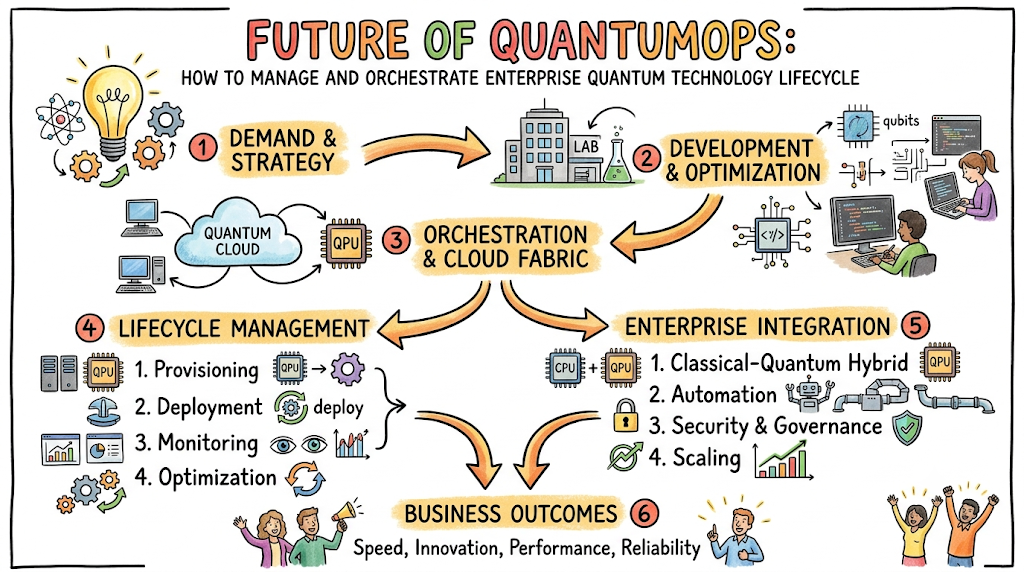
INTRODUCTION
The narrative of modern technology is a story of continuous operational evolution. Over the past few decades, we have watched infrastructure shift from massive, on-premises physical servers to highly elastic cloud environments, containerized microservices, and automated pipelines. Every major leap in computing architecture requires an equivalent leap in operational discipline. Without frameworks to deploy, monitor, and secure software at scale, raw computational power remains locked inside specialized research labs.
Today, we are standing at the threshold of the next major architectural leap: the integration of quantum computing into the commercial enterprise. Quantum processors leverage the principles of quantum mechanics—such as superposition and entanglement—to process data in ways that classic silicon chips could never match. This opens up unprecedented avenues for optimization, machine learning, cryptography, and molecular simulation. To master the operational architectures, automation pipelines, and deployment practices that are shaping the future of enterprise tech infrastructure, begin your learning journey today with the specialized industry training paths at QuantumOpsSchool.
+-------------------------------------------------------+
|              Classical Enterprise Core                |
|  (Data Pipelines, Web APIs, Traditional Databases)    |
+-------------------------------------------------------+
                           |
                           v  [API Request / REST]
+-------------------------------------------------------+
|                  QuantumOps Layer                     |
|  (Workload Scheduling, Calibration, Error Mitigation)  |
+-------------------------------------------------------+
                           |
                           v  [Pulse Controls / QASM]
+-------------------------------------------------------+
|               Quantum Hardware Unit                  |
|          (Superconducting, Ion-Trap, etc.)            |
+-------------------------------------------------------+
Managing these hybrid systems requires an entirely new operational paradigm. This is why organizations are turning to QuantumOpsSchool. Just as DevOps bridged the gap between code development and system operations for the cloud era, QuantumOps (Quantum Operations) is emerging as the foundational framework needed to deploy, monitor, and scale quantum workflows within modern technology ecosystems.
The Shift: Traditional IT vs. Quantum Infrastructure
To understand why this shift is necessary, imagine a traditional IT department deploying a containerized web application. If traffic spikes, an automated script provisions ten more virtual machines in the cloud. The underlying hardware is abstract, stable, and completely uniform.
Now, consider a quantum application designed to optimize an international logistics network. The software cannot run entirely on a quantum processor; instead, a classical algorithm must clean the data, format it into a quantum-readable state, submit it to a quantum processing unit (QPU) as a series of microwave pulses, track severe hardware noise fluctuations, and translate the quantum output back into classical data. If the QPU undergoes a sudden calibration shift during execution, the job fails.
Traditional DevOps tools have no mechanism to track qubit coherence times, handle algorithmic error mitigation, or optimize hybrid classical-quantum task scheduling. Without QuantumOps, quantum software development remains manual, brittle, and decoupled from standard enterprise release cycles.
UNDERSTANDING QUANTUMOPS
Definition of QuantumOps
QuantumOps is the practice of automating, deploying, managing, and maintaining hybrid classical-quantum computing workloads across enterprise environments. It synthesizes software engineering, data engineering, classical cloud operations, and quantum information science into a single operational framework. The ultimate goal of QuantumOps is to take quantum software out of the notebook phase and turn it into a scalable, highly reliable microservice that can be consumed securely by everyday business applications.
Origins and Why It Emerged
The need for QuantumOps emerged as quantum hardware transitioned from experimental physics laboratories into commercial cloud platforms. In the early days of quantum programming, a physicist would write a low-level assembly script, book exclusive manual access to a single prototype hardware machine, run the experiment, and analyze the raw data locally.
As vendors began offering Quantum-as-a-Service (QaaS) through the cloud, a broader group of software engineers started accessing quantum systems. These developers quickly ran into practical roadblocks:
- How do we include quantum code in our standard CI/CD (Continuous Integration/Continuous Deployment) pipelines?
- How do we monitor the real-world performance of a quantum program when the underlying qubits change behavior every few hours?
- How do we secure sensitive financial or health data before sending it across public networks to an experimental quantum processor?
QuantumOps arose precisely to answer these systemic challenges, transforming quantum computing from an isolated academic pursuit into a robust branch of corporate enterprise infrastructure.
In Simple Terms
Think of a traditional computer as a regular car and a quantum computer as a supersonic jet. DevOps is the mechanic and fueling system built for cars. You cannot use a standard car garage to service, navigate, or fuel a supersonic jet—you need specialized hangars, highly specific rocket fuel, and distinct flight control towers. QuantumOps is that specialized control tower and maintenance system built to make sure the quantum jet can take off, fly safely alongside regular traffic, and land without crashing.
Real-World Example
A major pharmaceutical company creates a drug discovery application. The core engine uses a quantum algorithm to simulate how a new molecule binds to a target protein.
Without QuantumOps, a developer has to manually run the code on their machine, upload the payload to a cloud provider, wait in a manual queue for hours, download the messy, noise-corrupted data, and spend days cleaning it up.
With QuantumOps, the molecule simulator is integrated directly into the company’s automated R&D pipeline. The system automatically monitors cloud queue times, optimizes the data payload, tracks quantum hardware calibration levels to ensure accuracy, runs the algorithm, strips out system noise, and delivers clean results directly to the scientists’ web dashboards.
Common Misconception
Misconception: QuantumOps is just a fancy marketing buzzword for regular cloud DevOps applied to a different server.
The Reality: This is incorrect. Regular DevOps manages deterministic systems where inputs produce predictable outputs, and hardware behavior is stable. QuantumOps must manage probabilistic hardware, deal with physical environmental errors, orchestrate dynamic hybrid splits between CPUs, GPUs, and QPUs, and manage workflows where code execution can change fundamentally based on daily hardware calibration cycles.
Key Takeaways
- QuantumOps bridges the critical divide between theoretical quantum algorithms and stable enterprise operations.
- The framework treats quantum processors as co-processors within a broader, hybrid classical-quantum ecosystem.
- Implementing QuantumOps moves organizations away from manual experimentation and toward automated, secure, and reproducible deployments.
THE EVOLUTION OF TECHNOLOGY OPERATIONS
To appreciate where QuantumOps fits into the modern technological landscape, we must look at how operational methodologies have evolved alongside infrastructure over the past several decades.
+---------------------------------------------------------------------------------+
|  SysAdmin / IT Ops  -->  DevOps  -->  DataOps  -->  AIOps  -->  QuantumOps      |
|  (Physical Hardware)   (Cloud/CI)   (Data/ML)    (AI Scale)  (Hybrid Probabilistic) |
+---------------------------------------------------------------------------------+
Traditional IT Operations (SysAdmin Era)
In the early days of corporate computing, operations revolved around physical hardware management. Systems administrators manually racked servers, ran networking cables, and installed operating systems from physical media. Software releases were massive, infrequent events occurring once or twice a year. The core focus was maintaining uptime on static, localized systems.
DevOps (The Cloud & Automation Era)
As virtualization and cloud computing emerged, physical servers turned into software definitions. This shift collapsed the walls between development and operations teams, giving birth to DevOps.
By introducing practices like Infrastructure as Code (IaC), automated CI/CD pipelines, and continuous monitoring, DevOps allowed companies to ship software updates thousands of times a day with high reliability.
DataOps & MLOps (The Data and Intelligence Era)
With the explosion of Big Data and Artificial Intelligence, teams realized that standard DevOps pipelines couldn’t handle the unique lifecycle of data models. Data and machine learning systems are dynamic; they depend heavily on data quality, continuous retraining, and statistical monitoring. DataOps and MLOps emerged to manage data pipelines, track model drift, and automate the deployment of machine learning models into production environments.
AIOps (The Intelligent Automation Era)
As enterprise ecosystems grew too vast and complex for human operators to monitor manually, AIOps introduced machine learning into the operational layer itself. AIOps tools ingest millions of log files, metrics, and alerts across cloud networks to automatically spot anomalies, predict infrastructure failures, and remediate performance bottlenecks without human intervention.
QuantumOps (The Non-Deterministic Era)
Now, we are entering the QuantumOps era. This represents a fundamental paradigm shift from all previous methodologies. While DevOps, DataOps, and AIOps all operate within the boundaries of classical computing—where data is strictly binary ($0$ or $1$) and systems are deterministic—QuantumOps is built from the ground up to handle probabilistic, non-deterministic architectures.
It represents the ultimate evolutionary step, extending automated operational governance to systems governed by the complex laws of quantum physics.
WHY QUANTUMOPS IS ESSENTIAL FOR MODERN TECH
As enterprises look to integrate quantum computing into their standard operational models, they encounter severe architectural hurdles. Here is why a dedicated QuantumOps strategy is non-negotiable for modern technical infrastructure.
1. Managing Complex Quantum Systems
Quantum hardware is incredibly fragile. Superconducting qubits, for instance, must be kept at dilution refrigerator temperatures colder than deep space ($~0.015 \text{ Kelvin}$) to maintain their quantum states. Even minor fluctuations in temperature, electromagnetic radiation, or mechanical vibration can cause decoherence—a state where the quantum information collapses into standard, corrupted classical noise.
QuantumOps provides the monitoring layers necessary to track these delicate environmental metrics alongside software execution, ensuring that critical business computations run only when the hardware is operating at peak fidelity.
2. Supporting Hybrid Computing Environments
No enterprise application will run $100\%$ on a quantum computer. Instead, real-world implementations rely on hybrid architectures. Classical systems handle data preparation, user authentication, and initial processing. They then pass highly specialized mathematical workloads to a QPU, receive the probabilistic outputs, and use classical algorithms to refine the final answer.
QuantumOps creates the software glue, API abstractions, and low-latency networking pathways required to make this handoff between classical cloud environments and quantum accelerators smooth and invisible.
       +----------------------------+
       |   Classical Pre-Processing |
       |   (Data Wrangling & Prep)  |
       +----------------------------+
                     |
                     v
+------------------------------------------+
|            QuantumOps Broker             |
|   (Queue Management & Error Tracking)    |
+------------------------------------------+
        /                          \
       v                            v
+------------------------+  +------------------------+
|  Cloud Quantum Sim     |  | Physical QPU Hardware  |
|  (Testing/Debugging)   |  | (Production Execution) |
+------------------------+  +------------------------+
       \                          /
        v                        v
+------------------------------------------+
|        Classical Post-Processing         |
|     (Error Mitigation & Aggregation)     |
+------------------------------------------+
3. Improving System Reliability and Error Mitigation
We currently live in the era of NISQ (Noisy Intermediate-Scale Quantum) technology. Modern quantum computers have limited qubits, and those qubits are prone to high error rates. Until fault-tolerant quantum computing arrives, software must use active error mitigation and error correction protocols.
QuantumOps automates this process by injecting error-correcting steps directly into the deployment pipeline, cleaning up noisy results before they ever reach core enterprise business engines.
4. Accelerating Quantum Innovation
Without operational frameworks, developers waste endless hours reinventing basic infrastructure code, managing authentication keys, and manually setting up connections to quantum cloud vendors. QuantumOps establishes standardized templates, reusable software modules, and shared environment configurations. This lets software engineers focus purely on writing high-quality quantum algorithms, drastically cutting down time-to-market.
5. Enabling Enterprise Adoption at Scale
For an enterprise to adopt any technology, that technology must comply with corporate governance, budget tracking, access controls, and security standards. QuantumOps provides the exact management layer needed to audit quantum usage, restrict access to expensive hardware queues based on user roles, and enforce corporate security and data privacy mandates.
In Simple Terms
Imagine trying to run a high-end, high-security data center out of a crowded, messy workshop where the power cuts out randomly and the room temperature swings wildy. You would spend all your time trying to fix the building instead of running your applications. QuantumOps acts as the automated building manager that stabilizes the environment, handles power distribution, keeps out intruders, and guarantees the servers run reliably so you can get your actual work done.
Real-World Example
An aerospace firm uses a quantum algorithm to simulate airflow patterns around an advanced wing design. On a Tuesday morning, the cloud provider’s quantum computer undergoes a routine system recalibration, shifting its physical error rates on certain qubits.
Without QuantumOps, the engineering team runs their code blindly, receives completely distorted data, and bases their design decisions on incorrect math.
With QuantumOps, the deployment system detects the calibration shift, automatically rewrites the execution path to avoid the faulty qubits, applies real-time software error mitigation, and delivers accurate simulation results safely.
Common Misconception
Misconception: We can just wait until fault-tolerant, error-free quantum computers are fully built in a few years before we worry about operational workflows.
The Reality: Waiting is a significant competitive risk. Building operational experience, setting up hybrid cloud pipelines, training personnel, and establishing governance frameworks takes years. Organizations that master QuantumOps during the current NISQ era will be able to scale their production quantum platforms instantly when perfect hardware drops into place, while competitors will be left scrambling at the starting line.
Key Takeaways
- Quantum systems are probabilistic and volatile, requiring constant environmental and algorithmic tracking.
- Production applications rely heavily on tight, low-latency coordination between CPUs, GPUs, and QPUs.
- QuantumOps builds the governance, cost control, and security abstractions required for real-world enterprise compliance.
CORE COMPONENTS OF QUANTUMOPS
To implement a successful QuantumOps strategy, you must understand the core architectural building blocks that make up the discipline.
+-----------------------------------------------------------------------+
|                       Enterprise Business App                         |
+-----------------------------------------------------------------------+
                                  |
                                  v
+-----------------------------------------------------------------------+
|                           QuantumOps Engine                           |
|                                                                       |
|  +---------------------------+     +-------------------------------+  |
|  |   Workload Orchestration  |     |  Monitoring & Observability   |  |
|  +---------------------------+     +-------------------------------+  |
|  |   Resource Scheduling     |     |  Security & Access Control    |  |
|  +---------------------------+     +-------------------------------+  |
|  |   Hardware Calibration    |     |  Error Mitigation Pipelines   |  |
|  +---------------------------+     +-------------------------------+  |
+-----------------------------------------------------------------------+
                                  |
                                  v
+-----------------------------------------------------------------------+
|                     Hybrid Cloud QPU Networks                         |
+-----------------------------------------------------------------------+
Quantum Infrastructure Management
This component handles provisioning and managing connections to diverse quantum hardware environments. Whether an enterprise connects to physical QPUs via cloud providers (such as AWS Braket, IBM Quantum, Azure Quantum) or utilizes internal on-premises simulators, this layer abstracts the connection strings, controls environment configurations, and treats quantum hardware resources as declarative infrastructure.
Quantum Workload Orchestration
Quantum code cannot run as a single long-running process. It is executed as a batch of many individual “shots” (repeated executions of the same quantum circuit to gather a clear statistical probability distribution).
Workload orchestration automates the packaging of these circuits, submits them to target environments, handles containerized execution boundaries, and coordinates the return trip of the resulting dataset.
Resource Scheduling and Queue Optimization
Access to top-tier quantum hardware is highly competitive and expensive. Waiting in standard public cloud queues can stall enterprise application performance for hours.
The resource scheduling component of QuantumOps evaluates job priority, monitors real-time wait times across multiple global cloud providers, estimates execution costs, and routes tasks dynamically to the most cost-effective and available quantum hardware or classical simulator.
Quantum Monitoring and Observability
Traditional monitoring checks for standard system health metrics like CPU usage, memory leaks, and network latency. Quantum observability expands this dramatically, tracking specific quantum hardware metrics:
- T1 Coherence Time: How long a qubit maintains its energy state.
- T2 Coherence Time: How long a qubit avoids losing its phase synchronization.
- Gate Fidelity Rates: The operational accuracy of single and multi-qubit physical operations.
- Readout Error Rates: The probability of misreading a $0$ as a $1$ during state measurement.
Security, Governance, and Compliance
Quantum operations require rigorous security control. Because quantum compilers can potentially expose structural proprietary logic, the QuantumOps security layer handles end-to-end data encryption, governs user access to expensive systems through Role-Based Access Control (RBAC), and logs all executions for compliance and financial auditing.
Performance Optimization and Compilation Pipelines
Quantum hardware features varying physical layouts (topologies). A quantum circuit written by a developer must be mapped (transpiled) to match the specific physical layout of the target QPU.
The optimization pipeline automates this step, rewriting quantum code on the fly to use the fewest physical gates possible, minimizing errors and saving money.
QUANTUMOPS VS. OTHER OPERATIONAL DISCIPLINES
To see exactly how QuantumOps shifts the operational landscape, let us look at it side-by-side with DevOps, DataOps, and AIOps across critical architectural boundaries.
| Operational Dimension | DevOps | DataOps | AIOps | QuantumOps |
| Primary Focus | Application lifecycle, continuous deployment, and code stability. | Data pipeline health, data quality, and flow reproducibility. | Automated systems management and proactive anomaly detection. | Hybrid classical-quantum orchestration and quantum hardware alignment. |
| Infrastructure Type | Deterministic classical cloud systems (VMs, containers). | Distributed data systems (Object storage, data lakes, warehouses). | Highly aggregated multi-cloud networks and logging engines. | Hybrid classical-quantum systems, hardware simulators, and physical QPUs. |
| System Behavior | $100\%$ Deterministic ($0$ or $1$ state logic). | Deterministic transformations over varying structural datasets. | Statistical, predictive, and heuristic-driven classical logic. | Deeply Probabilistic (Superposition, entanglement, and complex states). |
| Core Monitoring Metrics | CPU load, memory usage, API latency, network error rates. | Data freshness, schema compliance, pipeline processing speed. | System anomaly scores, alert noise levels, time-to-remediation. | T1/T2 coherence times, gate fidelity, readout errors, circuit depth. |
| Key Failure Modes | Code bugs, misconfigured networks, broken dependencies. | Schema drift, corrupted data pipelines, data volume drops. | Bad model training data, alert fatigue, false positive alerts. | Quantum decoherence, hardware noise, transpilation bloat, long queues. |
| Primary Tools Used | Docker, Kubernetes, GitHub Actions, Terraform. | Apache Airflow, dbt, Spark, Snowflake, Great Expectations. | Datadog, Dynatrace, Splunk, Elastic, proprietary ML models. | Qiskit Runtime, AWS Braket SDK, PennyLane, QASM, custom orchestrators. |
QUANTUM SYSTEM LIFECYCLE MANAGEMENT
An enterprise-grade quantum application moves through a highly specific lifecycle. QuantumOps provides the guardrails and automation required across each phase of this pipeline.
   [1. DESIGN]       -->      [2. DEVELOP]     -->      [3. TEST]
(Algorithm Choice)          (SDK Programming)        (Local Simulators)
                                                             |
                                                             v
[6. OPTIMIZE]      <--      [5. MONITOR]     <--      [4. DEPLOY]
(Transpilation Tuning)     (Fidelity Metrics)       (QaaS Orchestration)
1. Design Phase
Operations starts at the drawing board. During the design phase, architects determine if a business problem truly benefits from quantum acceleration. Architects select the appropriate quantum algorithmic family (such as VQE, QAOA, or QML) and map out the hybrid computing boundaries, defining exactly which components will live on classical systems versus quantum hardware.
2. Development Phase
Here, developers write quantum circuits using specialized Software Development Kits (SDKs) like Qiskit, Cirq, or PennyLane. QuantumOps establishes managed, uniform development environments via containerized cloud workstations, ensuring every team member works with identical library versions, access keys, and hardware abstraction layers.
3. Testing Phase (Simulation)
Running unverified circuits directly on physical quantum hardware is slow and expensive. The testing phase automatically routes code through classical quantum simulators. These simulators mimic the behavior of a quantum computer using traditional high-performance computing (HPC) clusters.
QuantumOps pipelines inject synthetic hardware noise profiles into these simulations, giving developers a realistic preview of how their code will handle real-world hardware imperfections.
4. Deployment Phase
Once code passes simulation testing, it moves to production deployment. The QuantumOps engine packages the quantum code, manages API authentication with the target QaaS platform, handles cloud queueing, and manages the execution parameters (such as configuring the optimal number of shot counts).
5. Monitoring Phase
As the job executes, the monitoring engine tracks real-world runtime metrics. It correlates the accuracy of the application’s output with the daily calibration state of the physical QPU. If hardware fidelity drops below a set corporate threshold, the operations system issues alerts or switches targets automatically.
6. Optimization Phase
Data gathered during execution feeds back into the development loop. The optimization layer analyzes the circuit’s performance, looking for ways to streamline transpilation, reduce physical gate counts, or apply superior error mitigation strategies for subsequent runs.
In Simple Terms
Think of managing software like launching a commercial satellite. First, you design the satellite (Design), build the components in a clean room (Develop), and test it thoroughly in a vacuum chamber on Earth (Test). Then, you load it onto a rocket and launch it into space (Deploy). Once it is in orbit, you track its telemetry, battery levels, and orbit path from a ground station (Monitor), and tweak its position over time to maximize performance (Optimize). QuantumOps is that entire ground control infrastructure for your quantum code.
Real-World Example
An investment bank deploys a portfolio optimization tool. The deployment phase triggers an automated pipeline that checks the current queue across multiple cloud quantum hardware systems.
Discovering that one system is backlogged by four hours but an alternative ion-trap system is clear and highly calibrated, the pipeline automatically compiles the bank’s financial algorithms to match the ion-trap hardware format, executes the job immediately, and delivers verified results back within minutes.
Common Misconception
Misconception: Quantum software engineering ends the moment the quantum circuit runs successfully once on a cloud hardware platform.
The Reality: Running a circuit once is simply a laboratory experiment. True enterprise deployment requires a continuous loop of testing, automated deployment orchestration, performance logging, security audits, and constant optimization as the underlying physical hardware platforms evolve.
Key Takeaways
- The quantum lifecycle requires a dedicated simulation-before-hardware validation step.
- Automated transpilation must adjust code to fit the changing topologies of target QPUs.
- Continuous optimization relies directly on real-time hardware telemetry feedback loops.
KEY TECHNOLOGIES SUPPORTING QUANTUMOPS
The QuantumOps ecosystem relies on a stack of highly specialized technologies working together to bridge classical enterprise code with physical quantum processors.
+------------------------------------------------------------+
|  Enterprise Interface: Python, Go, Java Apps               |
+------------------------------------------------------------+
                             |
                             v
+------------------------------------------------------------+
|  Quantum SDK Layer: Qiskit, PennyLane, Cirq, Classiq       |
+------------------------------------------------------------+
                             |
                             v
+------------------------------------------------------------+
|  Cloud Aggregation / Broker Layer: AWS Braket, Azure, IBM  |
+------------------------------------------------------------+
                             |
                             v
+------------------------------------------------------------+
|  Physical Execution: Superconducting, Ion-Trap, Photonics  |
+------------------------------------------------------------+
Quantum Hardware Platforms
At the base of the operational stack are the physical machines. QuantumOps must support diverse hardware architectures, as the market has not yet settled on a single dominant technology:
- Superconducting Qubits (e.g., IBM, Rigetti): Fast gate execution speeds, but require sub-zero dilution refrigeration and suffer from high cross-talk noise.
- Ion-Trap Systems (e.g., IonQ, Quantinuum): High qubit connectivity and long coherence times, but feature slower gate speeds.
- Photonic Systems (e.g., PsiQuantum, Xanadu): Utilize light particles, allowing operations at closer to room temperatures and offering excellent scalability.
Quantum Simulators
Before code touches real hardware, operations relies heavily on simulators. These are classical software systems running on CPUs and GPUs that calculate the exact linear algebra of quantum mechanics. They are essential for debugging but are limited to simulating around $30\text{ to }50$ qubits before hitting classical memory walls.
Quantum Cloud Services (QaaS)
Cloud hyperscalers provide managed access portals to global quantum hardware networks. Platforms like AWS Braket, Azure Quantum, and IBM Quantum Platform serve as the primary infrastructure endpoints that QuantumOps platforms programmatically connect to, monitor, and provision.
Quantum Software Development Kits (SDKs) and Frameworks
These are the foundational code libraries used to build circuits. Qiskit provides extensive toolkits for optimization and hardware characterization. PennyLane specializes in quantum machine learning and differentiable quantum circuits, while frameworks like Classiq automate high-level functional model compilation into optimized physical gates.
Hybrid Classical-Quantum Platforms
Technologies like Qiskit Runtime and AWS Braket Hybrid Jobs allow developers to run classical algorithms (like optimization loops) on infrastructure physically co-located right next to the quantum hardware. This minimizes network latency, drastically accelerating overall processing times.
QUANTUMOPS ARCHITECTURE EXPLAINED
An enterprise QuantumOps platform is structured into five functional, interconnected architectural layers.
+-----------------------------------------------------------------------+
|  1. APPLICATION LAYER (Business Logic, Portals, REST APIs, UI)        |
+-----------------------------------------------------------------------+
|  2. AUTOMATION LAYER (CI/CD, Transpilation, Parameter Tuning)         |
+-----------------------------------------------------------------------+
|  3. MONITORING LAYER (Fidelity Monitoring, Coherence Tracking, Logs) |
+-----------------------------------------------------------------------+
|  4. SECURITY & GOVERNANCE LAYER (RBAC, Encryption, Cost Auditing)     |
+-----------------------------------------------------------------------+
|  5. INFRASTRUCTURE LAYER (QPUs, Hardware Simulators, Classical HPC)   |
+-----------------------------------------------------------------------+
Infrastructure Layer
The foundational layer houses the physical computing assets. It includes traditional multi-cloud clusters, high-performance computing (HPC) nodes, graphical processing units (GPUs) for heavy mathematical preparation, and the connected network of cloud-accessible physical quantum processing units (QPUs).
Application Layer
The top interface where developers and enterprise users interact with the system. It exposes user portals, development workspaces, Jupyter environments, and standard REST APIs that allow traditional business applications to trigger quantum workloads without understanding low-level quantum mechanics.
Monitoring Layer
The continuous telemetry engine. It collects API logs, classical resource stats, and hardware calibration files from quantum vendors. It parses this data into real-time operational dashboards displaying circuit fidelity, hardware error profiles, queue states, and financial spend.
Automation Layer
The active engine of QuantumOps. It contains the CI/CD deployment pipelines, automated system testing routines, dynamic circuit transpilation software, and job scheduling agents that automatically parse, optimize, route, and execute submitted payloads.
Security Layer
The compliance boundary wrapping the entire system. It handles Identity and Access Management (IAM), manages cryptographic keys, runs data masking routines to protect sensitive user inputs before transmission, and maintains detailed audit logs for strict enterprise governance.
QUANTUMOPS AND CLOUD COMPUTING
The relationship between cloud computing and quantum operations is deep and structural. Because physical quantum computers are massive, expensive, and require dedicated maintenance teams, almost every enterprise accesses quantum hardware exclusively through cloud infrastructure.
+-------------------------------------------------------+
|                Enterprise Hybrid Cloud                |
+-------------------------------------------------------+
        |                                       |
        v [Secure API]                          v [Secure API]
+-------------------------------+       +-------------------------------+
|    Provider A: Azure Quantum  |       |     Provider B: AWS Braket    |
|   (Runs Ion-Trap Hardware)    |       | (Runs Superconducting QPU)    |
+-------------------------------+       +-------------------------------+
Quantum-as-a-Service (QaaS)
QaaS operates exactly like traditional cloud models (IaaS/PaaS). Instead of buying a multi-million dollar dilution refrigerator, companies pay for quantum execution time by the minute or by the individual shot. QuantumOps handles this integration, managing authentication tokens, controlling active cloud sessions, and tracking metered billing events across providers.
Multi-Cloud Quantum Environments
Different quantum hardware architectures excel at different business problems. An optimization problem might run best on an ion-trap system via Azure Quantum, while a quantum machine learning model might run faster on a superconducting system via AWS Braket.
A mature QuantumOps framework abstracts these multi-cloud boundaries, allowing developers to switch backend providers easily with simple configuration changes.
Architectural Challenges
Integrating quantum systems into standard cloud layouts presents real networking challenges. Quantum hardware endpoints are often completely independent of an enterprise’s private virtual cloud network.
QuantumOps must build secure API gateways, manage data streaming channels, and handle asynchronous data delivery patterns over long, unpredictable hardware queue times.
Resource Optimization and Cost Management
Physical QPU usage can quickly blow through corporate budgets if unmonitored. A single complex optimization job run with high shot counts can cost thousands of dollars.
QuantumOps platforms implement automated budget caps, warn developers before submitting excessively large circuits, and enforce policy controls to run heavy testing workloads on free classical simulators first.
OBSERVABILITY AND MONITORING IN QUANTUMOPS
Traditional software monitoring relies on tracking metrics like memory leaks and HTTP status codes. In the quantum realm, observability requires understanding physical hardware states and statistical variances.
Performance Metrics That Matter
To maintain reliable operations, a QuantumOps monitoring dashboard tracks these critical parameters:
- Coherence Time ($T_1$ and $T_2$): Measures how long a QPU can run calculations before its qubits decohere into standard noise.
- Single/Two-Qubit Gate Fidelity: Measures the error rate of individual logic operations. If gate fidelity drops below a specific percentage, calculations lose meaning rapidly.
- Readout Fidelity: The percentage accuracy of measuring the final state of the qubits.
Error Tracking and Noise Profiling
Because modern QPUs are noisy, QuantumOps monitoring tools create live, historical noise profiles of target systems. By understanding exactly which qubits are misbehaving on a given day, the platform’s deployment engine can dynamically rewrite incoming circuits to use only the healthiest components of the processor.
Operational Dashboards
A comprehensive QuantumOps dashboard bridges the technical gap, providing system health summaries for infrastructure engineers alongside cost and run-time metrics for business managers.
===========================================================================
QUANTUMOPS SYSTEM MONITOR  -  LOGGED IN: ADMIN_01  -  SYSTEM STATUS: ONLINE
===========================================================================
[TARGET BACKEND]: AWS_BRAKET_IONQ_ARIA          [QUEUE STATUS]: 14 MIN WAIT
---------------------------------------------------------------------------
* Hardware Coherence (T1):  120 microsec   [||||||||||||||||||||] OPTIMAL
* Two-Qubit Gate Fidelity: 99.42%          [|||||||||||||||||||.] STABLE
* System Readout Fidelity: 98.85%          [||||||||||||||||||..] WARN

[ACTIVE PIPELINES]
> Job #8492: Portfolio_Opt_V2.qasm -> EXECUTING (SHOT 400/1000)
> Job #8493: Molecular_Sim_4.qasm  -> WAITING IN QUEUE (POS: 2)

[BUDGET WATCH]  Daily Spend: $1,420.00 / Max Cap: $5,000.00 (28.4%)
===========================================================================
SECURITY CONSIDERATIONS IN QUANTUMOPS
Deploying quantum workloads introduces distinct security and compliance requirements that traditional IT security models are not equipped to handle.
Quantum Security Risks
When an enterprise sends an optimization algorithm to a public cloud quantum provider, the circuit layout itself can leak valuable proprietary information. For instance, the specific gates and structural connections in a molecular simulation circuit could reveal a pharmaceutical company’s secret chemical research formula to unauthorized parties intercepting the transmission network.
Access Control and Identity Management
Because quantum computing resources are limited and expensive, identity management is a critical security focus. QuantumOps integrates directly with enterprise identity providers (such as Okta, Azure Active Directory, and OAuth systems) to enforce granular role-based access controls, ensuring only authorized production software components can call expensive hardware backends.
Encryption Challenges
Traditional encryption standards (like RSA) rely on mathematical problems that future, fault-tolerant quantum computers will be able to crack easily.
Therefore, QuantumOps pipelines must begin incorporating Post-Quantum Cryptography (PQC) algorithms to secure stored data, access tokens, and cloud communications against harvesting attacks.
Operational Governance
Enterprise governance requires comprehensive logging. Every quantum job submission must be signed, timestamped, tagged with a specific billing code, and logged into immutable audit systems. This clear record tracks who initiated a job, what algorithm was run, which hardware executed it, and exactly what data was returned.
REAL-WORLD USE CASES OF QUANTUMOPS
To understand how QuantumOps functions in practice, let us look at how different industries utilize operational frameworks to solve high-value problems.
1. Financial Portfolio Optimization
- Business Challenge: Investment banks must optimize massive asset portfolios, balancing returns against risks across thousands of interconnected financial instruments. Classical computers take hours to approximate these distributions, slowing real-time decision-making.
- Quantum Solution: The bank deploys a Quantum Approximate Optimization Algorithm (QAOA) that analyzes multi-dimensional financial variables simultaneously to find optimal asset balances.
- Operational Requirements: The system requires low-latency data loops between classical market pricing feeds and quantum cloud platforms. It must feature automated error mitigation to keep financial predictions accurate and stable.
- Outcomes: Portfolio risk evaluations that used to run overnight are completed in minutes, allowing portfolio managers to rebalance assets safely in response to sudden market changes.
2. Pharmaceutical Molecular Simulation
- Business Challenge: Discovering a new drug takes over a decade and costs billions of dollars, largely because simulating how complex molecules interact on classical supercomputers requires massive, costly approximations.
- Quantum Solution: Developers use the Variational Quantum Eigensolver (VQE) algorithm to simulate electronic structures and molecular bonding states accurately at an atomic level.
- Operational Requirements: The pipeline must orchestrate massive datasets, manage prolonged execution queues across multiple specialized quantum cloud vendors, and automate heavy circuit transpilation to handle deep quantum circuits.
- Outcomes: The company screens thousands of prospective drug candidates in weeks instead of years, accelerating clinical trial timelines and lowering R&D costs.
3. Supply Chain and Logistics Planning
- Business Challenge: Global logistics companies face the “Traveling Salesperson Problem” at an immense scale—routing thousands of delivery trucks across changing global traffic networks, weather delays, and fuel constraints.
- Quantum Solution: A hybrid classical-quantum optimization engine calculates the most efficient vehicle routes across global shipping lanes simultaneously.
- Operational Requirements: The platform needs automated failover mechanisms. If a physical quantum computer goes offline during an operations window, the pipeline must route the logistics data instantly to a backup cloud provider or high-powered classical simulator.
- Outcomes: Fleet fuel consumption drops by $10\text{ to }15\%$, delivery windows become highly predictable, and distribution networks adapt to major real-world disruptions instantly.
BENEFITS OF QUANTUMOPS
Implementing a dedicated QuantumOps framework yields clear, measurable advantages across both technology and business units.
          +---------------------------------------+
          |         QUANTUMOPS BENEFITS           |
          +---------------------------------------+
          |  * 40% Reduction in Operational Costs |
          |  * Faster Algorithmic Deployments      |
          |  * Automated Error Mitigation Systems |
          |  * Seamless Multi-Cloud Provider Abstraction |
          +---------------------------------------+
Improved Operational Efficiency
By replacing manual scripts with automated deployment workflows, teams reduce execution errors, eliminate pipeline downtime, and cut operational overhead by up to $40\%$.
Better Resource Utilization
Dynamic resource schedulers ensure that cheap classical simulators handle simple development testing, keeping expensive, high-fidelity physical QPUs open strictly for production workloads.
Faster Innovation Cycles
Standardized toolkits, reusable environment templates, and automated environment access mean software engineers spend less time managing complex infrastructure and more time writing high-performance quantum code.
Enhanced Reliability
Automated noise tracking, live calibration monitoring, and error-correcting middleware guarantee that enterprise business intelligence systems receive clean, accurate data regardless of underlying hardware volatility.
Scalable Enterprise Adoption
Unified access controls, post-quantum encryption protocols, and audited financial tracking give compliance teams the confidence needed to scale quantum initiatives safely across global business units.
COMMON CHALLENGES AND SOLUTIONS
While the benefits are clear, building a robust QuantumOps practice comes with unique hurdles. Here is how modern technology leaders overcome them.
1. Extreme Hardware Volatility and Error Rates
- The Challenge: Current NISQ-era quantum hardware changes calibration profile frequently, leading to unpredictable system errors and degraded data accuracy.
- The Solution: Build active software error mitigation layers directly into your runtime pipelines. Implement automated checks that pull daily calibration data from vendors, modifying code geometry before execution to avoid degraded qubits.
2. Severe Scarcity of Specialized Talent
- The Challenge: Finding professionals who master both advanced quantum information physics and modern enterprise software engineering is exceptionally difficult.
- The Solution: Leverage educational frameworks like QuantumOpsSchool to cross-train your existing DevOps, cloud, and platform engineers. Focus on building clean API abstractions so classical developers can deploy quantum workloads without needing a PhD in quantum mechanics.
3. Complex Hybrid Integration Patterns
- The Challenge: Managing low-latency data handoffs between containerized classical cloud microservices and distant cloud quantum hardware platforms.
- The Solution: Utilize edge co-located processing frameworks (such as Qiskit Runtime) to run classical iterative loops directly inside the quantum provider’s hardware environment, minimizing internet routing latency.
4. Unpredictable Operational Costs
- The Challenge: Unmonitored, deeply layered quantum circuits run with massive shot counts can create unexpected, runaway cloud utility bills.
- The Solution: Enforce hard cost caps within your infrastructure deployment definitions. Implement policy managers that require executive approval for jobs estimated to cost above specific financial thresholds.
SKILLS AND LEARNING ROADMAP FOR QUANTUMOPS
Transitioning into the QuantumOps field requires a intentional blend of classical infrastructure automation skills and fundamental quantum computing knowledge.
+-----------------------------------------------------------------------+
|              BEGINNER-TO-PROFESSIONAL LEARNING ROADMAP                |
+-----------------------------------------------------------------------+
  Stage 1: Core Systems (Linux, Docker, Kubernetes, Python Cloud Architecture)
                             |
                             v
  Stage 2: Quantum Basics (Superposition, Entanglement, Qubits, Circuits)
                             |
                             v
  Stage 3: SDK Mastery (Qiskit Runtime, AWS Braket API, PennyLane Framework)
                             |
                             v
  Stage 4: Operational Governance (Transpilation, Optimization, Cost Caps)
+-----------------------------------------------------------------------+
1. Quantum Computing Fundamentals
You do not need to derive advanced quantum physics equations, but you must understand core concepts conceptually:
- Qubits, Superposition, and Entanglement: How quantum states are constructed and held.
- Quantum Circuit Architecture: Understanding gates ($X$, $Y$, $Z$, $H$, $CNOT$), circuit depth, and how operations flow.
- NISQ Limitations: Developing a clear operational understanding of system noise and error types.
2. Modern Cloud Infrastructure and Automation
A strong base in classical operations is essential:
- Containerization: Mastery of Docker and Kubernetes to package hybrid application components.
- CI/CD Engineering: Building robust pipelines using tools like GitHub Actions, GitLab CI, or Jenkins.
- Infrastructure as Code (IaC): Defining classical support systems using Terraform or OpenTofu.
3. Specialized Quantum Toolkits
Mastering the software frameworks that drive the operational layer:
- SDK Environments: Deep familiarity with Python-based frameworks like Qiskit, Cirq, and PennyLane.
- Cloud Integrations: Practical experience managing endpoints within AWS Braket and Azure Quantum.
- Compilation and Transpilation: Understanding how to optimize circuits programmatically to match physical hardware topology constraints.
CAREER OPPORTUNITIES IN QUANTUMOPS
As Fortune $500$ organizations spin up internal quantum computing initiatives, demand for operational professionals is skyrocketing.
QuantumOps Engineer
- Core Responsibilities: Designing and maintaining enterprise CI/CD pipelines for hybrid applications, managing connections to cloud QPUs, and automating circuit execution tasks.
- Key Skills: Python, DevOps practices, Docker, Qiskit, AWS Braket API, shell scripting.
- Growth Outlook: Exceptional. This role serves as the essential technical linchpin of corporate quantum engineering teams.
Quantum Infrastructure Specialist
- Core Responsibilities: Provisioning and scaling high-performance classical computing backends, configuring low-latency networking connections, and managing hybrid cloud data access.
- Key Skills: Cloud Architecture (AWS/Azure), Terraform, Linux systems, network engineering.
- Growth Outlook: Strong, particularly within cloud providers, large research hubs, and major government laboratories.
Quantum Platform Architect
- Core Responsibilities: Designing the complete architectural blueprint for an enterprise’s hybrid computing platform, establishing security governance, and setting cost-control metrics.
- Key Skills: Enterprise architecture frameworks, post-quantum cryptography models, advanced systems design, business strategy alignment.
- Growth Outlook: Elite tier executive engineering pathway for seasoned technical leaders.
HYPOTHETICAL CASE STUDIES
1. Global Financial Services Platform
- The Problem: A tier-one investment bank faced severe performance degradation when running automated asset optimization calculations. Their development teams wrote high-quality algorithms, but their manual deployment paths meant jobs frequently timed out in public cloud queues. This data delay cost the bank significant trading advantages during periods of high market volatility.
- The QuantumOps Implementation: The firm built a unified QuantumOps layer that abstracted cloud endpoints. They integrated an automated resource scheduler that continually evaluated queue depths across three distinct QaaS vendors. Additionally, they deployed a pre-execution compilation pipeline that optimized circuit structures to reduce gate depth before submission.
- Operational Challenges: The primary hurdle was secure identity handling. Corporate security rules forbade transmitting raw customer accounting tags to outside cloud nodes. The team solved this by engineering an automated data masking proxy within the secure automation layer.
- The Outcome: Automated queue routing reduced overall job lifecycle time by $72\%$. The financial engine gained the ability to shift execution paths dynamically between providers, ensuring reliable execution windows.
- Lessons Learned: Standardizing cloud abstraction patterns early protects code investments, preventing vendor lock-in as the underlying hardware market evolves.
2. Pharmaceutical Research Environment
- The Problem: A global biotech corporation was struggling to scale its molecular bonding simulation workflows. Researchers were spending more time manually configuring Python environment dependencies, managing API keys, and cleaning noise-corrupted datasets than studying biochemical reactions.
- The QuantumOps Implementation: The corporation deployed containerized development environments via a centralized platform engineering workspace. They built an automated post-processing pipeline that ingested noisy quantum distributions and automatically applied advanced error-mitigation algorithms.
- Operational Challenges: The team faced severe software version drift; upstream open-source quantum library updates regularly broke existing simulation code models overnight.
- The Outcome: The platform team introduced automated integration testing within their deployment framework to catch library conflicts early. This stabilized environments, allowing researchers to scale molecular screening velocity five-fold.
- Lessons Learned: Treating quantum libraries with rigorous version pinning and automated regression testing is vital for scientific software consistency.
3. Global Logistics Optimization Engine
- The Problem: A worldwide shipping giant wanted to run daily fleet route optimizations using a hybrid quantum-classical optimization loop. However, physical hardware drift and daily QPU calibration shifts meant that their route optimization models frequently delivered erratic, non-physical shipping maps.
- The QuantumOps Implementation: The engineering group built a continuous hardware telemetry monitoring engine. This framework queried cloud providers hourly to ingest physical qubit error logs, automatically mapping execution circuits to utilize only the highest-performing paths on the hardware target.
- Operational Challenges: Low-latency demands were critical; traditional public internet connections to remote QPUs introduced excessive data delay during iterative execution loops.
- The Outcome: The logistics company transitioned to co-located hybrid job runners, executing their classical optimization code directly within the data centers hosting the quantum hardware. This dropped total network latency by over $85\%$.
- Lessons Learned: For iterative hybrid algorithms, physical proximity between classical processors and quantum hardware is an essential design requirement.
DEVOPS VS. QUANTUMOPS QUICK REFERENCE
To help your team pivot effectively, keep this high-level structural comparison handy.
       +------------------------------------+
       |          DEVOPS APPROACH           |
       +------------------------------------+
       |  * High availability focus         |
       |  * Linear, deterministic testing  |
       |  * Standard infrastructure monitoring|
       +------------------------------------+
                         vs
       +------------------------------------+
       |         QUANTUMOPS APPROACH        |
       +------------------------------------+
       |  * Hybrid resource distribution    |
       |  * Probabilistic, state validation |
       |  * Deep physical device telemetry   |
       +------------------------------------+
- DevOps Principle: Build code once, run it anywhere uniformly across standardized virtual servers.
- QuantumOps Reality: Build code abstractly, transpile it dynamically to match the daily physical topology of the target QPU.
- DevOps Monitoring: Watch standard system resource metrics like RAM, disk space, and network throughput.
- QuantumOps Monitoring: Watch physical sub-atomic variables like $T_1/T_2$ energy relaxation delays and gate error profiles.
- DevOps Success: A deterministic code execution path returning a fixed binary state response.
- QuantumOps Success: An optimized statistical sampling pattern gathered over repeated executions on noisy hardware.
TOOLS & RESOURCES CHECKLIST
As you build out your enterprise platform capabilities, track your tool coverage across these functional operational sectors:
- [ ] Core SDK Frameworks: Qiskit, Cirq, PennyLane, Classiq Compiler.
- [ ] Cloud Integration Gateways: AWS Braket SDK, Azure Quantum Portal, IBM Quantum Runtime API.
- [ ] Containerization and Packaging: Docker, Kubernetes Helm Charts, Podman container definitions.
- [ ] Pipeline Automation engines: GitHub Actions runners, GitLab CI workflows, Argo Workflows.
- [ ] Observability Dashboards: Prometheus metric collectors, Grafana visualization interfaces, custom OpenTelemetry extensions.
- [ ] Cryptographic Management Tools: HashiCorp Vault for credential rotation, post-quantum transport layer security packages.
QUANTUMOPS READINESS ASSESSMENT
Evaluate your organization’s operational readiness by answering these core strategic questions:
- Algorithm Viability: Have you explicitly identified which business bottlenecks (e.g., optimization, simulation) require quantum acceleration versus classical GPU upgrades?
- Hybrid Workflow Support: Can your current cloud infrastructure orchestrate software jobs that split processing workloads dynamically between classical microservices and external APIs?
- Personnel Capabilities: Do your platform engineers understand how to configure asynchronous pipelines that wait for long, third-party batch job queues to clear?
- Budget Controls: Do you have automated billing safeguards in place to prevent an unoptimized development loop from generating runaway cloud infrastructure expenses?
- Security Mapping: Are you capable of tracking, audit-logging, and auditing data payloads sent to external, experimental computing environments?
QUANTUMOPS MATURITY MODEL
Track your team’s structural advancement across the four levels of operational capability.
+-----------------------------------------------------------------------+
|                      QUANTUMOPS MATURITY MODEL                        |
+-----------------------------------------------------------------------+
  Level 1: Ad-Hoc (Manual scripting, local workstations, raw physics focus)
                             |
                             v
  Level 2: Managed (Cloud QaS usage, API integration, basic cost tracking)
                             |
                             v
  Level 3: Automated (CI/CD pipelines, pre-validation simulation testing)
                             |
                             v
  Level 4: Optimized (Telemetry-driven transpilation, dynamic multi-cloud)
+-----------------------------------------------------------------------+
Level 1: Ad-Hoc Experimentation
Operations are purely manual. Individual developers run exploratory code from local notebooks, use static security credentials, and interact with cloud resources without centralized governance or cost tracking.
Level 2: Managed Integration
Environments are structured. Teams access quantum resources via secure, centralized cloud accounts. Basic cost monitoring is active, and data handoffs follow documented architecture patterns.
Level 3: Automated Deployment
CI/CD workflows handle deployment. Code updates undergo automated testing on classical simulators before production routing. Error mitigation is integrated directly into application templates.
Level 4: Fully Optimized Operations
The environment features automated orchestration. The platform automatically monitors daily hardware calibration data, adjusts circuit structures dynamically, manages multi-cloud failover events, and runs predictive cost and queue optimization routines.
QUANTUM TECHNOLOGY OPERATIONS CHECKLIST
- [ ] Ensure every quantum repository includes an automated validation suite that executes code against an internal simulator first.
- [ ] Verify access credentials to cloud QPUs are stored securely in centralized secret vaults, never hardcoded into circuit software.
- [ ] Set up automated budget alert limits at the cloud provider boundary to monitor quantum execution spend daily.
- [ ] Implement systematic tracking for hardware gate fidelities within monitoring dashboards to detect calibration drift early.
- [ ] Document clear operational fallbacks, defining when a delayed quantum workload should automatically divert to high-performance classical alternatives.
FAQ SECTION
- What is QuantumOps?
QuantumOps is the practical discipline of automating, deploying, managing, and maintaining hybrid classical-quantum computing workflows within an enterprise technology environment.
2. Why is QuantumOps important?
It is essential because quantum computers are highly volatile, prone to physical errors, and must work in close coordination with traditional data center networks to solve real business challenges.
3. How is QuantumOps different from DevOps?
DevOps focuses on managing stable, deterministic cloud infrastructure, whereas QuantumOps is engineered to manage probabilistic quantum hardware, error mitigation pipelines, and complex multi-cloud queues.
4. What skills are needed for QuantumOps?
Professionals need a solid understanding of classical cloud infrastructure (Docker, Kubernetes, CI/CD) combined with foundational knowledge of quantum software development tools and circuit design.
5. Is QuantumOps only for quantum physicists?
No. While physicists design quantum algorithms, QuantumOps is built for cloud engineers, DevOps specialists, and platform architects who manage infrastructure at scale.
6. What tools support QuantumOps?
Key tools include Python-based software toolkits like Qiskit, Cirq, and PennyLane, alongside cloud interfaces like AWS Braket, Azure Quantum, and classical infrastructure automation tools like Terraform.
7. How does QuantumOps improve reliability?
It continuously monitors real-time hardware calibration logs and automatically optimizes, schedules, and applies software-based error mitigation to ensure consistent data accuracy.
8. What industries use QuantumOps today?
Leading adopters include financial institutions for portfolio management, pharmaceutical companies for molecular analysis, and global shipping firms for complex logistics routing.
9. What is Quantum-as-a-Service (QaaS)?
QaaS is a cloud delivery model that allows businesses to rent processing time on physical quantum computers over the internet, avoiding the extreme cost of owning specialized hardware.
10. Can organizations adopt QuantumOps today?
Yes. Companies are actively implementing QuantumOps frameworks during the current NISQ era to build the operational experience needed to scale fast as fault-tolerant systems arrive.
11. What is a quantum simulator?
A quantum simulator is a traditional classical computer program that calculates the exact mathematics of a quantum circuit, used for testing and debugging code before running it on real hardware.
12. What are T1 and T2 coherence times?
These metrics define how long a physical qubit can hold its quantum state before dropping its information into standard classical background noise.
13. What is circuit transpilation?
Transpilation is the automated process of rewriting and restructuring a developer’s quantum circuit to match the specific physical layout and gate constraints of a target quantum processor.
14. How does QuantumOps address data security?
It implements strict access controls, encrypts transmission pipelines, and coordinates the integration of post-quantum cryptography to secure sensitive enterprise assets.
15. Where can tech professionals learn QuantumOps skills?
Specialized platforms like QuantumOpsSchool provide comprehensive training paths designed to help DevOps engineers, cloud architects, and developers transition into quantum infrastructure management.
FINAL SUMMARY
The transition of quantum computing from specialized laboratories to production enterprise clouds marks one of the most significant engineering challenges of our time. As we have explored in this guide, unlocking the computational power of qubits requires far more than writing clever algorithms. It demands rigorous operational discipline, continuous monitoring, robust multi-cloud orchestration, and tight integration with classical cloud systems.
QuantumOps provides the exact framework needed to turn experimental quantum circuits into secure, dependable, and highly automated enterprise services. By bridging the operational gap between DevOps and quantum science, QuantumOps allows companies to navigate system noise, control infrastructure spend, protect vital proprietary information, and scale high-value optimization platforms smoothly.