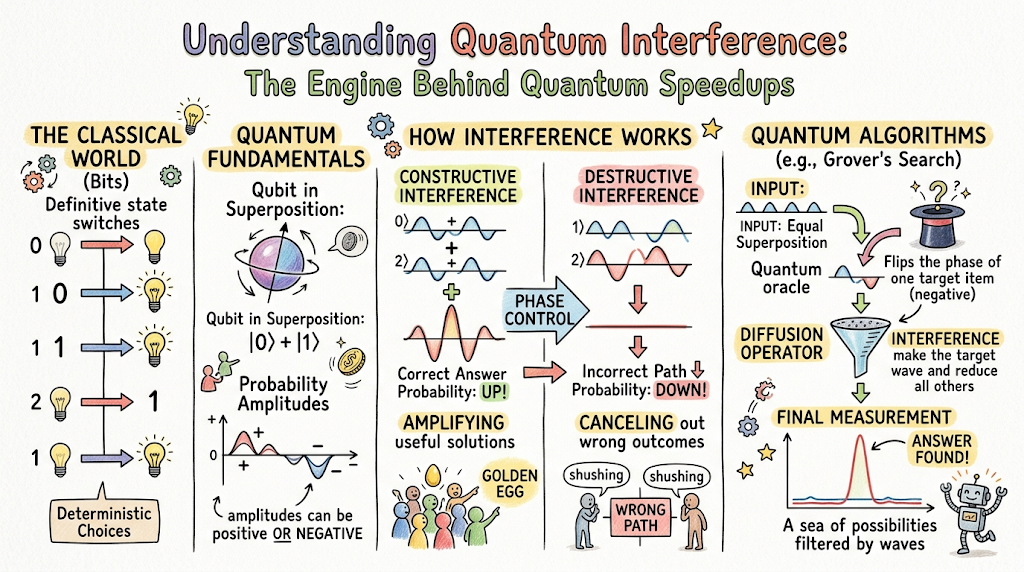
At the heart of this technological shift lies a collection of principles borrowed directly from quantum mechanics. While many people have heard of superposition and entanglement, there is another critical phenomenon that does not always get the same mainstream attention: quantum interference. Without interference, a quantum computer would be little more than a highly complex random number generator. It is the secret mechanism that allows quantum algorithms to sift through a vast sea of possibilities and land precisely on the correct answer. To truly understand how quantum computers achieve their world-changing speed, you must understand how interference works in quantum algorithms. This core mechanism bridges the gap between abstract quantum physics and practical computational power. At QuantumOpsSchool, our goal is to break down these advanced concepts into clear, actionable knowledge, helping future engineers and researchers master the operational mechanics of the quantum era.
Understanding Quantum Computing Fundamentals
To understand how interference operates, it helps to first establish the fundamental mechanics of quantum computing. Classical computers process information using bits, which represent definitive states of either 0 or 1. Every email sent, video streamed, and financial model run is ultimately reduced to vast strings of these binary choices.
Quantum computers use qubits instead of classical bits. A qubit is not restricted to being just a 0 or a 1. Thanks to a principle known as superposition, a qubit can exist in a linear combination of both states simultaneously. Think of a spinning coin: while it is flat on a table, it is clearly either heads or tails, but while it is spinning, it behaves as a blend of both possibilities at once.
When a qubit is in superposition, its true physical state is described mathematically as a quantum state. This state is written as a combination of the base states 0 and 1, each modified by a specific numerical factor. These factors are not traditional probabilities; instead, they are values called probability amplitudes.
What Is Quantum Interference?
Interference is a physical phenomenon most easily understood by looking at waves in the natural world. If you throw two stones into a still pond, ripples expand outward from each splash. When these ripples meet, they do not simply crash into each other and stop. Instead, they pass through one another, creating a new, combined wave pattern on the surface of the water.
Where the peak of one wave meets the peak of another, they combine to form a much larger wave. This process is called constructive interference. Conversely, where the peak of one wave meets the trough of another, they cancel each other out, leaving the surface of the water flat and calm. This process is known as destructive interference.
Constructive Interference:  Peak + Peak   = Higher Peak
Destructive Interference:   Peak + Trough = Cancellation (Flat)
Quantum interference is the application of this exact wave behavior to the probability amplitudes of quantum systems. Because qubits in superposition act like waves of probability rather than isolated classical objects, they naturally exhibit interference when they interact.
In a quantum computer, interference matters because it provides a way to control the evolution of a calculation. If a quantum computer merely evaluated every possible path at random, reading the final result would yield nothing but a random guess. By using interference, developers can intentionally shape the quantum state so that the paths leading to wrong answers cancel each other out, while the paths leading to the correct answer reinforce one another.
The Science Behind Quantum Interference
To look closer at the mechanics of quantum interference, we must focus on the concept of phase. Every wave has a specific position in its cycle at any given moment, which determines whether it is at a peak, a trough, or somewhere in between. This position is called its phase relationship.
In quantum computing, the probability amplitude assigned to a state contains this phase information. When an algorithm manipulates a qubit, it alters both the size of the amplitude and its phase orientation. If two computational paths have amplitudes with the same phase orientation, they combine constructively, increasing the likelihood of that outcome occurring.
If two paths have amplitudes with opposite phase orientations—meaning one is positive and the other is negative—they combine destructively. When these opposite amplitudes are added together, they reduce the overall value, lowering the chance of that specific outcome occurring.
This behavior directly changes the eventual measurement outcomes. When an algorithm runs, the quantum wave functions of all the qubits evolve together through a series of operations. The system explores a massive space of potential answers simultaneously.
However, this parallel exploration is only useful if the correct answer can be extracted at the end. By managing how these amplitudes combine throughout the calculation, the algorithm ensures that when the final measurement is taken, the wave function collapses into the correct, highly amplified solution with near certainty.
Comprehensive Comparison Table
To clarify the structural differences between these two computing styles, the table below highlights how information, waves, and probabilities are managed in both classical and quantum architectures.
| Concept | Classical Computing | Quantum Computing |
| Information Unit | Bits (Definitive 0 or 1) | Qubits (Superposition of 0 and 1) |
| Probability Handling | Standard positive percentages (0% to 100%) | Probability amplitudes (Can be positive, negative, or complex) |
| Parallel State Processing | Processes states sequentially or via multi-core hardware | Processes a vast space of combinations simultaneously |
| Wave Behavior | Absent in digital logic circuits | Fundamental to tracking qubit states |
| Interference Effects | None; bits do not cancel or reinforce each other | Active constructive and destructive manipulation |
| Computational Advantage | Scaled linearly by adding transistors | Scaled exponentially through quantum mechanics |
| Algorithm Design | Based on Boolean logic gates (AND, OR, NOT) | Based on unitary transformations and phase adjustments |
| Measurement Impact | Reading data leaves the underlying bit value unchanged | Reading data collapses the superposition into a single state |
Constructive and Destructive Interference Explained
To see how these concepts function in practice, let us look at how constructive and destructive interference work separately during an active calculation.
Constructive Interference
Constructive interference happens when the phase angles of two or more quantum states align closely with one another. When these states interact, their amplitudes reinforce each other, driving up the total probability of that specific state.
In everyday life, you can hear constructive interference when two people sing the same note perfectly in tune. The sound waves line up, producing a volume that is louder than either singer could manage alone. In a quantum system, this reinforcement acts as a beacon for the correct answer.
By designing a quantum circuit that guides multiple computational pathways toward identical phase orientations, an engineer can systematically boost the probability of the desired target state. This ensures that the computer is highly likely to return the correct solution when measured.
Destructive Interference
Destructive interference occurs when the phase angles of quantum states are misaligned or inverted relative to one another. When these states meet, their amplitudes counter each other, shrinking the probability of that state toward zero.
A familiar example of this is active noise-canceling headphones. These devices use an external microphone to analyze incoming ambient noise, then instantly generate an inverted sound wave. When the headphone’s inverted wave meets the outside noise wave, they cancel each other out, creating silence.
In quantum algorithms, destructive interference is used to silence the “noise” of incorrect answers. Because a quantum computer tracks an exponential number of possible states, most of those states represent wrong or irrelevant answers. Destructive interference systematically suppresses these unwanted outcomes, preventing the computer from displaying an incorrect result.
How Quantum Algorithms Use Interference
A common misconception is that quantum computers achieve high speeds simply by trying every possible answer at once through brute force. While superposition does allow the system to hold many possibilities simultaneously, that alone is not enough. If you measure a raw, unguided superposition, you will receive a random result, which is no more helpful than guessing.
The true magic happens when quantum algorithms use interference to choreograph these possibilities. The goal of a quantum algorithm is to alter the internal quantum state step by step, using interference to shape the probability landscape.
- Amplifying useful solutions: The algorithm identifies the characteristics of the correct answer and uses phase-shifting operations to align its components constructively.
- Eliminating incorrect paths: The algorithm forces the pathways leading to incorrect answers to conflict with one another, canceling them out via destructive interference.
- Improving computational efficiency: By canceling out bad options early, the system avoids exploring every incorrect path to its conclusion, reducing the time required to solve the problem.
- Guiding probability distributions: The algorithm reshapes the final probability curve, concentrating almost all the probability weight onto the correct choice.
This targeted guidance transforms quantum computing from a passive, random lottery into a highly organized, efficient mathematical filter.
Interference in Famous Quantum Algorithms
To understand how these concepts operate in real-world applications, let us review how interference drives the performance of some of the most famous quantum algorithms.
Grover’s Search Algorithm
Grover’s algorithm provides a dramatic speedup for searching unstructured databases. Imagine trying to find a specific item in an unsorted list of one million entries. A classical computer would have to check the items one by one, taking an average of 500,000 attempts to find it.
Grover’s algorithm solves this problem much faster by using a method called amplitude amplification, which relies heavily on interference. The algorithm starts by putting all possible database entries into an equal superposition. Next, it applies an operation known as an oracle, which flips the phase of the correct entry, making its amplitude negative while leaving all other entries positive.
The algorithm then applies a diffusion operator, which reflects all the amplitudes around their average value. Because the correct answer’s amplitude was negative, this reflection causes its amplitude to grow significantly, while the amplitudes of the incorrect answers shrink. By repeating this process, the algorithm uses constructive interference to maximize the correct answer and destructive interference to suppress the rest, finding the target entry in just a fraction of the time.
Shor’s Algorithm
Shor’s algorithm can find the prime factors of large integers exponentially faster than any known classical method. This capability has major implications for modern cryptography, which often relies on the practical impossibility of factoring large numbers with traditional computers.
At the core of Shor’s algorithm is a task called period finding, which determines the repeating pattern of a specific mathematical function. To find this period, the algorithm maps the problem onto a quantum state and uses the Quantum Fourier Transform.
As the system processes the data, the correct periodic states line up perfectly in phase, combining constructively. Meanwhile, the incorrect periods end out of phase and cancel each other out destructively. When the final measurement is taken, the true period emerges clearly from the canceled background noise, allowing the computer to factor the number efficiently.
Quantum Fourier Transform (QFT)
The Quantum Fourier Transform is the quantum equivalent of the classical Discrete Fourier Transform, which breaks down a signal into its individual frequencies. The QFT is a fundamental building block used in many advanced quantum algorithms.
The QFT operates by taking a set of quantum states and systematically shifting their phases. By applying targeted rotations to the qubits, the QFT mixes the amplitudes of the states according to precise mathematical patterns.
This mixing relies on interference to reveal hidden structures within the data. Paths that do not match the underlying frequency patterns experience destructive interference, while paths that match perfectly experience constructive interference, revealing the dominant frequency or phase information instantly.
Deutsch-Jozsa Algorithm
The Deutsch-Jozsa algorithm was one of the earliest demonstrations of a quantum algorithm outperforming a classical one. It solves a specific black-box problem: determining whether a given function is constant (returning the same output for all inputs) or balanced (returning 0 for half the inputs and 1 for the other half).
A classical computer must test multiple inputs to determine the nature of the function. In the worst-case scenario, it might need to check just over half of all possible inputs to be absolutely certain.
The Deutsch-Jozsa algorithm solves this problem in a single step. By preparing the input qubits in a superposition and passing them through the function, the algorithm creates an interference pattern. If the function is constant, constructive interference directs the final measurement to a specific base state. If the function is balanced, destructive interference alters the paths, ensuring the measurement returns a completely different state. The correct category is revealed in a single run.
Quantum Gates and Interference
Just as classical computers use logic gates like AND and OR to manipulate bits, quantum computers use quantum gates to manipulate qubits. These gates alter the quantum states of qubits by rotating their position in the state space, which changes both their amplitude values and their phase relationships.
The Hadamard Gate
The Hadamard gate is one of the most common gates used in quantum computing. Its primary job is to take a qubit from a definitive state (like 0 or 1) and put it into a balanced superposition, where it has an equal chance of being measured as a 0 or a 1.
Classical State |0⟩  ──[ Hadamard Gate ]──>  Superposition (Equal Phase)
Classical State |1⟩  ──[ Hadamard Gate ]──>  Superposition (Opposite Phase)
However, the Hadamard gate also plays a vital role in creating interference. When applied to a 0 state, it creates a superposition with a positive phase. When applied to a 1 state, it creates a superposition with a negative phase. When multiple gates are chained together, these differing phases interact, setting off the interference patterns that drive quantum calculations.
Phase Gates
Phase gates do not alter the balance of probabilities directly; instead, they change the phase angle of a qubit’s state. For example, a phase gate might rotate the phase of a 1 state by 90 or 180 degrees while leaving the 0 state completely untouched.
These gates are essential for setting up interference patterns. By selectively altering the phases of specific paths, phase gates determine whether those paths will combine constructively or destructively later in the circuit, effectively steering the direction of the calculation.
Controlled Gates
Controlled gates, such as the Controlled-NOT (CNOT) or Controlled-Phase gate, require two or more qubits to work together. In these operations, a target qubit is altered only if a control qubit meets a specific condition.
These gates allow qubits to become entangled, linking their states together. In terms of interference, controlled gates enable the phase of one qubit to alter the phase of another. This interaction allows complex, multi-qubit interference patterns to form across the entire system, which is necessary for tackling complex, large-scale problems.
Real-World Applications
By using quantum interference to accelerate complex calculations, these systems can address major challenges across a wide variety of industries.
Cryptography
As demonstrated by Shor’s algorithm, quantum computers can break many of the encryption methods currently used to secure digital communications, banking networks, and sensitive government databases.
However, this technology also enables the creation of quantum-resistant security systems. By using quantum mechanics to secure information, organizations can build communication networks that detect any attempts at interception immediately, paving the way for safer digital infrastructure.
Optimization Problems
Many industrial challenges boil down to optimization: finding the most efficient way to manage limited resources. Examples include routing delivery vehicles across a global supply chain, scheduling factory production runs, or organizing air traffic control networks.
Classical computers struggle with these tasks because the number of possible combinations grows exponentially with every new variable. Quantum algorithms use interference to evaluate all these options simultaneously, canceling out inefficient routes while amplifying the most practical, cost-effective paths.
Drug Discovery
Developing a new medication requires identifying molecules that can bind effectively to specific target proteins in the human body. To find a match, researchers must simulate how different molecular structures interact at an atomic level.
Because molecules are governed by quantum mechanics, classical computers struggle to simulate them accurately. Quantum computers can model these atomic structures naturally. By using interference patterns to identify stable molecular bonds, they can drastically accelerate the discovery of life-saving treatments.
Financial Modeling
The financial sector relies heavily on risk analysis and market forecasting. To predict how complex portfolios will perform under changing market conditions, institutions run massive simulations that require significant time and computing power.
Quantum algorithms can process these risk scenarios much faster. By using interference to analyze complex asset correlations and filter out market noise, quantum systems can provide real-time pricing models and more accurate risk assessments, helping firms protect their investments.
Artificial Intelligence
Modern artificial intelligence and machine learning models require processing enormous amounts of data to recognize patterns and make accurate predictions. Training these complex models takes substantial time and energy.
Quantum machine learning algorithms use interference to speed up this pattern-matching process. By translating data into quantum states, these algorithms can compare vast data sets simultaneously, accelerating training times and allowing AI models to solve more complex problems.
Scientific Simulations
From designing high-capacity batteries to creating new materials that can withstand extreme environments, advanced engineering depends on understanding materials at a molecular level.
Quantum computers allow scientists to simulate the quantum behaviors of these materials directly. By analyzing the natural interference patterns of electrons and atomic bonds, researchers can discover new superconductors and advanced materials without relying on slow, expensive laboratory trial and error.
Benefits of Quantum Interference in Computing
The integration of quantum interference into computer science delivers several key advantages over classical data processing architectures.
- Faster problem solving: By suppressing incorrect options and amplifying correct ones, quantum computers can solve specific complex problems in minutes that would take classical supercomputers thousands of years.
- Better optimization: Quantum systems can navigate vast landscapes of choices without getting stuck in local traps, allowing them to find superior solutions to complicated industrial problems.
- Efficient search capabilities: Algorithms like Grover’s search reduce the time required to locate unstructured data from a linear scale to a square-root scale, transforming how we interact with massive databases.
- Enhanced simulation power: By natively mimicking the wave-like behavior of nature, quantum computers can simulate chemical and physical reactions with a level of accuracy that classical binary systems simply cannot replicate.
Challenges and Limitations
Despite its immense potential, building reliable quantum computers remains an incredibly difficult engineering challenge. The primary obstacle is protecting the delicate quantum states required for interference to work.
The most significant threat is a process called decoherence. Qubits are highly sensitive to their surrounding environment. Even minor interactions with stray heat, electromagnetic fields, or physical vibrations can disrupt their phases, destroying the delicate alignment needed for constructive and destructive interference. When this happens, the quantum system loses its superposition and degrades back into random classical noise.
To combat this, researchers are developing quantum error correction protocols. These systems spread quantum information across multiple physical qubits to form a single, stable logical qubit. However, these systems require a massive overhead, often demanding thousands of physical qubits just to maintain one stable, error-corrected logical qubit. Managing this hardware complexity remains the biggest hurdle in modern quantum engineering.
Future of Quantum Algorithms
The ultimate goal of the field is to achieve fault-tolerant quantum computing—the creation of systems large and stable enough to run complex algorithms without being disrupted by environmental noise. As hardware manufacturers continue to scale up qubit counts and lower error rates, the practical utility of these systems will grow rapidly.
In the coming years, we can expect to see major advances in quantum algorithm design. Researchers are already working on hybrid systems that combine the strengths of classical cloud computing with targeted quantum accelerators.
As these tools become more accessible, enterprise-level quantum applications will emerge across industries like logistics, finance, and materials science. Companies that understand how to leverage these quantum resources will enjoy a major competitive advantage, transforming how businesses solve their toughest computational challenges.
Key Takeaways
- What interference is: Quantum interference is the process of combining probability amplitudes across multiple computational paths, drawing directly on the wave-like nature of quantum mechanics.
- Why it matters: Superposition allows a computer to hold many options at once, but interference is the mechanism that filters through those options, ensuring the correct answer can be read reliably.
- How algorithms leverage it: Advanced protocols like Grover’s and Shor’s algorithms use quantum gates to systematically alter the phases of qubits, using constructive interference to amplify correct answers and destructive interference to cancel out wrong ones.
- Future significance: Overcoming environmental decoherence to maintain stable interference patterns is the central challenge in building the next generation of fault-tolerant quantum computers.
FAQ Section
1.What is quantum interference?
Quantum interference is a fundamental principle of quantum mechanics where the probability amplitudes of qubits combine. When qubits are in a state of superposition, they behave like waves. When these waves meet during a calculation, they can either reinforce each other or cancel each other out, depending on their phase alignment. This behavior allows a quantum computer to alter the probabilities of different outcomes.
2.How does interference help quantum algorithms?
Interference gives quantum algorithms a way to extract useful answers from a vast space of possibilities. Without it, measuring a quantum computer would yield a random result. By using interference, an algorithm can manipulate the phases of various pathways so that incorrect answers cancel each other out, while the correct answer is amplified, making it highly likely to be selected during final measurement.
3.What is constructive interference?
Constructive interference occurs when two or more quantum waves align perfectly in phase. When their peaks and troughs match up, their probability amplitudes add together and grow larger. In a quantum algorithm, constructive interference is used to increase the probability of the correct answer, ensuring it stands out clearly from other possibilities.
4.What is destructive interference?
Destructive interference happens when quantum waves are out of phase with one another, meaning the peak of one wave aligns with the trough of another. When they meet, their amplitudes cancel each other out, reducing the probability of that outcome toward zero. Quantum algorithms use destructive interference to eliminate incorrect paths and unwanted answers from a calculation.
5.Why are probability amplitudes important?
Probability amplitudes are the numerical coefficients that describe the state of a qubit in superposition. Unlike classical probabilities, which are always positive, amplitudes can be positive, negative, or complex numbers. This flexibility is crucial because it allows amplitudes to cancel each other out when they have opposite signs, providing the mathematical foundation for destructive interference.
6.How does Grover’s algorithm use interference?
Grover’s algorithm uses interference through a process called amplitude amplification to find an item in an unstructured database. It first marks the target item by flipping its phase to negative. Then, it reflects all the amplitudes around their average value. This cause the positive amplitudes of the incorrect answers to cancel each other out, while the negative amplitude of the correct answer reinforces constructively, making it stand out.
7.What role do quantum gates play in interference?
Quantum gates act as the control mechanisms for interference. They alter the states of qubits by changing their amplitudes and rotating their phases. By carefully sequencing gates like the Hadamard, phase, and controlled gates within a circuit, developers can adjust the phase relationships of various pathways, determining exactly where constructive and destructive interference will occur.
8.Can interference occur in classical computers?
No, traditional digital computers cannot use quantum interference. Classical computers process information using bits, which are always in a definitive state of either 0 or 1. Because classical bits do not have wave properties, phases, or negative probability amplitudes, they cannot combine constructively or destructively. Classical interference only occurs in physical wave systems, like light or sound.
9.What challenges affect quantum interference?
The primary challenge threatening quantum interference is environmental noise, which leads to a process called decoherence. Qubits are incredibly fragile; any interaction with outside heat, physical vibrations, or electromagnetic fields can disturb their delicate phase relationships. If these phases are disrupted, the interference patterns break down, causing the calculation to collapse into useless noise.
10.How can beginners learn quantum algorithms?
Beginners can start by mastering the basics of linear algebra and probability, as these subjects form the mathematical foundation of quantum states. From there, exploring visual tools like the Bloch sphere can help build an intuitive understanding of qubit rotations. Engaging with structured educational platforms, reviewing open-source quantum programming frameworks, and studying foundational learning materials are excellent ways to develop practical skills.
Conclusion
Quantum interference is not just an interesting quirk of physics; it is the vital mechanism that makes quantum computing useful. While superposition allows a system to hold an extraordinary number of possibilities at once, it is interference that organizes this space, systematically drowning out incorrect answers and lifting the correct solution to the surface.
This elegant balance of constructive and destructive interference is what gives quantum algorithms their historic computational speedups. Mastering these concepts is the key to unlocking new breakthroughs in fields ranging from cryptography and global logistics to life-saving drug discovery.