Introduction
Navigating the complexities of vision care requires access to verified, authoritative information. When dealing with delicate structures like the cornea, retina, or optic nerve, finding the right medical center is paramount. The platform [suspicious link removed] serves as a premier global directory designed to empower patients by organizing critical data regarding clinics, ophthalmic technologies, and surgical specialists. This comprehensive educational guide explores how to evaluate the best eye hospitals in the world, details major vision correction procedures, analyzes changing economic factors like the cataract surgery cost in India, and offers practical steps to secure top-tier clinical outcomes.
Why Choosing the Right Eye Hospital Matters
Selecting an institution for vision care involves evaluating specialized parameters that directly influence safety and visual recovery. Dedicated eye clinics provide focused clinical environments where diagnostic equipment, nursing staff, and surgical suites are tailored exclusively to ophthalmic care. High-volume centers that perform thousands of annual interventions typically report significantly lower complication rates due to refined clinical workflows and rigorous peer reviews.
Furthermore, institutional infrastructure determines the availability of sub-specialized treatments. Conditions such as proliferative diabetic retinopathy, advanced open-angle glaucoma, and keratoconus cannot be treated uniformly by general practitioners. They demand specialized intervention from board-certified cornea specialists or retina specialists who operate within accredited facilities. Choosing a center focused on clinical excellence ensures access to multidisciplinary resources if unexpected anatomical anomalies arise during treatment.
Key Factors to Compare Eye Hospitals
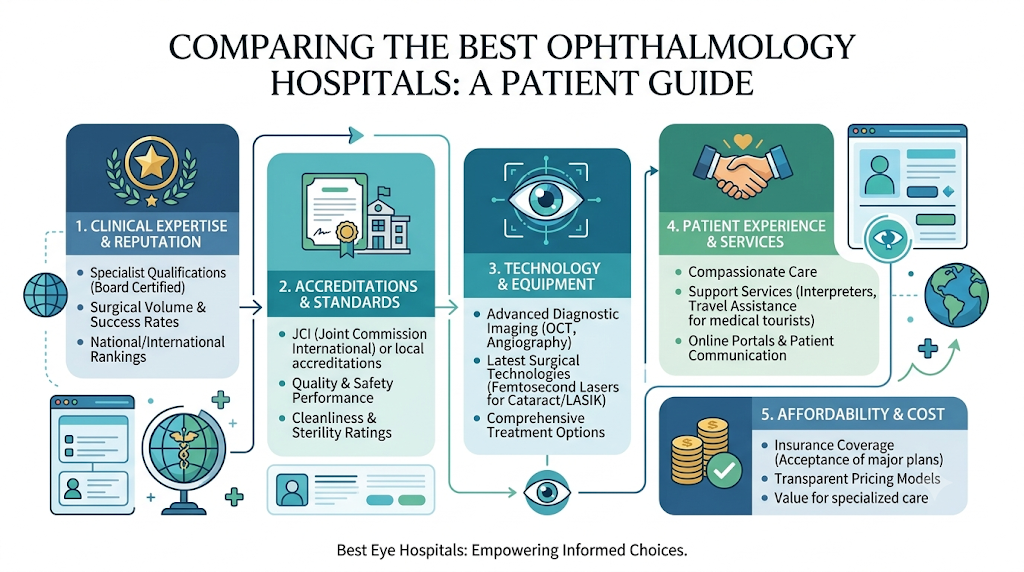
When assessing global healthcare facilities, patients must use objective benchmarks rather than relying solely on marketing claims. The following evaluation framework helps separate premier clinics from standard facilities:
- International and National Accreditations: Look for certifications from prestigious organizations like the Joint Commission International (JCI) or the National Accreditation Board for Hospitals & Healthcare Providers (NABH). These bodies enforce strict protocols regarding patient safety, sterile fields, and ethical standards.
- Diagnostic and Surgical Technology: The best eye surgery hospitals integrate state-of-the-art platforms, including optical coherence tomography (OCT), advanced corneal topography, and high-frequency ultrasound biomicroscopy.
- Surgeon Volume and Sub-Specialization: Inquire about the specific case histories of the medical staff. A hospital staffed by dedicated, fellowship-trained ophthalmologists yields superior long-term results compared to a general clinic.
- Comprehensive Emergency Infrastructure: True quality extends beyond the operating room. Ensure the facility features 24/7 ophthalmic emergency services to manage acute issues like retinal detachments or sudden intraocular pressure spikes.
Common Eye Conditions and Surgical Overview
Ophthalmic surgical interventions have transitioned largely to outpatient procedures, minimizing disruption to daily life while accelerating healing timelines. Understanding the primary modalities allows patients to accurately assess institutional listings on digital platforms.
Cataract Surgery Overview
Cataracts involve the progressive opacification of the natural crystalline lens, leading to gradual vision loss. Modern extraction uses high-frequency ultrasound or femtosecond lasers to emulsify the cloudy lens, which is then replaced with an artificial intraocular lens (IOL). Patients can choose from monofocal, multifocal, or extended depth of focus (EDOF) lenses depending on their lifestyle preferences and corneal architecture. Seeking the best hospitals for cataract surgery ensures that advanced biometric calculations are performed to optimize post-operative visual acuity.
LASIK Surgery Overview
Laser-Assisted In Situ Keratomileusis (LASIK) remains the standard for treating refractive errors like myopia, hyperopia, and astigmatism. A specialized microkeratome or femtosecond laser creates a precise, microscopic corneal flap. An excimer laser then reshapes the underlying stromal tissue to correct optical focus before the flap is repositioned. Choosing the best hospitals for LASIK surgery ensures access to advanced wavefront-guided or topography-guided platforms that map unique corneal imperfections, reducing the incidence of night-time glares or halos.
Comparison Matrices for Vision Care Options
To make an informed decision, patients must analyze how different clinical options align with their specific diagnoses and budgets. The following tables present balanced data across major ophthalmic categories.
Cataract Surgery vs. LASIK Surgery
| Features | Cataract Surgery | LASIK Surgery |
| Primary Indication | Age-related or secondary opacification of the lens | Refractive errors (myopia, hyperopia, astigmatism) |
| Surgical Approach | Lens replacement via phacoemulsification or laser | Corneal reshaping via excimer laser technology |
| Key Advantages | Permanent restoration of clarity; prevents blindness | Eliminates or significantly reduces reliance on glasses |
| Limitations | Requires highly precise pre-operative biometry | Dependent on adequate corneal thickness parameters |
| Suitable Patients | Typically individuals aged 50+ with functional loss | Adults with stable refractive prescriptions for 12+ months |
| Cost Considerations | Variable based on chosen IOL technology types | Flat rates per eye; rarely covered by standard insurance |
Traditional Phacoemulsification vs. Laser-Assisted Cataract Surgery
| Features | Traditional Phacoemulsification | Laser-Assisted Cataract Surgery (FLACS) |
| Incision Method | Manual creation using microscopic steel or diamond blades | Computer-guided femtosecond laser incisions |
| Key Advantages | Highly cost-effective; proven multi-decade track record | Extreme precision in capsulotomy; lower ultrasound energy |
| Limitations | Human-dependent variation in architectural shape | Higher structural overhead and equipment costs |
| Suitable Patients | Broad patient demographic with standard dense cataracts | Patients seeking premium multifocal or toric IOLs |
| Cost Considerations | Budget-friendly option accessible globally | Commands a premium surcharge for laser usage |
Government vs. Private Eye Hospitals
| Features | Government Eye Hospitals | Private Eye Hospitals |
| Infrastructure Focus | High-volume community care and subsidized medicine | Advanced personalized service and rapid technology adoption |
| Key Advantages | Highly economical; handles rare, complex pathologies | Negligible wait times; customized premium amenities |
| Limitations | Long waiting intervals; less individualized attention | Substantially higher out-of-pocket pricing schedules |
| Suitable Patients | Price-sensitive individuals seeking standard care | Patients prioritizing comfort, speed, and specific technologies |
| Cost Considerations | Subsidized or completely free clinical options | Premium pricing with extensive tiers based on service |
Treatment Cost Considerations Globally
Ophthalmic treatment pricing varies considerably based on regional economics, technology access, and institutional fees. Understanding these price points is essential for effective financial planning, especially when insurance coverage is limited.
Cataract Surgery Cost Variations
The cataract surgery cost in India ranges between ₹25,000 and ₹1,20,000 ($300 to $1,500 USD) per eye. This variation is driven primarily by the selected intraocular lens. Standard monofocal lenses remain highly affordable, whereas premium toric lenses (for astigmatism correction) or trifocal lenses command higher prices. In contrast, the same procedure in Western Europe or North America frequently exceeds $3,500 to $5,000 USD per eye, making international comparisons increasingly common.
Refractive Surgery Economics
The LASIK surgery cost in India typically scales from ₹40,000 to ₹95,000 ($500 to $1,150 USD) for both eyes. The specific technology used—such as standard customized LASIK, femtosecond blade-free SBK, or advanced SMILE (Small Incision Lenticule Extraction)—determines the final price. Because refractive procedures are classified as elective lifestyle enhancements rather than medical necessities, out-of-pocket spending is standard worldwide.
Medical Tourism for Eye Care in India
India has grown into a major hub for international patients seeking advanced vision care. This trend is driven by a unique combination of economic value and world-class clinical expertise.
Clinical Expertise and Technological Infrastructure
The best eye hospitals in India feature diagnostic infrastructure that matches top Western institutions. The best eye doctors in India are frequently board-certified, hold fellowships with global bodies, and contribute to international ophthalmic research journals. These specialists handle complex cases, offering second medical opinions for advanced vitreoretinal diseases, corneal dystrophies, and pediatric squint corrections.
International Patient Services
Major medical centers across urban hubs offer dedicated international patient divisions. These teams assist with medical visa documentation, airport transfers, local accommodation, and language interpretation services. This dedicated support ensures a smooth care journey, allowing international patients to focus entirely on their clinical recovery.
Common Mistakes to Avoid When Choosing a Hospital
Patients navigating the healthcare market often encounter pitfalls that can compromise both their financial planning and clinical outcomes. Avoiding these common missteps is essential for a safe care experience:
- Prioritizing Low Cost Over Safety Accreditations: Selecting a clinic solely because it offers the lowest price can lead to hidden costs, such as uncertified equipment or inadequate sterile protocols.
- Failing to Verify Surgeon Credentials: Ensure your specific procedure is performed by a credentialed specialist. For example, a refractive surgeon should handle your LASIK, while a vitreoretinal expert should manage macular treatments.
- Overlooking Post-Operative Continuity of Care: Vision surgeries require precise follow-up evaluations during the initial weeks. Choosing a clinic without a clear post-operative management plan can complicate your recovery.
- Misunderstanding What the Quoted Price Includes: Always ask for an itemized quote. Ensure the stated cost covers pre-operative biometry, surgical consumables, surgeon fees, protective eyewear, and initial follow-up visits.
Expert Tips for Selecting Ophthalmic Care
To find the right healthcare provider, look beyond standard advertisements and use direct, analytical evaluation methods:
- Request Audited Clinical Success Metrics: Ask clinics for their documented infection and success rates for your specific procedure. Reputable institutions share these statistics transparently.
- Confirm Equipment Recency: Ensure the hospital uses modern, up-to-date laser and diagnostic platforms rather than outdated generational systems.
- Read Unbiased Patient Testimonials: Look for reviews focused on clinical efficiency, nursing care quality, and billing transparency to get an accurate picture of the patient experience.
- Schedule an Initial Comprehensive Assessment: Use your initial diagnostic consultation to evaluate the hospital’s operational efficiency, cleanliness, and communicative clarity.
Best Practices for Pre- and Post-Operative Planning
Achieving optimal visual acuity depends on careful compliance with medical protocols before and after your procedure.
Pre-Operative Guidelines
Patients must undergo thorough diagnostic imaging, including corneal topography and optical biometry. If you wear contact lenses, switch to eyeglasses for at least two weeks before your refractive assessment to allow your cornea to return to its natural shape. Additionally, disclose all current medications, especially blood thinners or systemic prostate medications, as these can affect pupil dilation during surgery.
Post-Operative Care and Recovery
Protecting the eye from physical trauma and infection is crucial during the early healing phase. Patients must wear protective shields while sleeping and strictly avoid tap water contact, swimming pools, and eye makeup for at least two to three weeks. Administer prescribed antibiotic and anti-inflammatory eye drops exactly as directed by your surgeon, and attend all scheduled follow-up visits to monitor intraocular pressure.
Why Use BestEyeHospitals.com
The digital healthcare landscape can be overwhelming, with scattered data and inconsistent reviews. The platform [suspicious link removed] simplifies this process by gathering verified details on the world’s leading eye care centers into one accessible directory.
The platform allows users to compare hospitals by geographic region, specific sub-specialties, and international accreditations. Whether you are searching for advanced retina specialists or researching current refractive options, the site provides structured insights without promotional bias. By organizing infrastructure details, surgeon profiles, and transparent cost indicators, it serves as a practical decision-making tool for patients and caregivers worldwide.
Frequently Asked Questions
What distinguishes an ophthalmologist from an optometrist during eye treatment?
Ophthalmologists are medical doctors (MD or DO) specialized in advanced medical and surgical eye care. They perform complex surgeries and treat serious diseases. Optometrists provide primary vision care, focus on eye exams, and prescribe corrective lenses.
How do international accreditations ensure patient safety in eye hospitals?
Accreditations from bodies like JCI or NABH ensure strict compliance with international safety protocols. These include sterile operating environments, verified surgical checklists, proper infection control, and standardized medication management systems.
Why is surgeon case volume important when selecting an eye surgeon?
High case volumes indicate refined surgical skills, seasoned clinical judgment, and familiarity with diverse corneal variations. Surgeons who perform procedures regularly typically achieve more predictable visual outcomes and lower complication rates.
What does the typical cataract surgery cost in India include?
A comprehensive quote usually covers the diagnostic biometry, local anesthesia, surgical theater charges, surgeon fees, the selected intraocular lens (IOL), and the initial post-operative follow-up consultation.
Are premium intraocular lenses covered by standard health insurance policies?
Standard medical insurance typically covers basic monofocal lenses that restore general functional vision. Premium lenses, such as multifocal or toric options that reduce reliance on glasses, often require out-of-pocket copayments.
What is the recovery timeline after undergoing custom LASIK surgery?
Most patients notice a significant improvement in functional vision within 24 to 48 hours. However, complete corneal healing, stable vision stabilization, and the resolution of mild dry eye symptoms can take three to six months.
Can international medical tourists receive high-quality vision care in India?
Yes, India features world-class ophthalmic centers equipped with modern diagnostic tools. Many leading Indian eye surgeons hold international fellowships and offer advanced clinical treatments at highly competitive global price points.
What steps should I take if I experience sudden post-operative vision changes?
Contact your treating hospital’s emergency ophthalmic line immediately. Sudden vision drops, severe pain, flashes of light, or increased redness can indicate pressure changes or infections that require prompt medical evaluation.
Why is a corneal topography scan necessary before scheduling LASIK?
Corneal topography maps the surface curvature and thickness of your cornea. This diagnostic scan identifies irregularities like keratoconus, helping doctors determine if your eyes can safely undergo laser reshaping.
How do private eye clinics differ from large general hospital departments?
Dedicated private clinics focus exclusively on vision care, resulting in shorter wait times and rapid technology adoption. General hospitals offer wider multidisciplinary support, which can be beneficial for patients with complex systemic health conditions.
What long-term care is required after receiving a glaucoma treatment plan?
Glaucoma requires lifelong management to protect your optic nerve. Patients must strictly follow daily eye drop schedules and attend regular pressure checks, visual field tests, and OCT scans to track any disease progression.
How do modern eye hospitals treat advanced age-related macular degeneration?
Advanced centers manage macular degeneration using high-resolution OCT tracking combined with targeted anti-VEGF intravitreal injections. These specialized treatments help reduce abnormal blood vessel growth and preserve central vision.
What should I look for when comparing international patient services online?
Look for facilities that offer comprehensive support, including clear medical visa assistance, language interpreters, airport transfers, transparent pricing packages, and coordinated follow-up care with doctors in your home country.
Is it normal to experience dry eye symptoms after a refractive procedure?
Yes, mild dry eye symptoms are common after refractive surgeries due to temporary changes in corneal nerve sensitivity. Surgeons routinely prescribe preservative-free lubricating drops to support comfort during the recovery phase.
How does BestEyeHospitals.com help patients research treatment options effectively?
The platform provides a structured global directory that categorizes premier clinics by specialty, location, and technology. This allows patients to compare facilities objectively and make well-informed healthcare decisions.
Conclusion
Protecting your vision requires an informed approach to choosing healthcare providers. By carefully evaluating clinical accreditations, technology options, and surgeon expertise, patients can confidently navigate their treatment journeys. Whether you are planning a routine procedure or evaluating the LASIK surgery cost in India, verifying hospital credentials ensures a safer experience. Utilizing organized informational resources helps patients take an active, informed role in managing their long-term vision care.