Introduction
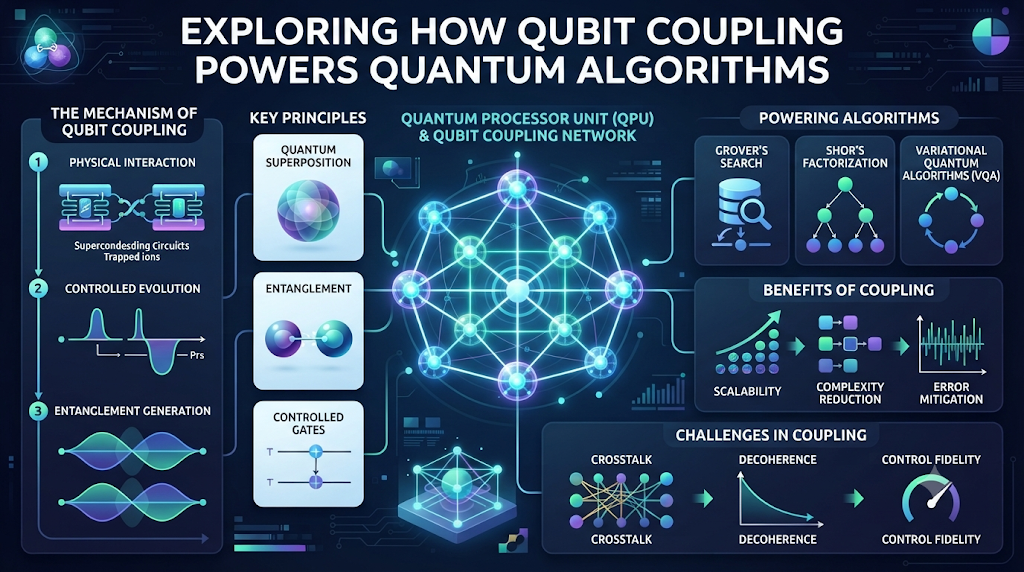
Classical computing relies on independent bits and logic gates to process information in definite states of zero or one, whereas quantum computing takes a fundamentally different path through multi-qubit operations. At the heart of this capability is a central idea: qubit interactions allow information stored in separate quantum systems to become correlated and enable controlled quantum operations. Recognizing that a quantum computer is not simply a collection of independent qubits, learners can explore comprehensive guides and tutorials at QuantumOpsSchool.com to understand how these vital interactions enable entanglement, multi-qubit logic, and advanced quantum algorithms.
What Is a Qubit?
Before exploring multi-qubit systems, it helps to review the building block of quantum information: the qubit.
Unlike a classical bit, a qubit can exist in a superposition of states. We represent a general single-qubit state using the equation:
ψ=α0+β1
Here, α and β are probability amplitudes. Their squared absolute values determine the probability of measuring the qubit in the zero or one state.
A single qubit can be manipulated independently using single-qubit gates. However, quantum logic becomes significantly more powerful when multiple qubits can interact with one another.
What Does Qubit Interaction Mean?
In beginner-friendly terms, qubit interaction means an operation or physical coupling allows the state of one qubit to influence the joint state of another qubit.
This interaction does not mean ordinary classical communication is happening between qubits. Instead, it describes a shared quantum evolution.
To see the difference, consider how independent operations compare to interacting operations:
- Independent Qubits: Each qubit is operated on separately.Plaintext
Qubit A ─── H ─── Qubit B ─── X ─── - Interacting Qubits: Operations involve the combined state of multiple qubits.Plaintext
Qubit A ─────●──── │ Qubit B ─────⊕────
Why Qubit Interactions Matter
Single-qubit gates change individual qubits, but multi-qubit interactions allow quantum systems to develop correlations that cannot be represented as independent single-qubit states.
These interactions enable:
- Entanglement
- Controlled operations
- Conditional logic
- Quantum correlations
- Multi-qubit algorithms
- Quantum error correction
- Quantum simulation
Without interactions, a quantum computer would just be a set of isolated, spinning coins unable to share information.
Single-Qubit Gates vs Two-Qubit Gates
| Feature | Single-Qubit Gate | Two-Qubit Gate |
|---|---|---|
| Qubits involved | 1 | 2 |
| Main purpose | Change one qubit | Create relationships between qubits |
| Example | X, Y, Z, H | CNOT, CZ, SWAP |
| Entanglement | Cannot create entanglement alone | Can create entanglement |
| Complexity | Generally simpler | Generally more demanding |
A universal quantum computer needs both single-qubit operations and suitable multi-qubit interactions to run complex programs.
Understanding the Two-Qubit State
When we look at two qubits together, we expand our view to a combined state space. Two qubits have four computational-basis states:
00,01,10,11
A general two-qubit state can be written as:
ψ=α00+β01+γ10+δ11
The total probability must equal one, meaning:
α2+β2+γ2+δ2=1
This larger joint state space is important because it grows exponentially with the number of qubits, providing the storage capacity required for advanced quantum algorithms.
What Is a Two-Qubit Gate?
A two-qubit gate is an operation that acts on the joint state of two qubits. Common examples include CNOT, CZ, SWAP, and controlled-phase gates.
The specific behavior of the gate depends on its design. Importantly, not all two-qubit gates create entanglement under every input condition; their effect depends heavily on the input state.
CNOT Gate
The CNOT (Controlled-Not) gate is the primary beginner example of a two-qubit operation. It features a control qubit and a target qubit, performing a conditional X operation.
Plaintext
q₀ ───●────
      │
q₁ ───⊕────
The rules are simple:
- If the control qubit is 0, the target qubit remains unchanged.
- If the control qubit is 1, the target qubit is flipped.
The computational-basis mapping looks like this:
- 00→00
- 01→01
- 10→11
- 11→10
This demonstrates fundamental conditional quantum logic in action.
How CNOT Creates Entanglement
One of the most famous uses of qubit interaction is creating entanglement. Consider this circuit:
Plaintext
|0⟩ ──H──●──
         │
|0⟩ ─────⊕──
- Step 1: Both qubits begin in the state 00.
- Step 2: A Hadamard gate is applied to the first qubit, creating a superposition: 2
1(00+10).
- Step 3: The CNOT gate is applied, resulting in: 2
1(00+11).
This final result is an entangled Bell state. It cannot be represented simply as one independent state for qubit A multiplied by one independent state for qubit B.
Entanglement and Qubit Interactions
The pathway to entanglement follows a specific progression:
Interaction→Correlation→Possible Entanglement
Interaction is a common mechanism for generating entanglement, but simply applying an arbitrary interaction does not automatically produce it.
Entanglement is vital for quantum algorithms, quantum communication, quantum simulation, and quantum error correction. However, these quantum correlations do not allow faster-than-light communication.
Controlled Quantum Operations
Beyond CNOT, quantum circuits use many types of conditional quantum logic. These include controlled-X, controlled-Z, controlled-phase, and controlled rotations.
Plaintext
Control ───●────────
           │
Target  ───U────────
In these operations, a target operation U is applied only depending on the state of the control qubit.
Controlled-Z Gate
The CZ (Controlled-Z) gate applies a phase change to the appropriate computational-basis component when both qubits meet specific conditions.
Plaintext
q₀ ───●───
      │
q₁ ───●───
The CZ gate is symmetric, meaning either qubit can act as the control or the target. It plays an important role in many quantum circuit architectures and measurement-based models.
SWAP Gate
Not every interaction is about creating entanglement. The SWAP gate exchanges the states of two qubits:
ab→ba
SWAP operations are especially useful when hardware connectivity limits which qubits can directly interact, allowing data to move across a processor.
Qubit Connectivity
Quantum hardware has physical limitations known as qubit connectivity. Not every physical qubit can interact directly with every other qubit.
Plaintext
Q0 ─── Q1 ─── Q2
       │
       Q3
Processors often use nearest-neighbor architectures defined by connectivity graphs. If two logical qubits need to interact but their physical counterparts are not connected, the system must use routing strategies involving SWAP operations.
Why Connectivity Matters for Quantum Logic
When physical qubits are not directly connected, running a multi-qubit gate requires extra routing steps. This introduces several engineering challenges:
- More circuit depth
- Additional gate errors
- Longer execution time
- More opportunities for decoherence
Managing connectivity is a key part of quantum circuit design and compilation.
Physical Qubit Interactions
Quantum hardware relies on physical mechanisms to let qubits interact. Different platforms use different approaches:
- Superconnected / Superconducting Qubits: Interactions are mediated through couplers, microwave control, and circuit elements.
- Trapped Ions: Interactions are mediated through shared motional modes and laser interactions.
- Neutral Atoms: Interactions are controlled through mechanisms such as Rydberg interactions.
Different hardware platforms use unique physical mechanisms to achieve qubit coupling.
Interaction Hamiltonians
From a physics perspective, a Hamiltonian describes how a quantum system evolves over time. An interaction term represents the physical coupling between parts of the system.
We can write a conceptual Hamiltonian as:
H=HA+HB+Hinteraction
- HA: Behavior of qubit A
- HB: Behavior of qubit B
- Hinteraction: Coupling between them
The interaction term allows the joint dynamics of the system to differ from two completely independent qubits.
Time Evolution and Interactions
The time evolution of a quantum state is governed by the Schrödinger equation operator:
U(t)=e−iHt/ℏ
This relationship connects the concepts together:
Interaction Hamiltonian→Quantum Evolution→Two-Qubit Correlations→Useful Quantum Operation
Through precise control of this evolution, physicists turn raw physical coupling into structured quantum logic gates.
Quantum Logic From Physical Interactions
It is important to distinguish between abstract concepts and hardware execution:
- Abstract Layer: CNOT Gate
- Compilation / Control: Translating instructions
- Hardware-Level Operations: Pulses and control signals
- Physical Qubit Interaction: Actual energy exchange in the processor
Logical quantum gates are the abstract operations used in circuits, while physical interactions are the hardware-level mechanisms used to implement them.
Gate Decomposition
A high-level gate requested in a program is rarely executed directly by hardware. Instead, a circuit compiler translates the operation into the hardware’s available native gate set.
This decomposition process must account for hardware constraints, gate fidelity, circuit depth, and execution time.
Qubit Interactions and Quantum Circuits
A typical quantum circuit combines preparation, single-qubit manipulation, multi-qubit interactions, and measurement:
Plaintext
q₀ ───H────●────M──
           │
q₁ ────────⊕────M──
- Prepare qubits in initial states.
- Apply a single-qubit operation (like Hadamard).
- Use a two-qubit interaction (like CNOT).
- Measure the resulting state.
- Analyze classical outcomes.
Interaction and Quantum Algorithms
Multi-qubit interactions appear across a wide variety of algorithms, including Grover’s algorithm, Shor’s algorithm, QAOA, VQE, quantum simulation, and quantum machine learning.
Algorithms use multi-qubit gates to create complex correlations and transform information across the entire quantum register.
Qubit Interactions in Quantum Simulation
Interactions are especially important for simulating physical systems. Real physical systems in nature contain interacting particles, molecules, and spin networks.
Quantum computers can encode such systems into qubits and use controlled quantum operations to reproduce aspects of their real-world dynamics.
Qubit Interactions in Quantum Error Correction
Quantum error correction requires multi-qubit operations and measurements to protect fragile quantum data.
The conceptual workflow involves:
- Data Qubits
- Ancilla Qubits
- Entangling Operations
- Syndrome Measurement
- Error Information
Interactions allow information about errors to be transferred into measurable syndrome data without directly disturbing the protected logical state.
Interaction Strength
Stronger coupling between qubits does not automatically mean better quantum computation. Engineers must carefully balance:
- Gate speed
- Gate fidelity
- Crosstalk
- Control accuracy
- Decoherence
- Hardware stability
Balancing these competing factors is a central challenge in quantum engineering.
Crosstalk
When operations are performed on one qubit, unwanted physical effects can influence neighboring qubits. This phenomenon is called crosstalk.
Consequences of crosstalk include incorrect gate behavior, readout errors, reduced fidelity, and unexpected correlations. Useful interactions must be carefully controlled, while unwanted coupling must be actively minimized.
Decoherence and Qubit Interactions
Qubits are extremely sensitive to their environment, suffering from energy relaxation, dephasing, and environmental noise.
Longer or more complicated interaction sequences provide more opportunities for errors to creep in. Because of this, quantum engineers strive to create interactions that are fast, accurate, repeatable, and well-calibrated.
Fidelity of Two-Qubit Gates
Gate fidelity measures how closely the actual output of a quantum gate matches the intended theoretical operation.
Two-qubit gate fidelity is a critical practical metric for quantum processors. Because multi-qubit gates are harder to control than single-qubit gates, improving two-qubit fidelity is a major focus of current hardware research.
Two-Qubit Gates vs Single-Qubit Gates
| Aspect | Single-Qubit Gate | Two-Qubit Gate |
|---|---|---|
| Number of qubits | 1 | 2 |
| Main role | Individual state manipulation | Correlation and conditional logic |
| Can generate entanglement? | No, not by itself | Yes |
| Hardware complexity | Usually lower | Usually higher |
| Error sensitivity | Often lower | Often higher |
| Connectivity required | No pair connectivity | Yes |
Common Beginner Misconceptions
- Misconception 1: “Qubits interact like classical bits.” Quantum states follow the rules of quantum mechanics, including superposition and phase, making them much richer than classical bits.
- Misconception 2: “Every two-qubit gate creates entanglement.” Entanglement depends heavily on both the input state and the specific gate operation being performed.
- Misconception 3: “Interaction means information travels instantly.” Quantum correlations cannot be used to transmit usable messages faster than light.
- Misconception 4: “More interaction is always better.” Uncontrolled interactions lead to crosstalk and errors; precise, targeted coupling is required.
- Misconception 5: “Logical gates are exactly what the hardware physically performs.” Hardware compiles abstract gates into native physical control pulses.
Beginner Example: Creating a Bell State
To see the math in action, examine a Bell-state circuit:
Plaintext
q₀ ───H────●────
           │
q₁ ────────⊕────
- Initial state: 00
- After Hadamard: 2
1(00+10)
- After CNOT: 2
1(00+11)
In an ideal circuit, measurement produces correlated results of either 00 or 11 with equal probability, with zero chance of measuring 01 or 10.
Beginner Learning Roadmap
- Step 1 — Learn Qubit Basics: Understand qubits, superposition, and measurement.
- Step 2 — Learn Single-Qubit Gates: Study X, Y, Z, and Hadamard gates.
- Step 3 — Learn Two-Qubit Gates: Study CNOT, CZ, and SWAP gates.
- Step 4 — Learn Entanglement: Build and analyze Bell states.
- Step 5 — Learn Circuit Connectivity: Understand hardware graphs and routing.
- Step 6 — Learn Noise: Study decoherence, crosstalk, and gate errors.
- Step 7 — Learn Hardware: Compare major quantum computing platforms.
- Step 8 — Build Multi-Qubit Circuits: Practice using a quantum simulator.
Practical Project
Try building a Two-Qubit Entanglement Experiment using a quantum software simulator:
- Initialize two qubits in the zero state.
- Apply a Hadamard gate to qubit 0.
- Apply a CNOT gate between qubit 0 (control) and qubit 1 (target).
- Measure both qubits.
- Run many shots to gather statistics.
- Plot the measurement counts.
- Expected ideal outcomes: 00→≈50%, 11→≈50%, 01→0%, 10→0%.
- Real hardware will show small deviations due to noise and imperfect operations, highlighting the importance of gate fidelity.
How QuantumOpsSchool.com Can Help
Building a solid understanding of quantum computing requires clear guidance on foundational topics, circuits, and hardware engineering.
QuantumOpsSchool.com supports learners by providing educational resources around quantum computing fundamentals, qubits, quantum operations, circuits, hardware, algorithms, noise, optimization, and quantum workflows.
Whether you are studying quantum qubit interaction for the first time or exploring advanced algorithms, structured learning resources help bridge the gap between theory and practice.
Future of Qubit Interactions
Research into quantum hardware and software continues to advance rapidly. Emerging directions include:
- Higher-fidelity two-qubit gates
- Improved hardware connectivity
- Tunable couplers for dynamic coupling control
- Better error suppression and correction
- Scalable logical qubit operations
- Fault-tolerant quantum computing architectures
- More efficient circuit compilation tools
These developments will continue to push quantum computing closer to large-scale, fault-tolerant execution.
Qubit Interaction Checklist
- [ ] I understand what a qubit is.
- [ ] I understand why multiple qubits are useful.
- [ ] I know what a two-qbit gate does.
- [ ] I understand CNOT.
- [ ] I understand controlled operations.
- [ ] I know how interactions can create entanglement.
- [ ] I understand qubit connectivity.
- [ ] I know what an interaction Hamiltonian represents.
- [ ] I understand crosstalk.
- [ ] I understand why two-qubit gate fidelity matters.
- [ ] I can build a simple Bell-state circuit.
- [ ] I understand the difference between logical gates and physical interactions.
Frequently Asked Questions
What are qubit interactions?
Qubit interactions refer to physical or operational couplings that allow the state of one qubit to influence another, forming the foundation for multi-qubit quantum logic.
Why are qubit interactions important in quantum computing?
They enable quantum computers to move beyond independent calculations, allowing for entanglement, conditional logic, and the execution of complex multi-qubit quantum algorithms.
What is a two-qubit gate?
A two-qubit gate is a quantum logic operation that acts simultaneously on the joint state of two qubits to establish relationships or correlations between them.
How does CNOT use qubit interaction?
The CNOT gate uses a control qubit to conditionally flip the state of a target qubit, serving as a core building block for conditional quantum logic and entanglement.
Can qubit interactions create entanglement?
Yes, specific interactions combined with appropriate initial states can generate entangled states, though not every interaction automatically creates entanglement.
What is the difference between single-qubit and two-qubit gates?
Single-qubit gates manipulate individual quantum states independently, while two-qubit gates establish mathematical relationships and correlations between pairs of qubits.
Why does qubit connectivity matter?
Because physical processors have limited direct connections between qubits, compilers often need to route operations using SWAP gates, affecting overall circuit performance.
What is an interaction Hamiltonian?
An interaction Hamiltonian is a mathematical description of the physical coupling energy between different parts of a quantum system that drives its joint time evolution.
How do qubit interactions affect quantum hardware performance?
Stronger and more precise control improves gate capabilities, but unmanaged interactions can cause crosstalk and introduce errors that reduce overall system fidelity.
How can beginners learn about qubit interactions?
Beginners can start by studying single-qubit states, exploring basic two-qubit gates like CNOT using simulators, and learning how circuit connectivity impacts quantum execution.
Conclusion
Qubit interactions remain fundamental to quantum logic because single-qubit gates manipulate individual states while two-qubit operations introduce critical relationships, conditional logic, and entanglement across the system. Although hardware connectivity constraints, physical coupling complexities, and environmental noise present ongoing design challenges, mastering these multi-qubit mechanisms is essential for building scalable, high-fidelity quantum processors. By keeping these core concepts in mind, practitioners can continue to deepen their expertise through educational programs and technical roadmaps available at QuantumOpsSchool to advance their understanding of quantum operations and computing workflows.