Introduction
To answer this, we can look at foundational insights shared across modern technical resources such as Quantum Speedup Guide. In the modern technology landscape, quantum computing is frequently surrounded by hype. A common misconception is that a quantum computer is simply a futuristic “super-fast computer” that will instantly accelerate everything from web browsing to video rendering. In reality, quantum computing is not about making every everyday operation faster. Instead, quantum speedup represents the improvement in computational performance that a specialized quantum algorithm can provide compared with a suitable classical algorithm for the same problem and computational model. Crucially, speedup is never assumed in a vacuum; it must always be measured and evaluated relative to a clearly defined classical baseline.
What Is Quantum Speedup?
Quantum speedup refers to the computational improvement achieved by using a quantum algorithm compared with an appropriate classical approach for the same problem.
When researchers talk about speedup, they are usually referring to scaling behavior rather than raw wall-clock execution time. Speedup may be measured using several criteria, including:
- Number of computational steps or query complexity
- Scaling behavior as input size grows
- Total resource requirements (such as memory or gate counts)
Importantly, quantum speedup is not universal. Quantum computers do not automatically make every task faster than classical computers. Performance depends heavily on the structure of the problem, the design of the algorithm, input size, and the quality of the underlying hardware.
Why Quantum Speedup Matters
Researchers and engineers study quantum speedup because certain computational challenges are fundamentally intractable for classical supercomputers when scaling to massive sizes. These include:
- Complex molecular simulations for chemistry and materials science
- Large-scale logistical optimization and routing
- Unstructured database search problems
- Cryptographic analysis and number theory
The ultimate value of quantum computing lies in identifying problems where quantum algorithms scale significantly better than classical alternatives. Quantum systems are not intended to replace classical computers generally; rather, they are designed to work alongside classical infrastructure to tackle classes of problems that overwhelm traditional machines.
How Quantum Computers Can Achieve Speedup
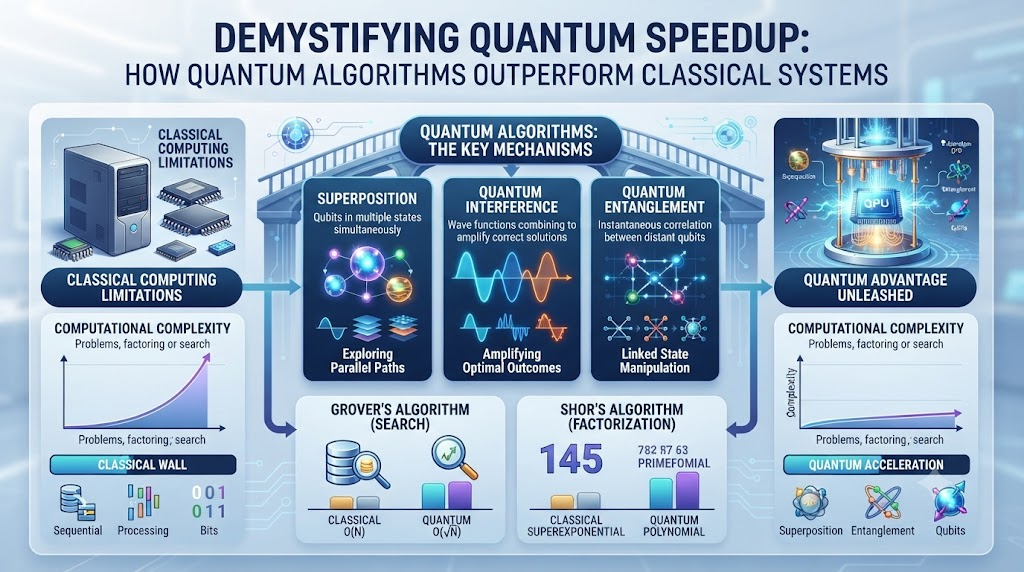
Quantum computers derive their unique computational mechanics from the laws of quantum physics. To understand how a quantum speedup occurs, we must look at three core principles.
Superposition
Quantum information is stored in quantum bits, or qubits. Unlike classical bits—which are strictly either 0 or 1—qubits can exist in a linear combination of states known as a superposition.
Common Misconception Alert: Superposition does not mean a quantum computer simply calculates every possible answer simultaneously and instantly reads off the right one.
Instead, superposition allows a quantum system to represent multiple possibilities simultaneously, setting up a rich mathematical landscape for manipulation.
Quantum Interference
Quantum algorithms carefully manipulate probability amplitudes so that incorrect answers interfere destructively (canceling each other out), while correct answers interfere constructively (amplifying their probability of being measured). Interference is the central engine behind how quantum algorithms extract useful outcomes.
Entanglement
Entanglement creates deep correlations between qubits such that the state of one qubit instantaneously influences another, regardless of physical distance. While entanglement alone does not automatically produce a speedup, it binds qubits together to process complex, multi-variable relationships that independent classical states cannot efficiently capture.
Quantum Speedup and Computational Complexity
To understand how speedup is quantified, we look at computational complexity—the study of how resource requirements (like time or operations) grow as the input size ($N$) increases.
For example, suppose a classical algorithm requires approximately $N$ operations to solve a specific problem. If a quantum algorithm can solve the exact same problem using approximately $\sqrt{N}$ operations, the quantum algorithm provides a quadratic improvement in that computational model. The precise nature of the speedup depends heavily on mathematical assumptions and problem constraints.
Types of Quantum Speedup
Quantum speedups are generally categorized by how dramatically their scaling improves relative to classical baselines.
Constant-Factor Speedup
A constant-factor improvement speeds up a process by a steady multiplier (such as running twice as fast). While helpful, constant-factor gains do not alter fundamental algorithmic scaling.
Polynomial Speedup
A polynomial speedup occurs when the quantum algorithm scales better by a polynomial relationship. A classic example is a quadratic speedup, where work scales with the square root of the classical input size.
Exponential Speedup
An exponential speedup represents a much stronger performance scaling. As the problem size grows, the performance gap between the classical and quantum approaches widens dramatically, making otherwise impossible computations feasible in theory.
Grover’s Algorithm and Quadratic Speedup
One of the most famous illustrations of quantum speedup is Grover’s algorithm, designed for unstructured search problems.
Imagine you need to find a single specific item hidden inside an unsorted database containing $N$ total possibilities. A classical computer performing an exhaustive search may require roughly $N$ queries in the worst-case scenario. Grover’s algorithm utilizes amplitude amplification and quantum interference to reduce the required query complexity to approximately $\sqrt{N}$.
This provides a clear quadratic speedup. However, it does not mean Grover’s algorithm transforms every search or optimization task into an instant operation; it is specifically tailored for unstructured search mechanics.
Shor’s Algorithm and Exponential Speedup
Shor’s algorithm is a landmark discovery in quantum computing, formulated to solve integer factorization.
Finding the prime factors of an extremely large composite number becomes exponentially harder for classical computers as the number of digits grows. Shor’s algorithm provides a theoretical exponential speedup over known classical factoring methods. Because modern public-key cryptography relies heavily on the difficulty of factoring large numbers, Shor’s algorithm has profound implications for future digital security. However, executing this algorithm at a scale capable of breaking modern production encryption requires fault-tolerant hardware far beyond current technological capabilities.
Quantum Speedup vs Classical Speedup
Evaluating a quantum speedup requires a fair comparison. Classical algorithms do not stand still; classical computing methods are continually optimized.
A quantum algorithm should never be benchmarked against an outdated or inefficient classical implementation. Accurate evaluation requires comparing the best known quantum approach against the best appropriate classical approach. Benchmarking must account for:
- Algorithm quality and design
- Hardware execution environment
- Data preparation and input size
- Compilation and classical processing overhead
Theoretical Quantum Speedup vs Practical Quantum Speedup
A critical distinction exists between theory and execution practice.
Theoretical Speedup
Theoretical speedup is demonstrated through mathematical complexity models and abstract algorithm analysis, assuming idealized conditions.
Practical Speedup
Practical speedup reflects real-world performance after accounting for physical constraints, such as:
- Hardware execution time and noise
- Quantum error correction overhead
- State preparation and measurement errors
- Data transfer and classical preprocessing/post-processing
An algorithm with a brilliant theoretical speedup may face substantial bottlenecks when executed on physical hardware.
Role of Quantum Hardware in Speedup
Hardware quality directly dictates whether theoretical improvements translate into real-world performance. Key physical factors include:
- Qubit Count & Connectivity: How qubits are physically linked dictates how easily complex circuits execute.
- Gate Fidelity & Coherence: High error rates and short coherence times cause quantum states to degrade before calculations finish.
- Circuit Depth: Longer sequences of quantum gates accumulate more noise, limiting execution success.
Simply adding more physical qubits does not automatically create greater speedup unless coherence and fidelity scale proportionally.
Quantum Speedup in Hybrid Quantum-Classical Systems
Most modern quantum workloads operate as integrated, hybrid systems rather than standalone quantum units. A typical workflow follows this path:
$$\text{Classical Input Preparation} \downarrow \text{Quantum Circuit} \downarrow \text{Quantum Execution} \downarrow \text{Measurement} \downarrow \text{Classical Post-Processing} \downarrow \text{Final Result}$$
Evaluating overall performance requires looking at this entire end-to-end pipeline rather than isolating the quantum processor alone.
How Quantum Speedup Is Measured
Because there is no single universal metric, researchers measure speedup across several dimensions:
- Runtime: The total wall-clock time for an end-to-end task.
- Query Complexity: How many times an algorithm accesses a data source or oracle.
- Gate Count & Circuit Depth: The number and sequential layers of quantum operations required.
- Resource Cost: Total qubit requirements and classical processing overhead.
Quantum Speedup vs Quantum Advantage vs Quantum Supremacy
| Term | Basic Meaning | Important Point |
| Quantum Speedup | Improvement in computational scaling or resources. | Must be measured against a defined classical baseline. |
| Quantum Advantage | Quantum approach performs better for a relevant, real-world task. | Practical usefulness and efficiency matter. |
| Quantum Supremacy | Historical term for surpassing classical computational feasibility. | The benchmark task may not have immediate commercial or practical value. |
| Quantum Utility | Useful quantum computation delivering reliable value. | Signifies operational reliability without requiring absolute supremacy. |
Common Misconceptions About Quantum Speedup
- Misconception 1: “Quantum computers are universally faster.” (Correction: Speedup is strictly problem-specific.)
- Misconception 2: “Superposition lets a computer try every answer instantly.” (Correction: Superposition is a state space, not an automatic solver.)
- Misconception 3: “Quantum speedup is always exponential.” (Correction: Many valuable algorithms offer polynomial or quadratic speedups.)
- Misconception 4: “More qubits always equal more speed.” (Correction: Noise, fidelity, and architecture matter more than raw qubit counts.)
- Misconception 5: “Quantum computers will replace classical machines.” (Correction: Hybrid architectures represent the future.)
Practical Example of Quantum Speedup
Consider a database containing one million customer records where you need to find a specific entry.
- Classical Approach: A standard linear search checks records sequentially, taking up to one million steps in the worst case.
- Quantum Approach: By applying Grover’s algorithm, a quantum system can find the target with a quadratic reduction in query steps (roughly one thousand steps instead of one million).
While this demonstrates a clear theoretical speedup, operational reality requires factoring in data loading costs, state preparation, and hardware execution overhead.
Quantum Speedup from a QuantumOps Perspective
When quantum workloads move into operational environments, engineering teams must monitor much more than abstract algorithmic complexity. Effective systems management requires tracking:
- Circuit execution and queue times
- Backend hardware availability and job success rates
- Gate fidelity and error rates
- Classical preprocessing and post-processing bottlenecks
Treating quantum workloads as stable, scalable operational systems bridges the gap between theoretical models and real-world utility.
Challenges in Achieving Practical Quantum Speedup
Realizing consistent speedup faces several hurdles:
- Noisy intermediate-scale hardware limitations
- Substantial quantum error correction overhead
- High data loading and measurement costs
- Ongoing improvements in classical algorithms that continually raise the performance baseline
Future of Quantum Speedup
The future of quantum performance will evolve through distinct stages:
- Current Capabilities: Running noisy circuits with error mitigation and hybrid pipelines.
- Emerging Developments: Scaling logical qubits and improving error-correction protocols.
- Long-Term Possibilities: Fully fault-tolerant quantum accelerators integrated seamlessly into high-performance computing centers.
FAQs
- What is quantum speedup?Quantum speedup is the improvement in computational performance or scaling that a quantum algorithm provides over an appropriate classical algorithm for the same problem.
- How does quantum speedup differ from quantum advantage?Quantum speedup measures algorithmic scaling relative to a baseline, whereas quantum advantage is a broader milestone indicating that a quantum system solves a practical, real-world task more efficiently than classical alternatives.
- Is quantum speedup always exponential?No. Speedups can be constant-factor, polynomial (such as quadratic), or exponential, depending entirely on the problem structure and algorithm design.
- What is Grover’s algorithm’s speedup?Grover’s algorithm provides a quadratic speedup for unstructured search problems, reducing query complexity from linear scale down to the square root of the input size.
- How does Shor’s algorithm demonstrate quantum speedup?Shor’s algorithm offers a theoretical exponential speedup for integer factorization compared to known classical factoring methods.
- Does superposition automatically create quantum speedup?No. Superposition allows quantum systems to represent complex state combinations, but achieving a speedup requires careful algorithmic design involving interference and amplitude manipulation.
- What is the difference between theoretical and practical quantum speedup?Theoretical speedup is derived from mathematical complexity models under ideal conditions, while practical speedup accounts for real-world hardware noise, error rates, and workflow overheads.
- How is quantum speedup measured?It is measured using metrics such as query complexity, gate count, circuit depth, runtime, and total resource scaling relative to a classical baseline.
- Do more qubits always mean greater quantum speedup?No. Raw qubit counts do not guarantee better performance if gate fidelity, error rates, and coherence times are insufficient.
- How does QuantumOps help manage quantum performance?QuantumOps provides the operational discipline needed to monitor execution times, error rates, hardware availability, and hybrid workflow efficiency in production environments.
Conclusion
Quantum speedup represents a fundamental performance improvement achieved by matching specialized quantum algorithms with appropriate classical baselines for specific computational tasks. As we have explored, speedup is never universal; it is heavily dependent on problem structure, algorithm design, and input scaling. While mechanisms like superposition and quantum interference enable powerful paradigms such as quadratic and exponential speedups, bridging the gap between theoretical models and real-world execution requires overcoming significant hardware and workflow challenges. Ultimately, as quantum technology transitions toward operational maturity, integrating these workloads through robust hybrid systems and structured management practices will be essential to unlocking their true potential.