Introduction
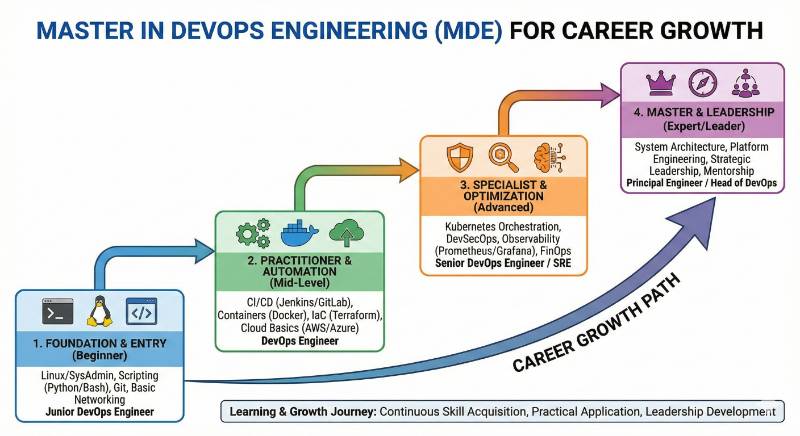
The Master in DevOps Engineering (MDE) is a premier certification program designed to bridge the gap between traditional software development and modern, high-velocity operations. Tailored for both aspiring and experienced engineers, this comprehensive course provides a deep dive into the entire DevOps ecosystem—including CI/CD pipelines, container orchestration with Kubernetes, Infrastructure as Code (IaC), and cloud-native security. By focusing on real-world automation and enterprise-grade architecture, the MDE program empowers professionals to design, manage, and scale complex systems with absolute precision. Whether you are looking to lead a digital transformation or master the latest toolchains, this certification serves as a definitive roadmap to achieving expert-level status in today’s competitive tech landscape.
Provider : DevOpsSchool
Why You Need a Master-Level Understanding
Most people start their DevOps journey by learning a single tool like Docker or Jenkins. While that is a good start, true mastery requires understanding the entire “ecosystem.” A Master in DevOps Engineering doesn’t just fix broken pipelines; they design systems that don’t break in the first place.
When you master this field, you aren’t just an “ops guy” or a “coder.” You become the person who ensures the business can deliver value to customers every single day without delays or security risks.
What is the Master in DevOps Engineering (MDE)?
What it is
The MDE is an advanced certification program that covers the full spectrum of modern software delivery. It moves beyond basic automation and dives into complex topics like container orchestration, infrastructure as code, cloud-native security, and financial optimization. It is designed to create leaders who can manage both the technology and the culture of a modern tech organization.
Who should take it
This program is perfect for:
- Software Engineers who want to understand how their code lives in production.
- Operations Engineers who want to learn how to use software mindsets to manage hardware.
- IT Managers who need to oversee technical teams and make big-picture architectural decisions.
Skills you’ll gain
- Advanced Automation: Designing pipelines that test, build, and deploy code with zero human intervention.
- Cloud Architecture: Learning how to build scalable systems on AWS, Azure, and Google Cloud.
- Orchestration: Mastering Kubernetes to manage hundreds of microservices.
- Infrastructure as Code (IaC): Writing code (like Terraform) to create and destroy entire data centers in minutes.
- Security Integration: Moving security to the beginning of the development process rather than the end.
Real-world projects you should be able to do after it
- End-to-End CI/CD: Build a pipeline that takes a developer’s code, runs security scans, performs load testing, and deploys it to a production Kubernetes cluster.
- Cloud Migration: Move a legacy “monolith” application from a local server to a cloud-native, microservices-based environment.
- Self-Healing Infrastructure: Set up a system that detects when a server is failing and automatically replaces it without the users ever noticing.
Preparation plan (60 days)
- Days 1–15 (The Basics): Master Linux administration, Shell scripting, and Git. You cannot build a house without a foundation; these are the foundation.
- Days 16–30 (Automation & Containers): Learn how to package applications in Docker and automate their delivery using Jenkins or GitHub Actions.
- Days 31–45 (Orchestration & IaC): Spend this time deep-diving into Kubernetes and Terraform. This is where you learn to manage “scale.”
- Days 46–60 (Advanced Topics): Focus on monitoring, logging, and security. Learn how to use Prometheus and Grafana to see what is happening inside your systems.
Common mistakes
- Tool Obsession: Many engineers learn “how” to use a tool but not “why” they are using it. Always focus on the problem you are solving, not just the shiny new tool.
- Ignoring Security: Waiting until the end of a project to check for security flaws is a recipe for disaster.
- Lack of Documentation: Expert engineers write code that is easy to read and document their processes so the team can follow along.
Best next certification after this
Once you have the MDE, you should look into the DevSecOps Master or the SRE Master to specialize even further.
Complete Certification Table
This table summarizes the various tracks available within the Master in DevOps Engineering framework.
| Track | Level | Who it’s for | Prerequisites | Skills Covered | Recommended Order |
| Core MDE | Expert | Engineers & Managers | Basic Linux/Git | Full CI/CD, K8s, Cloud, IaC | 1 |
| DevSecOps | Advanced | Security focused Engineers | DevOps Basics | Vault, Security Scans, Compliance | 2 |
| SRE | Expert | Reliability Engineers | Admin Experience | SLOs, SLIs, Chaos Engineering | 2 |
| AIOps/MLOps | Advanced | Data & Ops Engineers | MDE Basics | AI for Ops, Model Pipelines | 3 |
| DataOps | Advanced | Data Engineers | SQL/MDE Basics | Data Pipelines, Data Quality | 3 |
| FinOps | Advanced | Managers & Leads | Cloud Basics | Cloud Cost Management, ROI | 2 |
Choose Your Path: 6 Specialized Learning Paths
DevOps is a broad field. To be a master, you need to choose a path that fits your career goals.
1. The DevOps Path
This is the standard path. It focuses on the culture of collaboration and the technical tools that make it possible. It is perfect for those who want to be the “glue” that holds the development and operations teams together.
2. The DevSecOps Path
Security is the most critical part of modern IT. In this path, you learn how to build security into the pipeline. You will learn about secret management, vulnerability scanning, and making sure your code is safe from hackers before it ever goes live.
3. The SRE (Site Reliability Engineering) Path
SRE is about using software engineering to solve operations problems. If you love automation, high availability, and making sure systems stay up 99.99% of the time, this is your path. It is heavily focused on monitoring and performance.
4. The AIOps/MLOps Path
Modern systems generate too much data for humans to watch. This path teaches you how to use Artificial Intelligence and Machine Learning to watch your servers for you. It also covers how to deploy and manage ML models in production.
5. The DataOps Path
Data is the new oil, but it’s hard to manage. DataOps focuses on bringing DevOps discipline to data pipelines. You will learn how to automate data flows, ensure data quality, and make data available to the business faster.
6. The FinOps Path
The cloud is expensive. FinOps is the practice of bringing financial accountability to the cloud. You will learn how to track spending, optimize resources, and make sure the company isn’t wasting money on idle servers.
Role → Recommended Certifications Mapping
| If your role is… | You should follow this path… |
| DevOps Engineer | Master in DevOps Engineering (MDE) → DevSecOps specialization. |
| SRE | MDE → Site Reliability Engineering (SRE) Master. |
| Platform Engineer | MDE → Advanced Kubernetes & Infrastructure as Code. |
| Cloud Engineer | MDE → Multi-Cloud mastery (AWS/Azure/GCP). |
| Security Engineer | MDE → DevSecOps Master Professional. |
| Data Engineer | MDE → DataOps Specialist. |
| FinOps Practitioner | MDE → FinOps Master. |
| Engineering Manager | Master in DevOps Engineering (MDE) Leadership Track. |
Top Institutions for MDE Training
Choosing the right place to learn is vital. Here are the top institutions that provide high-quality training and certification for the MDE program:
- DevOpsSchool DevOpsSchool is a global leader in DevOps education. They provide deep, hands-on training that goes far beyond theory. Their instructors are industry veterans who teach you how to solve real-world production problems using the latest toolsets.
- CotocusCotocus is known for its intensive, project-based learning. They focus on “learning by doing,” making sure that every student builds a portfolio of real work. This institution is excellent for engineers who want to gain practical experience quickly.
- ScmgalaxyScmgalaxy is one of the largest communities for DevOps and Build/Release engineering. They offer a wealth of resources, tutorials, and certification paths that are highly respected in the Indian and global tech markets.
- BestDevOpsBestDevOps specializes in tailored training for both individuals and corporate teams. They focus on the most in-demand tools and help professionals bridge the gap between their current skills and expert-level mastery.
- DevSecOpsSchoolAs the name suggests, this school is the primary destination for security-focused DevOps. They provide deep dives into automated security testing, compliance as code, and securing containerized environments.
- SreSchoolSreSchool focuses exclusively on the principles of Site Reliability Engineering. They teach the Google-style approach to managing large-scale systems, focusing on reliability, scalability, and performance.
- AIOpsSchoolThis institution is at the cutting edge of the industry. They teach you how to integrate AI and Machine Learning into your operations, preparing you for the future of “intelligent” infrastructure.
- DataOpsSchoolDataOpsSchool is dedicated to the intersection of data science and DevOps. They help data engineers and architects automate their data workflows to ensure speed and accuracy.
- FinOpsSchoolFinOpsSchool focuses on the financial side of the cloud. They teach engineers and managers how to optimize cloud costs and ensure that IT spending aligns with business goals.
General FAQs
1. How difficult is the MDE certification?
The MDE is an expert-level program, so it is meant to be challenging. However, because the curriculum starts from the foundations, anyone with a strong interest and commitment can pass it. It is less about “difficulty” and more about “dedication.”
2. How much time do I need to commit daily?
If you want to finish in 60 days, you should spend about 2 to 3 hours a day. Professionals with experience might only need 1 hour a day to review the advanced topics.
3. What are the prerequisites for this course?
You need a basic understanding of how computers and networks work. Knowing a little bit of coding (like Python) or being comfortable with the Linux command line will give you a big head start.
4. What is the best sequence to learn the topics?
Always start with Linux and Git. Once you have the foundation, move to CI/CD (Jenkins), then Containers (Docker), and finally Orchestration (Kubernetes). Ending with Monitoring and Security is the most logical path.
5. Is the MDE certification worth the investment?
Yes. MDE-certified professionals often see salary increases of 20% to 30%. In India and globally, the demand for “Full-Stack” DevOps Architects is at an all-time high.
6. What are the main career outcomes?
The most common roles are DevOps Architect, Senior Site Reliability Engineer (SRE), and Platform Lead. You will also be qualified for high-level Cloud Engineering positions.
7. Can I switch from a non-IT background to MDE?
It is possible, but you will need more time. We recommend starting with a basic Linux and Networking course before starting the MDE program.
8. Does this certification expire?
Most professional certifications suggest a refresh every 2-3 years. However, at DevOpsSchool, the skills you learn are valid for life, and you get lifetime access to the community.
9. Is there any job assistance provided?
Yes, institutions like DevOpsSchool and Cotocus provide resume building, mock interviews, and access to a network of hiring partners.
10. How is the exam conducted?
The exam is usually an online-proctored test. It consists of multiple-choice questions and sometimes lab-based scenarios where you must solve a technical problem.
11. Do I need a powerful computer for the labs?
No. Most labs are performed in the cloud or on virtual machines. A standard laptop with 8GB of RAM and a stable internet connection is usually enough.
12. What makes this different from a basic DevOps course?
A basic course teaches you how to use tools. MDE teaches you how to design entire systems and lead the transformation of a company’s technology culture.
Master in DevOps Engineering (MDE) Specific FAQs
1. What exactly is the “Master” part of the MDE?
The “Master” level means you are not just an engineer who follows instructions. You are an architect who can design complex systems from scratch, ensuring they are secure, fast, and cost-effective.
2. Does the MDE cover both AWS and Azure?
Yes. The MDE program is designed to be cloud-neutral, meaning you learn the principles that apply to AWS, Azure, and Google Cloud equally.
3. Is there a capstone project required for MDE?
Yes. To graduate, you must complete a real-world project where you build a fully automated, secure infrastructure for a complex application.
4. How does MDE integrate DevSecOps and SRE?
Instead of treating them as separate courses, MDE teaches them as part of the same lifecycle. You learn to build (DevOps), secure (DevSecOps), and maintain (SRE) systems in one workflow.
5. Are the labs provided by DevOpsSchool?
Yes, the training includes access to a dedicated lab environment where you can practice on real tools and cloud environments without any extra cost.
6. Who are the instructors for the MDE program?
Instructors are industry experts who have years of experience working in global tech companies. They bring real “on-the-job” scenarios to the classroom.
7. Can I complete the MDE certification online?
Yes. There are flexible options for live online classes, self-paced learning, and even corporate classroom training.
8. Where can I find the official registration and more details?
You can find everything you need, including the full syllabus and pricing , at the MDE certification page .
Conclusion
Mastering DevOps is about more than just knowing how to run a container or write a script; it is about developing the architectural mindset needed to lead complex, global digital transformations. The Master in DevOps Engineering (MDE) provides the perfect bridge to this level of expertise, blending high-level strategy with hands-on technical depth across SRE, DevSecOps, and Cloud operations. By committing to this path, you are not just upgrading your skills, but positioning yourself as a vital leader in the future of software engineering. Whether you are aiming to scale global infrastructure or optimize cloud costs, this certification is the definitive key to unlocking the next stage of your professional journey.