Introduction
Are you dreaming of a brighter future, a flourishing career, and a high quality of life in Canada? Moving to a new country is a life-changing decision that brings immense opportunities for growth, safety, and success. However, the migration journey begins with a crucial first step: understanding your eligibility. Canada uses an objective, merit-based points system to select the most qualified candidates from around the world. To assess your chances, you need to use a reliable tool known as the Canada PR Points Calculator. This tool evaluates your profile and provides a clear picture of where you stand in the immigration pool. Before you invest your time and hard-earned money into application fees, it is essential to check your eligibility. Knowing your score beforehand helps you avoid costly mistakes and allows you to plan your profile improvement strategies effectively. This comprehensive guide explains everything you need to know about the Express Entry system, the Comprehensive Ranking System (CRS), and how to maximize your points for a successful Canadian permanent residency application. For more details on managing your migration profile and calculating your points accurately, you can visit the Desinri Canada PR Points Calculator.
What is Canada PR Points Calculator
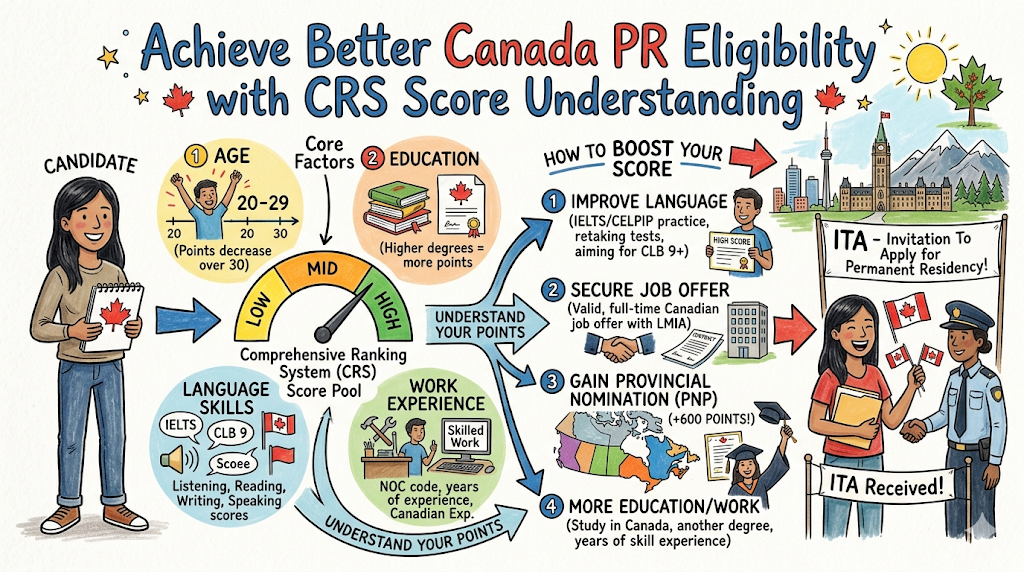
The Canada PR Points Calculator is an online processing tool designed to estimate a candidate’s selection probability for Canadian Permanent Residency (PR). By evaluating core factors such as age, education, language ability, and professional history, it translates personal demographics into a mathematical score.
Why Canada uses a points-based immigration system
Canada uses a merit-based selection system to eliminate bias and meet its economic needs. Rather than relying on a slow, backlogged, first-come, first-served pipeline, the points system identifies highly skilled applicants who can quickly integrate into the local workforce and pay taxes to sustain public infrastructure.
What is Express Entry system
Express Entry is Canada’s primary electronic application management platform. Launched to automate skilled worker migration, it groups eligible candidates into a single national pool, ranks them dynamically, and processes completed permanent residency visas within a rapid six-month window.
Importance of checking eligibility before applying
Navigating immigration requires substantial time and money spent on language testing, credential evaluations, and regional translation fees. Checking your preliminary scores prevents you from entering the pool with an uncompetitive profile and helps you pinpoint exactly where your application needs improvement.
How this guide will help readers
This guide serves as a practical manual for your application journey. It deconstructs complex regulatory frameworks, breaks down hidden bonus point combinations, and maps out a clear path to optimize your profile for a successful permanent residency invitation.
What Is Canada PR Points Calculator?
Definition
The Canada PR Points Calculator is a specialized digital profiling system that mirrors the official point distribution algorithms of Immigration, Refugees and Citizenship Canada (IRCC). It converts an applicant’s human capital data into a standardized numeric ranking.
Purpose
The primary purpose of this tool is to provide applicants with immediate data clarity. Instead of guessing their chances, candidates can instantly see whether their profiles meet current competitive cut-offs, helping them make informed decisions about their immigration strategy.
How it works
The calculator operates using a multi-layered input form. Once you enter your age, education levels, language exam sub-scores, and job history details, the system processes these variables through two distinct grading frameworks to produce an immediate point total.
Why Canada uses CRS system
The Comprehensive Ranking System (CRS) acts as an automated filter for the labor market. By ranking candidates competitively, Canada ensures that top-tier international talent—such as highly trained tech professionals and essential healthcare workers—is fast-tracked over lower-scoring profiles.
Difference between eligibility score and CRS invitation score
Understanding the difference between these two scoring systems is vital for a successful application strategy:
- The Six Selection Factors (The 67-Point Grid): This is a preliminary filter for the Federal Skilled Worker Program. You must score at least 67 out of 100 points based on factors like education, language skills, and age just to enter the Express Entry pool.
- The Comprehensive Ranking System (The CRS Score): Once you pass that initial gate and enter the competitive pool, you are re-graded out of 1,200 points. This ranking determines whether you receive an actual invitation to apply for residency during periodic IRCC draws.
Example Scenario: A candidate can easily clear the initial 67-point grid thanks to a Master’s degree and solid work experience. However, if their IELTS scores are low, their pool ranking might stall at a CRS score of 390. Since recent invitation cut-offs hover around 480, they will remain in the pool without receiving an invitation until they take steps to improve their language scores.
How Canada PR Points System Works
Age Points
Age points are heavily front-loaded to reward younger applicants who can contribute to Canada’s tax base over a long career. Points reach their peak between the ages of 20 and 29 and decrease steadily each year after your 30th birthday.
| Age Range | Points (With a Spouse) | Points (Without a Spouse) |
| 18 to 20 years of age | 90 | 95 |
| 20 to 29 years of age | 100 | 110 |
| 30 years of age | 95 | 105 |
| 35 years of age | 70 | 75 |
| 40 years of age | 45 | 50 |
| 45 years of age or more | 0 | 0 |
Education Points
To claim points for education completed outside of Canada, you must obtain an Educational Credential Assessment (ECA) from an approved organization like WES. Higher credentials yield significantly more points.
- Ph.D. / Doctoral level: 140 points (with spouse); 150 points (without spouse)
- Master’s degree: 125 points (with spouse); 135 points (without spouse)
- Two or more post-secondary credentials (one being at least 3 years long): 119 points (with spouse); 128 points (without spouse)
- Bachelor’s degree (3 or more years): 112 points (with spouse); 120 points (without spouse)
Language Proficiency (IELTS/CELPIP/PTE)
Language skills are mapped directly to Canadian Language Benchmark (CLB) levels. Reaching CLB 9 across all four language abilities (Listening 8.0, Reading 7.0, Writing 7.0, Speaking 7.0 in IELTS General) is a key milestone, as it unlocks substantial bonus points within the skill transferability section.
- CLB 10 and Above: 32 points per section (with spouse); 34 points per section (without spouse)
- CLB 9: 29 points per section (with spouse); 31 points per section (without spouse)
- CLB 8: 22 points per section (with spouse); 23 points per section (without spouse)
Work Experience
Your foreign professional history works hand-in-hand with your language scores to boost your profile through skill transferability combinations. The system evaluates experience based on National Occupational Classification (NOC) codes.
- 1 Year of Continuous Foreign Experience: Establishes your basic program eligibility.
- 3 or More Years of Foreign Experience: Maxes out your points within the skill transferability combination matrix.
Canadian Experience
Acquiring skilled, legal work experience within Canada offers a powerful boost to your profile. This local experience demonstrates that you can successfully integrate into the Canadian job market.
- 1 Year of Inside-Canada Experience: 35 points (with spouse); 40 points (without spouse)
- 2 Years of Inside-Canada Experience: 46 points (with spouse); 53 points (without spouse)
- 5 or More Years of Inside-Canada Experience: 70 points (with spouse); 80 points (without spouse)
Spouse Points
When you apply with a spouse or common-law partner, 40 core points from the primary applicant’s profile are reallocated to the spouse. Your partner can then earn these points back for the couple by demonstrating their own language skills, education, and Canadian work experience.
- Spouse Language Proficiency: Up to 20 points (5 points per section for achieving CLB 9 or higher).
- Spouse Education Level: Up to 10 points (awarded for a verified Bachelor’s or Master’s degree).
- Spouse Canadian Work History: Up to 10 points (earned by completing a year of skilled work within Canada).
Job Offers
A job offer must be full-time, non-seasonal, and backed by a positive Labor Market Impact Assessment (LMIA)—unless it meets specific exemption criteria—to count toward your points total.
- NOC TEER 0 Major Group 00: Adds 200 points to your profile for senior executive positions.
- Other Eligible NOC TEER 0, 1, 2, or 3 Roles: Adds 50 points for standard engineering, IT, or administrative positions.
Provincial Nomination
Receiving a nomination from a Canadian province provides the single largest point boost available in the Express Entry system.
- Enhanced Nomination Certificate: Adds 600 points directly to your profile, guaranteeing that you will receive an Invitation to Apply (ITA) in the very next draw.
Canada Express Entry System Explained
Federal Skilled Worker Program (FSWP)
The Federal Skilled Worker Program is designed for skilled professionals living outside of Canada. To qualify, you must show at least one year of continuous experience in a TEER 0, 1, 2, or 3 occupation, pass the 67-point preliminary assessment, and provide proof of settlement funds to support your move.
Canadian Experience Class (CEC)
The Canadian Experience Class is tailored for individuals who already have local roots in Canada, such as temporary foreign workers and international graduates. It requires at least one year of full-time, skilled Canadian work experience within the last three years, has flexible language requirements based on your job level, and does not require proof of settlement funds.
Federal Skilled Trades Program (FSTP)
The Federal Skilled Trades Program focuses on workers in high-demand technical and industrial trades, including electricians, industrial mechanics, and heavy equipment operators. Applicants must have at least two years of full-time experience in their trade, a valid one-year job offer in Canada, or a provincial certificate of qualification.
Provincial Nominee Program (PNP)
The Provincial Nominee Program allows individual provinces to select immigrants who meet local economic needs. Many of these pathways link directly to the Express Entry system through “enhanced streams,” allowing provinces to browse the pool and nominate candidates who match their regional labor shortages.
How Express Entry Pool Works
The Express Entry system operates as an ongoing, automated process:
CRS Score Breakdown
Detailed CRS Score Table
The points in the Comprehensive Ranking System are distributed across four main sections, adding up to a maximum score of 1,200 points.
| CRS Core Components | Max Points (With Spouse) | Max Points (Without Spouse) |
| Section A: Core Human Capital Factors | 460 | 500 |
| Section B: Spouse / Partner Factors | 40 | 0 |
| Section C: Skill Transferability Combinations | 100 | 100 |
| Section D: Additional Factor Endorsements | 600 | 600 |
| Maximum Comprehensive System Total | 1,200 | 1,200 |
Maximum Possible Score
The absolute maximum score a candidate can achieve is 1,200 points. While it is rare for someone to reach this perfect score, achieving a score between 480 and 540 points generally keeps you highly competitive for regular all-program draws.
Core Human Capital Factors
This section looks at your foundational qualifications, offering up to 500 points for single applicants. It assesses your age, language test scores, education history, and any Canadian work experience to determine your basic potential for economic success in Canada.
Skill Transferability Factors
This section awards up to 100 points by looking at how your skills combine. For example, the system awards extra points when strong language skills are paired with a post-secondary degree, or when high language scores are combined with years of international work experience.
Additional Points
This section provides a maximum of 600 points for specific achievements that support Canadian economic and community goals. It rewards candidates who have secured provincial nominations, completed studies within Canada, have a valid job offer, speak fluent French, or have a sibling residing in the country.
Step-by-Step Example Calculation
Let’s look at a step-by-step example for a single applicant to see exactly how these points accumulate.
29-year-old software engineer
- Profile: Single, 29 years old, holds a Master’s degree, has 3 years of foreign work experience, and achieved CLB 9 scores on their language test.
- Age Points: Being 29 years old earns the maximum possible allocation of 110 points.
Master’s degree
- Education Assessment: A verified international Master’s degree awards 135 points under the core human capital section.
IELTS CLB 9
- Language Score Breakdown: Reaching CLB 9 across all four sections yields 31 points per ability, contributing a total of 124 points ($31 \times 4$) to the profile.
3 years experience
- Work History Points: While foreign experience does not earn direct points under Section A, it works together with language skills to unlock points in the skill transferability section:
- Master’s Degree + CLB 9 Language Skills = 50 points
- 3 Years Foreign Work Experience + CLB 9 Language Skills = 50 points
Total Estimated CRS Points Calculation
By combining the points from each section, we can determine the candidate’s final ranking:
$$\text{Core Age Points (110)} + \text{Core Education (135)} + \text{Core Language (124)} + \text{Skill Transferability (100)} = 469 \text{ Points}$$
This total score places the candidate in a strong, competitive position for category-specific draws or provincial nomination opportunities.
How to Improve CRS Score
Improve IELTS Score
Retaking your language exam is one of the most effective ways to increase your score. For example, raising your scores from a CLB 8 to a CLB 9 can add over 40 points to your profile by increasing both your baseline language points and your skill transferability combinations.
Learn French
Canada places a high value on bilingual candidates. Taking an approved French test like the TEF and achieving a CLB 7 or higher can add up to 50 additional points to your profile, while also making you eligible for targeted French-language category draws.
Gain More Experience
If you have less than three years of foreign work experience, continuing to work full-time in your field will help you earn more points. Alternatively, obtaining a temporary work permit to gain even one year of local experience in Canada will significantly boost your score.
Get Provincial Nomination
Securing a provincial nomination is the most powerful way to improve your profile. A nomination certificate adds 600 points to your score, guaranteeing an invitation to apply for permanent residency in the next Express Entry draw.
Secure Canadian Job Offer
Landing a valid full-time job offer that is supported by an LMIA adds 50 to 200 points to your profile, helping you stand out and clear competitive cut-off scores.
Higher Education
Completing an additional educational program can give your score a steady boost. For instance, earning a one-year post-graduate diploma on top of a Bachelor’s degree unlocks the “Two or more credentials” category, increasing your points across multiple sections.
Provincial Nominee Programs (PNPs)
What are PNPs
Provincial Nominee Programs are regional immigration pathways managed by individual Canadian provinces and territories. They allow local governments to select and nominate economic immigrants who have the specific skills needed to support local industries.
Why they matter
PNPs offer an excellent alternative route for candidates whose standalone CRS scores are below the cut-offs for general federal draws. They allow skilled applicants to fast-track their permanent residency by matching their experience with regional labor demands.
How they add 600 CRS points
When a province selects your profile from the Express Entry pool, they issue an enhanced nomination certificate through the online portal. Accepting this nomination automatically adds 600 points to your profile, ensuring you receive an invitation in the next draw.
Ontario PNP
The Ontario Immigrant Nominee Program (OINP) uses its Human Capital Priorities stream to regularly search the Express Entry pool for skilled professionals, with a strong focus on tech specialists, software developers, and financial managers.
Alberta PNP
The Alberta Advantage Immigration Program (AAIP) selects candidates directly from the pool who work in occupations that support the province’s economic growth or who have a job offer from an employer in Alberta.
Saskatchewan PNP
The Saskatchewan Immigrant Nominee Program (SINP) manages streams that target international skilled workers whose experience matches the province’s in-demand occupations list, particularly in engineering, agriculture, and technical trades.
British Columbia PNP
The British Columbia Provincial Nominee Program (BCPNP) features targeted tech and healthcare draws, providing a streamlined pathway to residency for professionals who hold a long-term job offer in the province.
Documents Required for Canada PR
Passport
Must be valid and clear of any travel restrictions throughout the entire application and verification process.
ECA report
An official evaluation report from an approved body like WES that confirms your international degree is equal to a Canadian education standard.
IELTS/CELPIP results
Your official language test certificate, which must be less than two years old at both the time of profile submission and final application processing.
Work experience proof
Detailed reference letters from previous employers on official letterhead, clearly stating your job titles, employment dates, exact duties, hours worked per week, and salary.
Educational documents
Clear copies of your university degrees, diplomas, certificates, and official transcripts to back up your ECA report.
Proof of funds
Official bank letters and statements demonstrating that you have the required unencumbered, liquid settlement funds to support your family when you arrive.
Police clearance
Official certificates showing a clean record from every country where you have lived for six consecutive months or more since turning 18.
Processing Time & PR Process
Express Entry timeline
The general process—from creating your initial profile to receiving an invitation—depends entirely on your CRS score. Once you receive an invitation and submit your complete application, IRCC aims to process the majority of visas within six months.
ITA process
When your score meets or exceeds the cut-off in an Express Entry draw, you receive an official Invitation to Apply (ITA) in your portal. This gives you a strict 60-day window to upload all required documents and pay your application fees.
Medical examination
Applicants must undergo a standard immigration medical exam performed by an IRCC-approved panel physician to confirm they meet health requirements for residency.
Biometrics
After submitting your application, you will receive an official instruction letter to visit a local visa application center to provide your fingerprints and photos.
COPR process
Once your application is approved, IRCC issues your Confirmation of Permanent Residence (COPR) along with an entry visa sticker in your passport, allowing you to travel to Canada and officially complete your landing process.
Common Mistakes to Avoid
Wrong CRS calculations
Claiming points for work experience or language scores before you have the actual certificates can lead to your application being rejected for misrepresentation if your points drop after receiving an invitation.
Expired IELTS scores
Language test results are only valid for two years. If your scores expire while your profile is in the pool or during application processing, your profile automatically becomes invalid.
Incorrect NOC code selection
It is essential to base your NOC code selection on your actual daily job duties rather than just your job title, as mismatched descriptions can lead to an immediate rejection.
Incomplete documents
Uploading unreadable scans, leaving out pages of a document, or omitting mandatory police certificates will cause your application to be returned as incomplete.
Misunderstanding PNP process
Failing to track provincial invitations or missing regional deadlines can lead to your nomination being canceled, requiring you to start the process over again.
Real-Life Case Studies
Case Study 1: Young IT professional applying through Express Entry
- Initial Score: 412 points (Age 27, Bachelor’s degree, 3 years experience, IELTS CLB 8).
- Weaknesses: Their initial score was too low to clear general federal draws, which were averaging around 475 points.
- Improvement Strategy: The applicant studied intensively and retook the IELTS exam, raising their scores to a CLB 9 across all sections.
- Final Result: This language improvement added 8 core points and unlocked 40 bonus points in the skill transferability section, bringing their total score to 460 points and allowing them to secure an invitation during a targeted STEM draw.
Case Study 2: Married couple improving CRS score using spouse points
- Initial Score: 428 points (Primary applicant had a Master’s degree and a CLB 9, but did not include any information for their spouse).
- Weaknesses: Including a spouse without their credentials lowered the primary applicant’s core points, dropping their score below competitive levels.
- Improvement Strategy: The spouse completed an ECA for their Bachelor’s degree and took the language exam, achieving a CLB 8.
- Final Result: The spouse’s education added 8 points and their language scores contributed another 12 points, raising the couple’s total score to 448 points and helping them secure an invitation.
Case Study 3: Healthcare worker getting PR through PNP
- Initial Score: 385 points (Age 36, Post-graduate diploma, 5 years foreign experience, IELTS CLB 7).
- Weaknesses: Points had decreased due to age, and their language scores were below the CLB 9 threshold.
- Improvement Strategy: The applicant submitted an Expression of Interest to Nova Scotia’s Labor Market Priorities stream, which specifically targets healthcare workers.
- Final Result: Nova Scotia selected their profile and issued a provincial nomination, adding 600 points to their profile for a final score of 985 points, ensuring an immediate invitation.
FAQs
What is a good CRS score?
A good CRS score depends on current draw trends and your occupation. Generally, a score above 470 is competitive for regular draws, while lower scores can be successful in targeted category draws like STEM, healthcare, or trades.
How many points are needed for Canada PR?
To enter the Express Entry pool under the Federal Skilled Worker Program, you must first score at least 67 points on the initial eligibility grid. Once in the pool, there is no fixed passing score; you compete based on the CRS cut-off scores set during regular IRCC draws.
Can I apply without job offer?
Yes, you can absolutely apply and be successful without a job offer. The Express Entry system focuses primarily on your human capital traits—like your age, education, and language skills—and the majority of applicants receive an invitation without a Canadian job offer.
Does age affect CRS score?
Yes, age has a major impact on your points. You receive the maximum number of age points between the ages of 20 and 29. After you turn 30, your points drop gradually each year, and you receive 0 age points once you reach 45.
Is IELTS mandatory?
Yes, proving your language skills is a mandatory part of the application. You must take an approved language test like IELTS or CELPIP for English, or TEF/TCF for French, to enter the Express Entry pool and claim points.
Can spouse increase CRS score?
Yes, a spouse can help increase your overall score. When applying together, your spouse can earn up to 40 points for the profile by providing their own educational credential assessments and language test results.
Which province is easiest for PR?
The best province depends on your specific career background. Ontario and British Columbia are ideal for technology and IT professionals, while Alberta, Saskatchewan, and Nova Scotia frequently target healthcare workers and skilled tradespersons.
How long is an ECA valid?
An Educational Credential Assessment (ECA) report is valid for five years from the date it is issued by the evaluation organization.
Can I update my profile after entering the pool?
Yes, your Express Entry profile is completely dynamic. You can log in and update your information at any time to add new language scores, higher educational degrees, or changes in your work experience.
What happens if my profile expires?
An Express Entry profile stays active in the pool for 12 months. If you do not receive an invitation within that year, your profile will expire, and you can create a new one to re-enter the pool.
What is the difference between IELTS Academic and General?
For Canada PR immigration pathways, you must take the IELTS General Training exam. The IELTS Academic exam is used for university admissions and is not accepted by IRCC for Express Entry.
How much proof of funds is required?
The required settlement funds change annually based on your family size. For a single applicant, it is usually around $14,000 to $15,000 CAD. Applicants qualifying under the Canadian Experience Class or those with a valid job offer are exempt from this requirement.
Conclusion
Successfully navigating your path to permanent residency requires clear planning, accurate calculations, and a focus on improving your profile. Your CRS score is not a fixed number; it can be actively managed and improved. By dedicating time to raising your language scores, pursuing further education, or exploring regional provincial nominee streams, you can steadily increase your ranking in the pool. Using a reliable tool like the Canada PR Points Calculator helps you see exactly where you stand and guides your next steps. While the immigration journey requires patience and attention to detail, the long-term rewards—a stable career, an excellent quality of life, and a bright future for your family—make the effort well worth it.