Introduction
The dawn of modern quantum computing has brought us to the edge of a major technological shift. By harnessing the strange rules of quantum mechanics, these advanced systems can process complex calculations at speeds that leave even the most powerful classical supercomputers far behind. From modeling molecular structures to optimizing global logistics pipelines, the potential applications of this technology are vast. To build a reliable quantum ecosystem, we must first understand how these microscopic disruptions work, how they impact information storage, and how we can protect qubits from outside interference. For students, researchers, and engineers looking to master these foundational concepts, educational platforms like QuantumOpsSchool provide the comprehensive training and structured learning paths needed to navigate the complexities of quantum infrastructure and error mitigation.
Key Takeaways
- System Fragility: Qubits are highly sensitive to their surroundings, meaning even minor environmental interactions can disrupt information.
- Information Loss: Quantum decoherence marks the point where a system loses its unique quantum properties and shifts back to classical behavior.
- Error Vectors: Quantum noise causes physical qubit errors, primarily through unwanted bit-flips and phase-flips.
- The Stability Metric: Coherence time defines the brief window an engineer has to run quantum gates before the data degrades.
- The Path Forward: Developing robust quantum error correction is essential for building scalable, fault-tolerant quantum computers.
What Is Quantum Noise?
To understand quantum noise, it helps to look at how we define noise in everyday classical systems. In standard electronics or telecommunications, noise refers to any unwanted random disturbance that corrupts a signal. For example, the static hiss on an untuned radio or the grain in a low-light photograph are forms of classical noise. In these scenarios, the underlying signal remains intact, but it becomes obscured by random background interference.
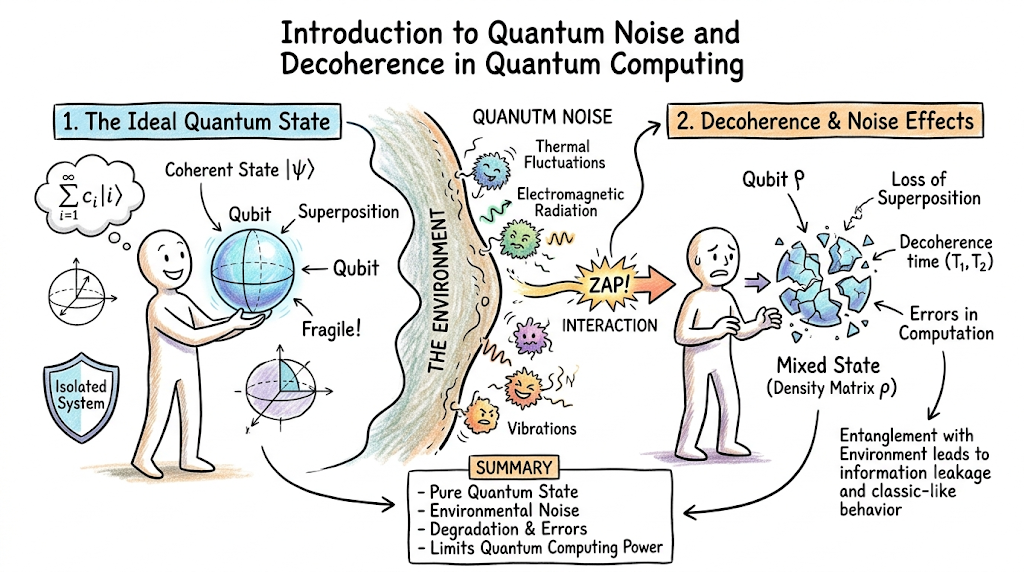
Quantum noise operates on a much more fundamental level. In a quantum processor, noise refers to any unintended interaction between a qubit and its surrounding environment that alters the qubit’s state. Because qubits exist in highly delicate states, these unwanted interactions do not just obscure the data—they physically alter the underlying quantum information itself.
Classical Noise:
[Signal] + [External Static] ───> [Obscured but Identical Signal]

Quantum Noise:
[Qubit State] ───> [Environmental Interaction] ───> [Altered/Corrupted Qubit State]
This noise comes from a variety of subtle sources within the physical hardware layer. It can manifest as tiny fluctuations in the magnetic fields surrounding the processor, minor variations in the control lasers or microwave pulses used to manipulate qubits, or random thermal energy leaking into the system. Even the materials used to construct the quantum chip itself can host microscopic defects that generate localized noise.
When quantum noise strikes a qubit, it degrades the integrity of the computation. A qubit holding a specific value may experience a sudden drift, causing it to lose its precise alignment. This vulnerability represents one of the primary quantum computing limitations, as random environmental noise continuously introduces faults into running algorithms.
What Is Quantum Decoherence?
Quantum decoherence is the process by which a quantum system loses its unique quantum properties, such as superposition and entanglement, due to interactions with the external environment. To understand this concept, think of a spinning coin. While the coin is spinning smoothly on a table, it exists in a state analogous to a superposition—it is neither strictly heads nor tails, but a dynamic combination of both.
However, if a gust of wind hits the coin, or if it rubs against a rough patch on the table, it loses its momentum, wobbles, and falls flat. Once it falls, it is locked into a single, classical state: either heads or tails. The unique, dynamic state of the spin has vanished.
In a quantum computer, decoherence represents the moment the spinning coin falls flat. When a qubit interacts with its environment, it exchanges information with the outside world. This interaction forces the qubit to lose its quantum characteristics and transition into a standard classical state.
[Pure Quantum Superposition]
             │
             ▼ (Interaction with External Environment)
[Information Leaks into the Outside World]
             │
             ▼
[Decoherence Occurs: Transition to Standard Classical State]
This loss of quantum information means that the system can no longer sustain the multi-layered computations that make quantum algorithms so powerful. Once a system undergoes decoherence, it behaves exactly like a slower, traditional classical computer, rendering the quantum architecture ineffective.
Preventing this transition from quantum to classical behavior is critical for the future of advanced computing. If a quantum computer cannot maintain its quantum states long enough to complete a set of logical operations, it cannot deliver correct computational results.
Difference Between Noise and Decoherence
While the terms are often used interchangeably in casual conversation, noise and decoherence represent distinct physical concepts within quantum information science. Understanding this boundary is essential for diagnosing hardware faults.
+───────────────────────────────────────────────────+───────────────────────────────────────────────────+
|                   Quantum Noise                   |                Quantum Decoherence                |
+───────────────────────────────────────────────────+───────────────────────────────────────────────────+
| Refers to the environmental disturbances and      | Refers to the actual loss of quantum properties   |
| imperfections that actively alter a qubit state.  | as a system transitions to classical behavior.    |
+───────────────────────────────────────────────────+───────────────────────────────────────────────────+
| Acts as the cause or mechanism of disruption      | Acts as the systemic consequence or final result  |
| within the operational system.                    | of prolonged environmental interaction.           |
+───────────────────────────────────────────────────+───────────────────────────────────────────────────+
| Can cause specific, identifiable errors like      | Leads to the total randomization of phase and    |
| bit-flips or phase-shifts.                        | the complete erasure of superposition states.     |
+───────────────────────────────────────────────────+───────────────────────────────────────────────────+
Think of a clean window looking out onto a landscape. Quantum noise is like a heavy dust storm blowing against the glass. The individual grains of sand hitting the window represent localized noise events.
Quantum decoherence, on the other hand, is the resulting loss of visibility through the window as the dirt accumulates. The noise is the active disturbance vector; decoherence is the state of degradation that occurs when the system can no longer resist that disturbance. Noise drives the system toward decoherence, stripping away its quantum compliance over time.
Causes of Quantum Noise and Decoherence
To control these disruptions, we must look at the specific physical vectors that cause noise and decoherence within quantum hardware. Qubits are sensitive to multiple environmental factors.
Environmental Interaction
A quantum processor cannot exist in a complete vacuum isolated from the universe. Every qubit remains surrounded by a physical matrix of control wiring, containment shielding, and neighboring qubits. Any unintended contact between the qubit and these surrounding elements allows information to leak out, disrupting the delicate quantum state.
Thermal Fluctuations
Heat is the enemy of quantum stability. Thermal energy causes atoms to vibrate randomly. In many types of quantum computers, such as superconducting systems, these atomic vibrations shake the qubits, causing them to drop out of their target energy states. This requires keeping quantum processors chilled to temperatures colder than deep space.
Electromagnetic Interference
Qubits are often manipulated using precise microwave pulses or laser beams. However, the surrounding environment is full of stray electromagnetic waves from Wi-Fi signals, cellular networks, and power lines. If even a tiny amount of this ambient radiation breaches the processor’s protective shielding, it can distort control signals and introduce noise.
Material Imperfections
The physical chips that house qubits are rarely perfect on an atomic level. Variations in the silicon substrate, trace impurities in the metal pathways, or microscopic defects at material interfaces can create erratic local magnetic fields. These internal structural flaws act as permanent, localized sources of noise that disrupt nearby qubits.
Measurement Disturbances
Reading the final result of a quantum calculation requires interacting directly with the qubits. However, the process of measuring one qubit can easily cause energy to bleed into neighboring qubits. This crosstalk can unintentionally alter the states of nearby qubits before their parts of the calculation are complete, leading to readout errors.
How Quantum Noise Affects Qubits
When quantum noise interacts with a processor, it introduces specific types of qubit errors that corrupt active calculations. These errors generally fall into two primary categories.
Bit-Flip Errors
A bit-flip error is the quantum equivalent of a classical bit flipping from a 0 to a 1, or vice versa. In a quantum system, this means the physical qubit unexpectedly absorbs or releases a packet of energy, causing it to flip between its ground state and its excited state. This directly corrupts the underlying data profile.
Bit-Flip Error:      |0⟩ ───────────────( Noise Event )───────────────> |1⟩
Phase-Flip Error:    (|0⟩ + |1⟩) ───────( Noise Event )───────────────> (|0⟩ - |1⟩)
Phase-Flip Errors
Phase-flip errors are unique to quantum computing. They occur when a qubit retains its base energy level but its relative phase relationship shifts. For example, a qubit in a balanced superposition state might have its phase inverted, changing its mathematical sign from positive to negative. Because quantum algorithms rely on precise phase alignments to perform calculations, a phase-flip error can completely invalidate the final output.
Superposition Disruption
Maintaining a qubit in a superposition state requires keeping it perfectly isolated from outside observations. When noise forces an unintended interaction, it acts like a premature measurement, disrupting the superposition and forcing the qubit to resolve into a standard 0 or 1 state too early.
Entanglement Degradation
Entanglement links multiple qubits together so that the state of one instantly correlates with the state of another. Quantum noise disrupts this delicate link, breaking the connection between entangled pairs. Once entanglement degrades, the quantum processor loses its multi-layered processing efficiency, causing the algorithm to stall.
Decoherence in Quantum Systems
When a quantum system is exposed to noise over time, its overall coherence begins to break down. This progressive decay highlights the unique challenges of managing quantum hardware.
As a quantum computer runs an algorithm, information continuously leaks into the surrounding environment. This process can be viewed as a gradual decay of quantum properties rather than a sudden, catastrophic break. The longer an algorithm runs, the more classical the system becomes, steadily erasing the unique quantum data required for the calculation.
System Coherence Level
  ▲
1.0 ┼█████████
    │         ▀▀▀███████▄▄▄
0.5 ┼                      ▀▀▀▀███████▄▄▄
    │                                    ▀▀▀▀████████
0.0 ┼─────────────────────────────────────────────────► Time
    ▲                                    ▲
    Start of Algorithm                   Coherence Time Limit (Total Loss)
Because of this gradual breakdown, coherence time is one of the most critical metrics in quantum engineering. Coherence time is the operational window during which a qubit can reliably hold quantum information before decoherence randomizes its state. This time window varies based on the hardware architecture used:
- Superconducting Qubits: Offer fast gate processing speeds but generally have shorter coherence times, often measured in microseconds.
- Trapped Ion Qubits: Provide significantly longer coherence times, sometimes lasting for seconds, but feature slower operational gate speeds.
This reality creates a challenging trade-off for quantum developers. An engineer must design algorithms that can complete all necessary computational steps well before the hardware’s coherence time limit runs out. If the calculation takes longer than this window, decoherence will erase the data, leaving behind only random classical noise.
Mathematical Intuition (Simple Explanation)
You do not need an advanced degree in quantum mechanics to understand the basic math behind noise and decoherence. At its core, the concept is about preserving delicate wave alignments.
In a quantum computer, a qubit’s state is described by a wave function. This wave function uses probability amplitudes to calculate the likelihood of a qubit resolving into a 0 or a 1 when measured. As long as these amplitudes remain stable, the quantum computer can perform clean calculations.
Perfect Quantum Wave alignment:
   /\    /\    /\    /\    (Constructive Interference - Clean Calculation)
  /  \  /  \  /  \  /  \

Randomized Phase due to Quantum Noise:
   /\    /\      /\        (Phase Alignment Broken - Corrupted Data)
__/  \__/  \____/  \______
Quantum mechanics relies heavily on phase relationships, much like how two overlapping ocean waves can combine to form a larger wave (constructive interference) or cancel each other out (destructive interference). Quantum algorithms use these phase relationships to amplify correct answers and cancel out incorrect ones.
When quantum noise strikes, it introduces random variations into these delicate phase values. This phase randomization disrupts the alignment of the wave function. Once these phases are scrambled, the system can no longer perform the constructive and destructive interference steps needed to solve a problem, causing the entire calculation to collapse into random errors.
Real-World Impact on Quantum Computing
The presence of noise and decoherence has a direct, tangible impact on what modern quantum hardware can actually accomplish. These factors create clear boundaries for current technology.
First, they lead to frequent quantum algorithm failures. If a program requires running hundreds of sequential gate operations, errors accumulate with each additional step. By the time the algorithm reaches its final stage, the accumulated noise completely distorts the results, returning meaningless data instead of a clear solution.
This lack of stability severely limits computational accuracy. Modern quantum processors can typically only run short, shallow algorithms before noise takes over. This constraint defines the Noisy Intermediate-Scale Quantum (NISQ) era of computing, where machines possess enough physical qubits to perform complex tasks but lack the stability to deliver reliably accurate results over long calculations.
[Algorithmic Scaling Challenge]

Physical Qubit Count: ─── Increasable via Manufacturing (Scales Up)
Coherence Time Limits: ── Constrained by Physics/Materials (Blocks Progress)
These limitations create significant hardware and scalability issues. You cannot solve the problem simply by adding more qubits to a processor. In fact, adding more physical qubits increases the system’s surface area, creating more opportunities for environmental interaction and making noise management even more complex.
Quantum Error Correction
To move beyond the limitations of noisy hardware, researchers developed a specialized field known as quantum error correction. This approach provides the blueprint for building stable, reliable quantum systems out of inherently unstable components.
The basic idea behind quantum error correction relies on information redundancy. In classical computing, if you want to protect a bit against corruption, you can use a simple repetition code—storing a single data bit across three physical bits (e.g., storing a 1 as 111). If an isolated glitch flips one bit to a 0, the system can take a majority vote (101) and correctly deduce that the intended value was a 1.
Classical Repetition:  Data Bit [1] ───> Physical Replication [1][1][1]

Quantum Redundancy:    Logical Qubit ──> Thousands of Physical Qubits
                       (Maintains data)  (Absorb and track local noise)
Quantum systems cannot be copied or replicated in this manner due to a fundamental law of physics known as the no-cloning theorem. Because you cannot make identical copies of an unknown quantum state, engineers must use more sophisticated approaches. Instead of copying states, they distribute a single unit of protected quantum data across a large, highly entangled network of physical qubits. This architecture creates a clear distinction between two types of qubits:
Physical Qubits
The actual, material qubits built onto a quantum chip (such as individual superconducting loops or trapped ions). These qubits are highly sensitive to their surroundings and prone to frequent errors.
Logical Qubits
A single, highly stable virtual qubit created by combining hundreds or thousands of interconnected physical qubits. The system coordinates these physical qubits to work together, allowing it to detect and correct internal errors without disturbing the core quantum information stored across the broader network.
This error tracking relies on specialized hardware operations known as surface codes. These codes constantly monitor the relationships between physical qubits, generating error signatures without directly measuring the protected data. By isolating and correcting individual bit-flips and phase-flips in real time, quantum error correction allows the broader system to maintain stability far longer than any individual physical qubit could on its own.
Techniques to Reduce Noise and Decoherence
While software engineers develop error-correcting codes, hardware architects use advanced engineering techniques to minimize noise at the physical level.
Cryogenic Cooling
Most leading quantum processors require extreme cooling to operate. Dilution refrigerators use a specialized mix of helium isotopes to lower the hardware’s temperature down to roughly 10 millikelvin. This environment is colder than deep space, freezing out thermal fluctuations and stopping atomic vibrations from disrupting the qubits.
Isolation Systems
To protect systems from electromagnetic and physical disruptions, quantum processors are housed within multi-layered isolation chambers. These structures feature thick mu-metal shielding to block stray magnetic fields, high-vacuum enclosures to eliminate air molecule collisions, and specialized shock-absorption mounts to isolate the hardware from building vibrations.
Better Qubit Design
Material scientists are continually researching new materials and geometries to build inherently more resilient qubits. By using ultra-pure synthetic materials and refining manufacturing processes, engineers can eliminate the microscopic structural defects that generate localized magnetic and electrical noise.
Dynamical Decoupling
Dynamical decoupling is a control strategy used during active computations. By hitting qubits with rapid, precisely timed sequences of open-loop microwave pulses, engineers can effectively average out low-frequency environmental noise. This technique acts like noise-canceling headphones for qubits, extending their operational coherence time.
Fault-Tolerant Architectures
The long-term goal of the industry is building complete fault-tolerant architectures. This design standard requires integration across both hardware and software layers, ensuring that every component—from control wiring to software compilers—is built to handle and suppress errors natively, preventing individual failures from cascading through the system.
Role in Quantum Computing Evolution
Overcoming noise and decoherence is the defining challenge for the next generation of advanced computing hardware. The evolution of this technology depends entirely on our ability to stabilize these systems.
Development Roadmap:
[ NISQ Era Systems ] ───> [ Active Noise Mitigation ] ───> [ Fault-Tolerant Systems ]
(Modern Noisy Hardware)   (Extending Coherence Times)      (True Quantum Scalability)
The path toward scalable quantum computers requires moving past the current NISQ era. While contemporary processors can demonstrate quantum utility for specific, narrow tasks, they cannot run the deep, multi-stepped algorithms required for revolutionary breakthroughs. Extending coherence times and lowering error rates is the only way to unlock true computational scalability.
This transition presents an immense engineering challenge. It requires combining ultra-precise manufacturing, cryogenic engineering, and advanced computer science. Resolving these issues will mark the transition of quantum computing from an experimental laboratory science into a reliable, mature commercial industry.
Real-World Applications Affected by Noise
The limitations imposed by noise and decoherence create a bottleneck for several high-value industries waiting to leverage quantum power.
+───────────────────────+───────────────────────+───────────────────────+
|      Cryptography     |   Quantum Simulation  |    Drug Discovery     |
+───────────────────────+───────────────────────+───────────────────────+
| Noise prevents running| Disrupts attempts to  | Structural errors     |
| deep prime-factor     | model complex atomic  | limit the tracking of |
| Shor's algorithms.    | lattice interactions. | molecular bonds.      |
+───────────────────────+───────────────────────+───────────────────────+
Cryptography
Quantum computers have the theoretical capability to break widely used classical encryption standards using specialized tools like Shor’s algorithm. However, running these algorithms requires maintaining thousands of stable logical qubits through millions of sequential operations. Current noise levels cause these calculations to fail early, keeping modern data secure for now.
Quantum Simulation
One of the most promising uses for quantum computers is simulation—modeling quantum mechanics in chemistry and material science. Uncontrolled noise introduces artificial distortions into these simulations, making it difficult for researchers to accurately calculate the ground states of complex molecules or predict material behaviors.
Drug Discovery
In pharmaceutical research, quantum computers could radically accelerate drug discovery by simulating exactly how new molecular compounds interact with target proteins. However, phase errors and decoherence can distort these molecular simulations, forcing researchers to rely on approximations rather than precise, verified data.
Optimization Problems
Enterprises want to use quantum algorithms to solve massive, multi-variable optimization problems, such as streamlining global supply chains or managing complex financial portfolios. Random qubit errors can cause these algorithms to settle on sub-optimal or incorrect paths, reducing their advantage over traditional classical sorting methods.
Future of Quantum Stability Research
The global research community is pursuing multiple promising avenues to solve the quantum stability puzzle and build dependable hardware.
[Future Stability Frameworks]
  ├── Topological Qubits ─── Native structural protection via physics
  ├── Hybrid Systems ─────── Offloading noise-heavy steps to classical chips
  └── Resilient Code ─────── Algorithms designed to bypass system errors
One major research focus is the development of topological qubits. Unlike standard qubits, which store data in vulnerable localized points, topological qubits split information across non-local geometric structures. This design protects the underlying data through physics, making topological qubits natively resilient against local environmental noise.
Simultaneously, computer scientists are designing noise-resilient algorithms. These software architectures are tailored to tolerate a certain level of hardware noise, using clever math to extract accurate answers even when individual physical qubits encounter errors during execution.
Finally, hybrid quantum-classical systems are providing immediate value. These setups use a classical computer to handle the bulk of a workflow, offloading only specific, high-complexity tasks to the quantum processor for short bursts. This approach minimizes the time qubits need to remain in coherent states, making the overall workflow less vulnerable to decoherence.
FAQ Section
1.What is quantum noise in simple terms?
Quantum noise refers to any unwanted random disturbances from the outside world, like temperature shifts or magnetic fields, that interfere with a qubit and corrupt the information it holds.
2.What is quantum decoherence?
Quantum decoherence is the process where a quantum system loses its unique quantum states, such as superposition, and turns back into a basic classical system due to environmental interactions.
3.How does decoherence affect qubits?
Decoherence strips qubits of their ability to exist in multiple states simultaneously, forcing them to resolve into standard classical 0s or 1s and halting quantum calculations.
4.What causes quantum noise?
Quantum noise is caused by several environmental factors, including temperature changes, stray electromagnetic waves, physical vibrations, material flaws on the processor chip, and signal interference from neighboring qubits.
5.What is the difference between noise and decoherence?
Quantum noise is the active cause or disturbance from the environment, while quantum decoherence is the resulting loss of quantum properties as information leaks out of the system.
6.Can quantum noise be eliminated completely?
No, quantum noise cannot be completely eliminated because it is impossible to isolate a physical system perfectly from the universe. Instead, researchers use engineering and error correction to minimize its impact.
7.What is quantum error correction?
Quantum error correction is a method that protects quantum data by spreading information across large networks of entangled physical qubits, allowing the system to find and fix errors without ruining the calculation.
8.Why are quantum computers sensitive to noise?
Quantum computers are highly sensitive to noise because qubits rely on incredibly delicate, subatomic states that can be disrupted by even a tiny amount of external energy or observation.
9.What is coherence time?
Coherence time is the brief window of time that a qubit can reliably hold its quantum information before environmental noise causes it to decoherence and lose its data.
10.How can beginners understand decoherence?
Think of a spinning top. While spinning, it represents a dynamic quantum state. Decoherence is like friction or a bump that causes the top to wobble, slow down, and fall flat onto the floor.
Conclusion
Understanding the mechanics of quantum noise and decoherence is essential for anyone looking to work with next-generation computing technologies. These phenomena represent the primary engineering bottlenecks of our time, defining the boundaries of what current hardware can achieve while shaping the roadmaps of global research laboratories.
While these limitations present significant hurdles, they also drive incredible innovation across material science, cryogenic engineering, and error-correcting software. Overcoming these challenges will unlock the full potential of quantum information science, paving the way for breakthroughs in cryptography, chemistry, and industrial optimization.