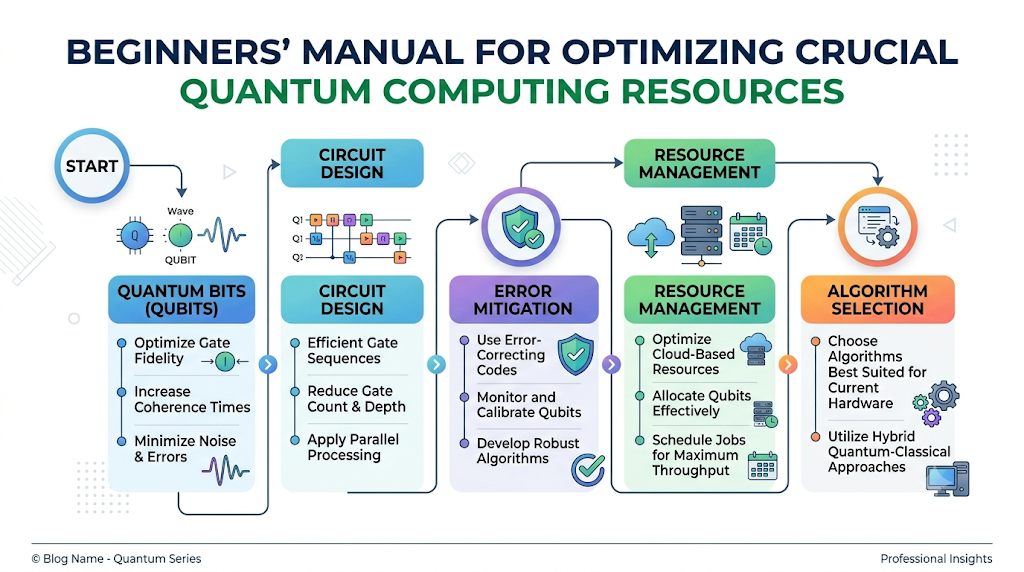
Introduction
Quantum computing is transitioning from experimental laboratory settings into practical, real-world deployment. As processing capabilities scale, organizations are shifting their focus from simply building quantum hardware to operating it reliably. Effective execution requires an intentional approach to how hardware is utilized. Understanding how to orchestrate these systems is no longer a niche research problem; it is a foundational skill for the next generation of IT leaders. Educational platforms like QuantumOpsSchool.com provide structured pathways to help tech professionals bridge the gap between classical cloud engineering and quantum infrastructure management. This guide covers core concepts, resource scheduling, and standard operational strategies used to optimize quantum workflows.
What Is Quantum Resource Management?
Quantum Resource Management is the strategic practice of allocating, scheduling, and monitoring quantum computing resources to maximize processing efficiency, lower hardware operational costs, and minimize calculation errors.
Its primary purpose is to ensure that complex quantum operations run smoothly on real hardware without overloading the delicate infrastructure. In a professional environment, this involves balancing multi-user queues, delegating specific sub-tasks to the best-suited physical processing units, and managing error correction protocols.
The Airline Analogy: Think of quantum resource management like a busy international airport. The quantum processors are the runways. You only have a few runways available, and airplanes (incoming computational tasks) are constantly waiting to land. If you do not have air traffic controllers (resource managers) directing which plane lands when, prioritizing emergency flights, and managing fuel limits, the entire airport grid locks up.
Understanding the Basics of Quantum Computing
To understand how to manage a quantum environment, you must first understand the fundamental building blocks of quantum infrastructure.
- Qubits: Unlike a classical bit that represents either a 0 or a 1, a quantum bit (qubit) can hold far more complex data states.
- Quantum States: The specific physical condition of a qubit at any given moment determines its mathematical value.
- Superposition: This principle allows a qubit to exist in a state representing both 0 and 1 simultaneously, enabling a quantum computer to calculate millions of possibilities at once.
- Entanglement: A unique connection where the state of one qubit instantly influences another, no matter how far apart they are. This allows processors to share information rapidly across a system.
- Quantum Circuits: The step-by-step arrangement of logical operations designed to perform a specific calculation.
Why Resources Are Limited
Quantum resources are scarce because qubits are incredibly fragile. They require temperatures colder than deep space to operate stably. Any slight vibration, temperature spike, or electromagnetic wave can cause decoherence (loss of quantum data). Because keeping these systems alive is computationally and physically demanding, every second of processor time must be tightly guarded.
Why Quantum Resource Management Matters
- Efficient Resource Utilization: Ensures that expensive processors spend less time sitting idle and more time processing high-value algorithms.
- Workload Prioritization: Allows operations teams to rank urgent research calculations ahead of low-priority tests.
- Cost Optimization: Prevents unnecessary expenses by maximizing the computing power harvested out of every single cloud-hosted quantum session.
- Improved Performance: By matching specific tasks to the healthiest qubits inside a processor, managers can achieve higher calculation accuracy.
- Scalability Considerations: Lays down the operational framework needed to transition from small 50-qubit test models to enterprise-grade systems with thousands of qubits.
Key Components of Quantum Resource Management
Quantum Hardware Resources
The physical quantum processing unit (QPU) is the core hardware resource. Managing it involves tracking the total number of physical qubits, their individual coherence times, and their connection layout inside the chip.
Compute Scheduling
Scheduling involves determining the precise order in which various computing circuits are sent to the QPU. This process prevents system bottlenecks and keeps the physical hardware running continuously.
Queue Management
In multi-user cloud platforms, dozens of engineers submit jobs simultaneously. Queue management groups these requests together, manages wait times, and sets limits to prevent a single user from hogging the system.
Error Correction Resources
Because qubits are noisy, a significant portion of a system’s processing power must be spent on error mitigation. Managing these resources means deciding how many physical qubits are used to back up and protect a single “logical” qubit of clean data.
Memory and Storage Considerations
Quantum information cannot be copied or saved like traditional files due to physical laws. Resource managers must carefully coordinate with classical storage databases to save the final readout data the millisecond a quantum experiment concludes.
Resource Monitoring
Live monitoring tools track system health, logging real-time error rates, temperature levels, and calibrations to ensure the processor is performing within safe margins.
How Quantum Resource Allocation Works
The process of quantum resource allocation follows a distinct pipeline designed to transform a user’s code into stable physical operations:
[User Code Input] ➔ [Circuit Compiler Optimization] ➔ [Queue Prioritization] ➔ [QPU Execution]
- Job Scheduling: A user submits a quantum circuit through a cloud interface. The resource allocator reads the request, estimates how long it will take, and places it into an active calendar slot.
- Resource Prioritization: The system evaluates the nature of the task. If a job requires high accuracy, the allocator maps it onto the highest-performing qubits available.
- Capacity Planning: The management layer evaluates upcoming enterprise workloads to ensure the system has enough operational availability without causing extreme delay times for everyday users.
- Performance Balancing: Jobs are dynamically rearranged based on hardware calibration schedules. If a portion of a chip begins showing high error rates, workloads are instantly routed to alternative sectors.
- Multi-User Environments: Virtual partitions are created so multiple distinct engineering teams can safely share fractional access to the same centralized quantum system.
Challenges in Managing Quantum Resources
- Limited Hardware Availability: There are relatively few functional quantum computers globally, making access highly competitive.
- Noise and Error Rates: Environmental interference introduces background noise, forcing software to constantly adjust mid-execution.
- Resource Contention: Multiple complex algorithms frequently compete for the exact same qubits or physical gate pathways, resulting in scheduling delays.
- Scalability Issues: As hardware developers add more qubits, the complexity of orchestrating their connections grows exponentially.
- Infrastructure Complexity: Operating a QPU requires a massive secondary fleet of classical supercomputers, cooling systems, and microwave control lines that must all sync perfectly.
Practical Use Cases of Quantum Resource Management
- Scientific Research: Simulating molecular behaviors at an atomic level requires precise execution windows on high-performance QPUs.
- Drug Discovery: Pharmaceutical companies use managed quantum workloads to model complex chemical compounds, significantly accelerating early-stage testing.
- Financial Modeling: Banks deploy optimized quantum algorithms to run massive risk-assessment scenarios and predict volatile market fluctuations.
- Optimization Problems: Shipping networks use quantum allocations to discover the single most efficient route out of millions of global transit paths.
- Logistics and Supply Chain: Automating warehouse distributions and factory production lines by processing live variable data using distributed quantum networks.
Quantum Resource Management vs. Traditional Computing Resource Management
| Operational Attribute | Traditional Resource Management | Quantum Resource Management |
| Data Retention | Data can be saved, duplicated, and copied endlessly in RAM or hard drives. | Data cannot be copied due to the no-cloning theorem; it must be processed live. |
| Error Handling | Hardware errors are incredibly rare; software management handles bugs. | Hardware is inherently noisy; constant error mitigation is required during runtime. |
| Environment | Works on standard servers at room temperature with basic fans. | Requires dilution refrigerators running at near absolute zero temperatures. |
| Core Metric | Focuses on CPU percentage, memory allocation, and disk space. | Focuses on qubit coherence times, gate fidelity, and circuit depth. |
Best Practices for Quantum Resource Optimization
Efficient Workload Planning
Always pre-compile and optimize your quantum circuits on classical simulators before running them on physical hardware. This catches syntax issues early, ensuring you do not waste precious QPU runtime on a broken script.
Resource Monitoring
Implement automated monitoring dashboards to keep track of real-time calibration updates. If gate fidelity drops on a specific sector of the chip, modify your software mapping to bypass those components.
Error Mitigation Strategies
Incorporate error mitigation techniques like dynamical decoupling into your workload pipelines. This adds protective pulses to the qubits, extending their operational lifespan during long calculations.
Capacity Forecasting
Analyze historical queue data to identify peak usage hours. Schedule long, complex, and low-priority algorithmic runs during off-peak windows to maintain balanced system availability.
Continuous Performance Evaluation
Regularly audit runtime logs to compare your estimated circuit execution time against actual physical performance. Use these benchmarks to refine your future resource planning models.
Emerging Tools and Technologies
- Quantum Cloud Platforms: Services like IBM Quantum, AWS Braket, and Microsoft Azure Quantum offer foundational resource allocation tools to manage cloud-based jobs.
- Resource Orchestration Systems: Emerging software layers sit between user code and bare metal, acting like Kubernetes but engineered specifically to manage quantum execution layers.
- Monitoring Solutions: Advanced telemetry platforms read internal physical diagnostics, translating fridge temperatures and magnetic fields into actionable performance dashboards.
- Automation Capabilities: Smart compilers that automatically detect hardware bottlenecks and rewrite quantum circuits on the fly to match the healthiest parts of the processor.
Future of Quantum Operations
The expansion of quantum infrastructure is driving a major evolution in how data centers operate. As enterprise adoption grows, organizations will increasingly move away from isolated test systems toward complex, integrated setups.
The future relies heavily on hybrid quantum-classical environments. Instead of a quantum computer replacing your current servers, it will act as an advanced co-processor. Classical computers will handle database lookups and user interfaces, offloading specific mathematical problems to the QPU.
As automated orchestration software matures, AI systems will likely take over real-time resource tuning. These intelligent agents will constantly predict noise shifts and re-route complex live circuits without human intervention.
Career Opportunities in Quantum Operations
- Quantum Engineer: Focuses on the physical development, calibration, and stabilization of quantum hardware layers.
- Quantum Researcher: Designs the mathematical algorithms and high-level circuit frameworks used to solve advanced problems.
- Quantum Operations Specialist: Manages day-to-day job scheduling, infrastructure health, cloud queue balancing, and platform optimization.
- Quantum Software Developer: Builds compilers, developer tools, and API integrations that connect classical codebases to quantum hardware platforms.
- Infrastructure and Platform Roles: System administrators and DevOps engineers tasked with managing the classical supercomputers and networks that keep QPUs running.
Common Misconceptions About Quantum Resource Management
Myth: Quantum resource management is just normal cloud DevOps under a different name.
Reality: While some scheduling principles cross over, quantum management deals with entirely different physics constraints, such as tracking live qubit decoherence, gate noise, and atomic-level calibrations that standard IT systems never experience.
Myth: You need a PhD in theoretical physics to manage quantum systems.
Reality: Hardware developers build the physics engines. Operational roles focus on software pipelines, resource metrics, queue scheduling, and cloud management—skills that traditional software engineers and IT professionals can master with targeted training.
Myth: Resource management won’t matter once hardware gets better.
Reality: Even as hardware scales up, the size of the problems humans want to solve scales faster. Efficient resource handling will always be necessary to optimize costs, minimize delays, and maintain system stability.
FAQ Section
- What is the primary goal of quantum resource management?
The main objective is to allocate scarce quantum hardware assets efficiently, minimizing calculation errors and scheduling bottlenecks while keeping operational costs under control. - Why can’t we manage quantum resources exactly like classical servers?
Quantum hardware suffers from unique physical vulnerabilities like qubit decoherence and gate noise, which require constant real-time tracking and error-mitigation strategies that traditional servers do not use. - What is a QPU?
A QPU stands for Quantum Processing Unit. It is the physical chip containing qubits that executes quantum logic gates, working alongside a traditional CPU to complete specialized computing tasks. - How do noise and errors affect resource planning?
High noise levels mean that some qubits perform poorly. Resource managers must monitor these error fluctuations and dynamically map important jobs away from unstable areas of the processor. - Can multiple users run jobs on a quantum computer at the same time?
Yes, modern platforms use advanced queue managers and virtual partitioning to let multiple users share space or queue jobs sequentially on a single quantum system. - What role does classical computing play in quantum resource management?
Classical computers handle the operational heavy lifting, including compiling the code, managing user queues, tracking hardware diagnostics, and sorting the final output data. - Do I need access to physical quantum hardware to learn this?
No, you can learn the fundamentals by using classical cloud simulators, which replicate the behavior and constraints of quantum processors inside a standard web environment. - What is qubit coherence time, and why does it matter?
Coherence time is the brief window where a qubit can maintain its quantum state before dropping out of superposition. Resource managers must ensure circuits finish executing before this time runs out. - Are there orchestration tools available for quantum workloads?
Yes, major cloud providers offer built-in resource orchestrators, and open-source frameworks are actively expanding to help automate system mapping and execution tasks. - How can an IT professional transition into a quantum operations career?
Traditional systems administrators and DevOps engineers can transition by studying quantum fundamentals, learning how quantum circuits operate, and mastering hybrid cloud platform tools.
Final Summary
Building an operational quantum ecosystem requires a calculated focus on system efficiency. Quantum Resource Management provides the essential tools, metrics, and frameworks needed to keep these incredibly complex processors stable, accessible, and cost-effective for modern enterprise needs. As hybrid systems combine the strengths of classical and quantum computing, the demand for specialized operations talent will continue to grow. Mastering these orchestration techniques now prepares technical professionals to lead tomorrow’s advanced computing infrastructure.