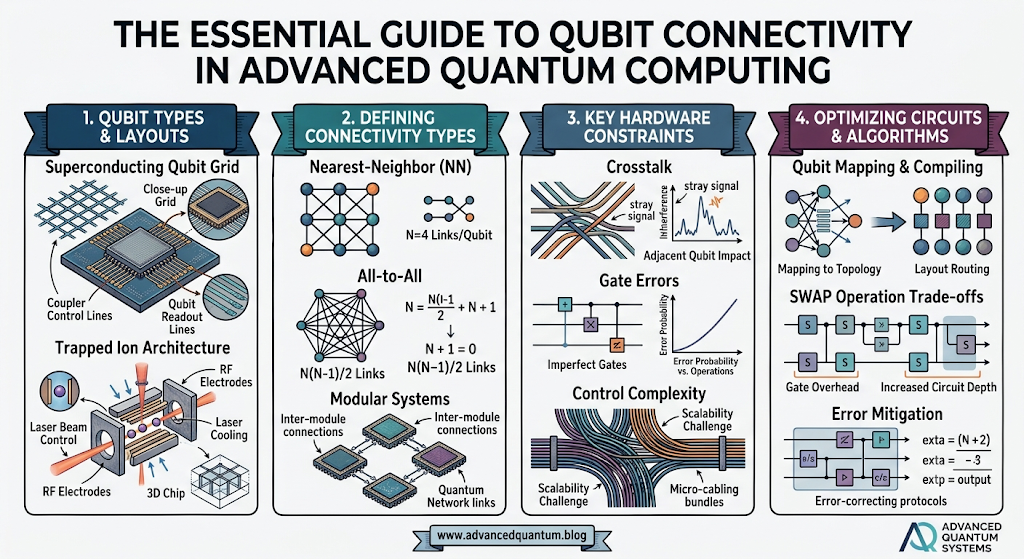
Quantum computing feels like magic, but it relies on physical architecture. If you have been exploring quantum computing, you have likely heard about qubits. We often focus on how many qubits a quantum computer has. However, there is another equally important factor: how those qubits talk to each other. This is known as qubit connectivity. Understanding how qubits interact within quantum devices is crucial. It dictates how fast a system runs, how complex the programs can be, and how many errors occur. For high-quality learning resources on this architecture, visit QuantumOpsSchool.com. Let’s dive into what qubit connectivity is, why it matters, and how it shapes the future of quantum hardware.
What Is Qubit Connectivity?
Definition
Qubit connectivity refers to the physical or logical arrangement that allows individual qubits to interact and share quantum information with one another.
Basic Concept
Imagine a room full of people. If everyone can talk to anyone else directly, communication is instant. If you can only speak to the person sitting directly next to you, passing a message across the room takes time and effort. In quantum processors, qubits are the people, and connectivity determines who can talk directly to whom.
Why Qubits Need to Communicate
For a quantum computer to solve problems, qubits must work together. They cannot calculate in isolation. They need to share states, create mutual dependencies, and execute complex quantum circuits. If two qubits cannot communicate, the computer cannot perform calculations that involve both of them.
Understanding Qubits
To understand connectivity, we must first understand the fundamental building blocks of quantum information.
What Is a Qubit?
A qubit, or quantum bit, is the basic unit of information in a quantum computer. While a classical computer uses transistors to process information, quantum systems use subatomic particles or engineered superconducting circuits.
Classical Bits vs. Qubits
- Classical Bits: Like a standard light switch. They can only be in one of two states: 0 (off) or 1 (on).
- Qubits: Like a spinning coin. While spinning, it is a mix of both heads and tails until it stops.
Superposition
Superposition is the ability of a qubit to exist in a combination of multiple states (both 0 and 1) simultaneously. This allows a quantum device to process vast amounts of possibilities at the same time.
Entanglement
Entanglement is a unique quantum phenomenon where two or more qubits become deeply connected. What happens to one instantly affects the other, no matter how far apart they are. This requires strong physical or logical connectivity to set up.
Quantum States
A quantum state is the mathematical description of a qubit’s current condition. Maintaining these fragile states requires extreme precision within the hardware.
Why Qubit Connectivity Matters
High connectivity is a major advantage for quantum operations. Here is why it is so critical:
- Faster Quantum Operations: When qubits talk directly, operations happen faster. There is no need to route information through intermediate steps.
- Efficient Quantum Circuits: Designers can write shorter code. Fewer operations mean less time spent running the circuit.
- Better Algorithm Performance: Complex algorithms run smoother and yield more accurate results when qubits are highly connected.
- Reduced Communication Overhead: In low-connectivity chips, qubits must constantly swap information just to get next to each other. High connectivity eliminates this wasted effort.
- Improved Scalability: As systems scale to thousands of qubits, smart connectivity architectures prevent the hardware from becoming a tangled mess.
How Qubit Connectivity Works
Physical Connections
In some systems, like superconducting qubits, connections are physical wires or resonators etched onto a silicon chip. The qubits must be physically close to interact.
Logical Connections
In other systems, like trapped ion qubits, lasers or radiofrequency fields manipulate the atoms. Here, connections are logical and dynamic, meaning qubits can be linked regardless of physical placement.
Neighbor-to-Neighbor Communication
Many current chips rely on nearest-neighbor communication. If Qubit A wants to talk to Qubit C, it must pass the message through Qubit B.
Direct vs. Indirect Connectivity
- Direct: Immediate interaction via a single quantum gate.
- Indirect: Requires multiple swap operations across intermediate qubits, which adds delay and risks introducing errors.
Quantum Gate Interactions
A quantum gate is an operation that changes the state of qubits. Multi-qubit gates require reliable, high-fidelity connectivity pathways to succeed without breaking the fragile quantum state.
Types of Qubit Connectivity
[Linear]  0 --- 0 --- 0 --- 0

[Grid]    0 --- 0       [All-to-All]   0 === 0
          |     |                      |  X  |
          0 --- 0                      0 === 0
Linear Connectivity
Qubits are arranged in a straight line. Each qubit can only talk to its left and right neighbors. While simple to build, running complex algorithms on this layout requires a lot of slow information swapping.
Grid Connectivity
Qubits are arranged in a 2D grid (like a chessboard). Each internal qubit can talk to four neighbors. This is common in many modern superconducting chips.
All-to-All Connectivity
Every single qubit can talk directly to every other qubit in the system. This is the ideal scenario for algorithm designers, though it is incredibly difficult to engineer as the system grows.
Heavy-Hex Architecture
A modern design where qubits are arranged on the edges of hexagons. This reduces the number of immediate neighbors, which helps lower unwanted interference between adjacent qubits.
Modular Quantum Architectures
Instead of building one massive chip, engineers link smaller, highly connected quantum chips together using quantum networks.
Factors Affecting Qubit Connectivity
Designing a connected quantum chip is a balancing act. Engineers must weigh several competing factors:
- Hardware Architecture: The physical medium (atoms, light, or circuits) dictates how qubits can link up.
- Qubit Layout: The geometric arrangement directly limits how many direct pathways can exist without cluttering the chip.
- Gate Fidelity: The accuracy of quantum operations. High connectivity is useless if the pathways themselves introduce too many errors.
- Error Rates: Every interaction increases the chance of an error. More connections can sometimes mean more opportunities for mistakes.
- Decoherence: Qubits lose their quantum properties quickly when exposed to environmental noise. Highly connected environments can accelerate this decay.
- Crosstalk: When one pair of qubits talks, their signals can accidentally bleed into neighboring qubits, corrupting data.
- Scalability: Adding more connections makes the wiring incredibly complex, creating a bottleneck for manufacturing larger chips.
Benefits of Better Qubit Connectivity
Investing in better connectivity yield major rewards for quantum developers:
- Higher Computational Efficiency: Algorithms run with fewer total steps, saving precious computing time.
- Reduced Circuit Depth: Circuit depth is the number of sequential steps a quantum program takes. Better connectivity keeps circuits shallow, meaning they finish before qubits decay.
- Better Performance: The system handles complex tasks with higher overall accuracy.
- Improved Reliability: Fewer data swaps mean less exposure to environmental noise and lower overall error rates.
- Easier Optimization: Software compilers don’t have to work as hard to map abstract code onto physical hardware.
Challenges and Limitations
Achieving perfect connectivity is one of the hardest problems in modern physics:
- Hardware Complexity: Wiring up an all-to-all system requires a massive maze of control lines that quickly becomes unmanageable.
- Noise: More connections mean more exposure to magnetic, thermal, and electrical interference.
- Limited Connectivity: Most scaling systems are stuck with low connectivity layouts, forcing developers to write complex, inefficient code to compensate.
- Error Correction: Quantum error correction requires extra “helper” qubits. Poor connectivity makes managing these helper qubits incredibly difficult.
- Engineering Challenges: Manufacturing chips with sub-nanometer precision while managing thousands of microscopic control lines is an ongoing hurdle.
Real-World Applications
Why do we care about solving these connectivity issues? Because doing so unlocks revolutionary capabilities:
- Scientific Research: Simulating quantum mechanics and molecular bonds with extreme precision.
- Cryptography: Creating unhackable communication networks and testing current encryption limits.
- Drug Discovery: Simulating complex molecular interactions to discover lifesaving medicines in days instead of decades.
- Financial Modeling: Optimizing massive global portfolios and risk management systems in real time.
- Optimization: Solving logistics, supply chain, and traffic routing problems that would take classical supercomputers millennia to compute.
- Artificial Intelligence: Training advanced machine learning models significantly faster using quantum-enhanced algorithms.
Current Technologies and Architectures
Different hardware platforms approach connectivity in unique ways:
- Superconducting Quantum Processors: These use tiny electrical circuits on silicon chips. They usually feature grid or heavy-hex connectivity. They scale well but suffer from crosstalk.
- Trapped Ion Systems: These hold individual charged atoms in electromagnetic fields. They offer natural all-to-all connectivity via shared motion, but scaling to large numbers of ions remains slow.
- Photonic Quantum Computing: These systems use particles of light (photons) traveling through mirrors and waveguides. They offer flexible routing but face challenges with photon loss.
- Neutral Atom Quantum Systems: These trap uncharged atoms using optical tweezers. They allow flexible, dynamic reconfiguring of qubits in 2D or 3D spaces during a calculation.
- Quantum Networking Approaches: Linking distinct quantum chips using fiber-optic cables to build a larger, distributed quantum computer.
Future Trends
- Scalable Quantum Processors: Designers are moving away from monolithic chips toward modular designs to bypass physical routing limits.
- Improved Connectivity Architectures: New multi-layer chip designs allow control lines to run underneath the qubits, freeing up space for more direct links.
- Fault-Tolerant Quantum Computing: The ultimate goal. Highly connected setups will enable seamless error correction, allowing systems to run indefinitely without crashing.
- Quantum Internet: Connecting quantum computers worldwide to share quantum states over vast distances.
- Distributed Quantum Computing: Combining the power of multiple smaller quantum devices across a network to tackle massive problems together.
- Advanced Quantum Hardware: New materials and cleaner manufacturing techniques that drastically reduce crosstalk and noise.
Best Practices for Learning Qubit Connectivity
If you are new to the field, navigating these concepts can feel overwhelming. Here are a few practical tips to help you master the material:
- Start with the Fundamentals: Ensure you fully understand classical logic gates before moving on to quantum gates.
- Use Visual Simulators: Tools like IBM Quantum Composer or Google Quantum AI platforms let you build circuits visually, making it easy to see how connectivity constraints affect your design.
- Focus on One Architecture First: Don’t try to learn superconducting chips, trapped ions, and photonics all at once. Pick one and learn its physical layout deeply.
- Read Hardware Specifications: Look up real documentation from companies like IBM, Rigetti, or IonQ. Look at their coupling maps to see how actual qubits are linked.
- Join Communities: Engage with fellow learners on forums, Discord servers, and educational platforms dedicated to quantum systems.
Types of Qubit Connectivity
| Connectivity Type | Description | Advantages | Limitations | Suitable Applications |
| Linear | Qubits arranged in a single line; talk to immediate left/right neighbors. | Easy to manufacture and design. | High communication overhead for long-distance swaps. | Simple demonstration circuits and basic education. |
| Grid | Qubits arranged in a 2D layout; talk to up to four neighbors. | Balances manufacturing complexity with decent routing. | Limited long-distance routing; susceptible to local crosstalk. | Error-correction testing and medium-scale algorithms. |
| All-to-All | Every qubit connects directly to every other qubit. | Zero routing overhead; highly efficient circuits. | Extremely difficult to scale physically past dozens of qubits. | Complex quantum chemistry simulations and deep algorithms. |
| Heavy-Hex | Qubits arranged on the edges of interconnected hexagons. | Drastically reduces crosstalk and interference. | Requires clever software compilation to handle sparse links. | Large-scale commercial quantum processors and error mitigation. |
Classical Computing Connections vs. Qubit Connectivity
| Feature | Classical Computing | Quantum Computing | Key Difference |
| Data Routing | Done via shared data buses and complex memory routing networks. | Done via direct physical links or shared quantum fields. | Quantum data cannot be copied; it must be interacted with directly or swapped. |
| Physical Proximity | Transistors do not need to be adjacent to share data. | Qubits often must be physically adjacent to execute multi-qubit gates. | Proximity directly limits what calculations can be run instantly. |
| Signal Interference | Minimal; modern chips insulate wires exceptionally well. | High; adjacent pathways frequently cause crosstalk and noise. | Quantum connections are highly sensitive to their surrounding environment. |
FAQs
What is the difference between qubit count and qubit connectivity?
Qubit count is the total number of processing units on a chip. Qubit connectivity is the measure of how many of those units can talk directly to one another without intermediate steps.
Can a quantum computer work with zero connectivity?
No. Qubits must interact to run multi-qubit gates and perform meaningful calculations. Without connectivity, you just have isolated bits that cannot run complex algorithms.
Why don’t all quantum computers use all-to-all connectivity?
Because it is incredibly difficult to engineer. As you add more qubits, the number of physical connections grows exponentially, leading to severe wiring issues and overwhelming noise.
What is a SWAP gate in low-connectivity systems?
A SWAP gate is an operation that trades the states of two adjacent qubits. It is used to move information across a chip until the target qubits are next to each other.
How does qubit connectivity affect error rates?
More connections can lead to higher crosstalk, where signals bleed into neighboring qubits. However, low connectivity requires more total gates, which also increases the chance of errors.
Which technology has the best qubit connectivity right now?
Trapped ion systems generally offer the best connectivity because they feature natural all-to-all interaction inside the ion trap.
What is crosstalk in quantum hardware?
Crosstalk occurs when an operation on one qubit accidentally disturbs the state of an adjacent, unconnected qubit due to electromagnetic leakage.
Does software help fix poor qubit connectivity?
Yes. Quantum compilers take abstract code and optimize it to fit the specific physical layout of the chip, minimizing the number of data swaps needed.
What is a heavy-hex layout?
It is a geometric pattern where qubits sit on the borders of hexagons. It reduces the number of immediate neighbors each qubit has, lowering crosstalk while remaining scalable.
Will future quantum computers have perfect connectivity?
Likely not across the whole system. The future points toward modular architectures, where small, perfectly connected clusters are linked together by a sparse network.
Conclusion
Qubit connectivity remains one of the defining pillars of quantum hardware design. While high qubit counts dominate headlines, it is the underlying connectivity architecture that determines how efficiently, accurately, and rapidly a quantum device can process information. As engineers continue to innovate around physical layouts, minimize crosstalk, and explore modular designs, unlocking smarter connectivity pathways will pave the way toward truly practical, fault-tolerant quantum computing.