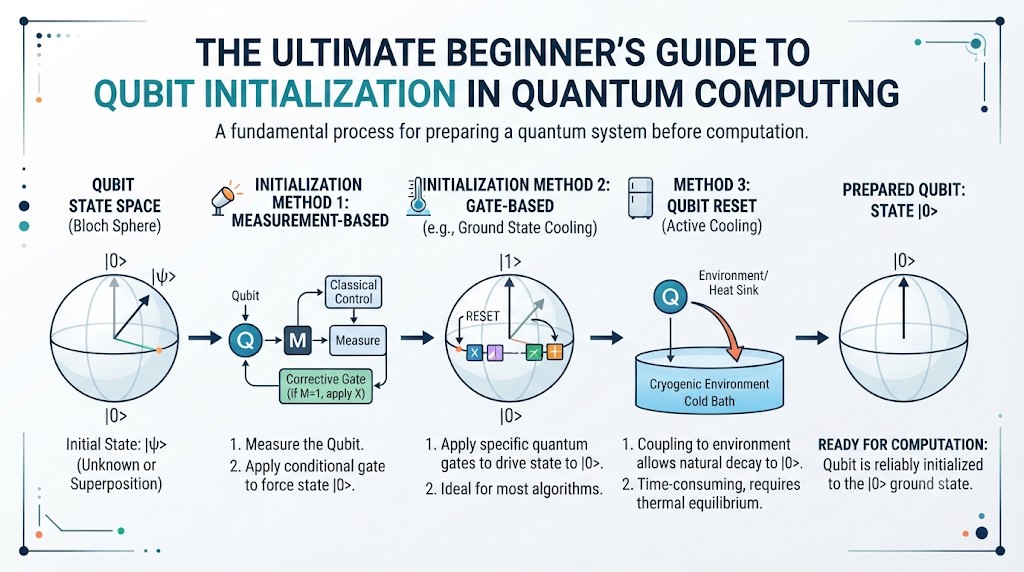
Imagine trying to write a brilliant novel, but your laptop’s keyboard randomly inputs letters before you even touch the keys. Or picture setting up a high-stakes race where the runners start at completely different points on the track instead of the starting line. The results would be chaotic, unpredictable, and completely unreliable. Properly prepared qubits give developers a blank canvas. Without this reliable starting point, a quantum computer cannot execute quantum circuits accurately, leading to broken calculations and unusable data. For anyone diving into quantum programming or exploring quantum hardware, understanding how we prepare these systems for action is the absolute first step toward mastering the technology. You can learn more about these foundational concepts on QuantumOpsSchool.com.
What Is Qubit Initialization?
Definition
Qubit initialization is the process of setting a quantum bit (qubit) into a specific, known starting state before any computational task begins. In the vast majority of cases, this means resetting the qubit to its lowest possible energy level, which scientists write as the ground state, or $\vert{}0\rangle$.
Purpose
The primary purpose of initialization is to establish a trustworthy baseline. Think of it like resetting a calculator to zero before starting a new math problem. If the calculator still holds numbers from your last calculation, your next answer will be completely wrong. Qubit initialization clears out residual data from previous operations, ensuring that the machine begins its work with a clean slate.
Why Initialization Is Necessary
Quantum computers do not work like the smartphones or laptops you use every day. They are highly sensitive systems that interact constantly with their environments. Because qubits naturally drift, fluctuate, and retain footprints of past actions, initialization is necessary to enforce predictability. Without it, you cannot know if a final output is a true result of your program or just random leftover noise.
The Difference Between Initializing Classical Bits and Qubits
In classical computing, resetting a bit is simple. A classical bit is like a standard light switch—it is either ON (1) or OFF (0). To initialize it, the system applies a small electrical current to flip the switch to the desired position.
Qubits, however, behave like a spinning coin. They do not just switch between 0 and 1; they navigate a delicate landscape of probabilities. Initializing a qubit requires carefully calming this “spinning coin” down so that it rests perfectly flat on the table in a predictable position. Because qubits are governed by the laws of quantum mechanics, initializing them requires much more precision than simply sending a quick pulse of electricity down a wire.
Understanding the Basics
To appreciate how initialization works, we need to look at the basic building blocks of quantum information science.
Qubits
A qubit, or quantum bit, is the basic unit of information in a quantum computer. While classical computers use transistors to store bits, quantum hardware uses microscopic systems—such as single electrons, trapped ions, or tiny superconducting circuits—to act as qubits.
Quantum States
A state is simply the current condition or configuration of a physical system. For a classical bit, the state is strictly 0 or 1. For a qubit, the quantum states represent the mathematical possibilities of what the qubit will reveal when we look at it.
The $\vert{}0\rangle$ and $\vert{}1\rangle$ Basis States
Quantum scientists use special brackets to write quantum states. The state $\vert{}0\rangle$ (pronounced “ket zero”) usually represents the lowest energy state, while $\vert{}1\rangle$ (pronounced “ket one”) represents the higher energy state. These are the two fundamental poles, similar to the North and South poles on a globe. Qubit initialization is almost always focused on placing the qubit exactly at the $\vert{}0\rangle$ pole.
Superposition
Once a qubit is initialized to $\vert{}0\rangle$, it can be manipulated into a state called superposition. This is the unique ability of a qubit to exist in a combination of both $\vert{}0\rangle$ and $\vert{}1\rangle$ states at the same time.
The Spinning Coin Analogy: Think of a classical bit as a coin lying flat on a table. It can only show heads ($\vert{}0\rangle$) or tails ($\vert{}1\rangle$). A qubit in superposition is like a coin spinning rapidly on the table. While it spins, it is not purely heads and it is not purely tails—it is a fluid combination of both possibilities.
Quantum Measurement
You cannot watch a coin spin forever; eventually, it must land. In quantum computing, looking at the qubit is called quantum measurement. The moment you measure a qubit in superposition, the spinning stops, the magic fades, and it instantly forces the qubit to choose a side—collapsing into a solid 0 or a solid 1. Because measurement destroys the delicate quantum state, initialization is required to start the process all over again for the next test run.
Why Qubit Initialization Matters
Why do researchers spend so much time worrying about the very beginning of a calculation? Without excellent initialization, the entire promise of quantum speedups falls apart.
- Reliable Computation: A quantum computer needs to run millions of operations without losing its way. Proper initialization ensures that every run of a program starts from the exact same point, providing stability across long computational workloads.
- Repeatable Experiments: Science requires repeatability. If a developer runs a quantum algorithm ten times, they need to know that any variance in the final output comes from the algorithm itself, not because the qubits started in slightly different states each time.
- Accurate Quantum Algorithms: Advanced algorithms rely on precise mathematical interference to cancel out wrong answers and highlight correct ones. If the starting states are skewed even by a fraction of a percent, the entire mathematical harmony of the algorithm breaks down.
- Reduced Computational Errors: In quantum systems, errors grow like a rolling snowball. A tiny flaw during the initialization phase multiplies as the qubits interact through various quantum gates, ruining the final output.
- Better Quantum Circuit Performance: A quantum circuit is a sequence of operations mapped out over time. High-quality initialization reduces the background noise inside these circuits, allowing them to run deeper, more complex programs successfully.
- Foundation for Quantum Error Correction: To build truly powerful machines, we use quantum error correction—a system where multiple physical qubits work together to protect a single piece of logical data. This error-checking process requires a constant stream of freshly cleaned, perfectly initialized qubits to detect and sweep away errors in real time.
How Qubit Initialization Works
We know why it is important, but how does quantum hardware actually achieve it? While different types of quantum computers use different physical methods, the high-level concepts remain the same.
Preparing a Known Quantum State
The ultimate goal is to steer the qubit from an unknown, chaotic state into a perfectly clean, known quantum state (usually $\vert{}0\rangle$). Think of this like guiding a wandering toddler back to the starting line of a game.
Cooling Quantum Hardware
Many advanced quantum computers, like those using superconducting circuits, must be kept incredibly cold—colder than deep space. By dropping the temperature to near absolute zero, the system drains almost all thermal energy out of the qubits. This extreme cold naturally forces the qubits to drop down into their lowest possible energy level, which is the $\vert{}0\rangle$ state.
Reset Operations
If a developer needs to clear a qubit in the middle of a program run, they cannot wait for the entire refrigerator to cool down again. Instead, they use active reset operations. These are targeted commands that quickly clear out the qubit’s existing information.
Quantum Gate Preparation
Sometimes, hardware control systems apply specific, finely tuned pulses of microwave or laser energy—known as quantum gates—to manipulate the qubit. If the system detects that a qubit is sitting in state $\vert{}1\rangle$, it applies a specific gate to flip it cleanly back to $\vert{}0\rangle$.
Measurement-Based Reset
In this method, the computer actively measures the qubit first to see what it is doing. If the measurement shows the qubit is already at $\vert{}0\rangle$, the computer leaves it alone. If the measurement reveals it is at $\vert{}1\rangle$, the system triggers a quick control pulse to flip it back to $\vert{}0\rangle$. It is a proactive, look-and-fix approach.
State Verification
Before giving the green light to run an important algorithm, the control system runs a quick verification check. This ensures the initialization was successful and that the qubit is truly resting at the starting line, waiting for commands.
Common Challenges
Achieving a perfect baseline state is incredibly difficult. Quantum hardware engineers battle several persistent roadblocks to keep qubits stable.
- Quantum Noise: Qubits are highly sensitive to their surroundings. Stray magnetic fields, Wi-Fi signals, and minor temperature fluctuations create environmental noise that knocks qubits out of their initialized states before the calculation even begins.
- Decoherence: This is the natural tendency of a qubit to lose its quantum properties and decay back into a boring, classical state. Decoherence acts like a ticking clock, constantly threatening to ruin the initialized state if the computer does not work fast enough.
- Imperfect Initialization: No hardware tool is perfect. Sometimes, a reset pulse fails to shift the qubit entirely to the ground state, leaving it stuck in an unwanted, intermediate position.
- Hardware Limitations: The physical wires, lasers, and amplifiers used to manage qubits have minor imperfections. These physical limits make it tough to deliver the exact amount of energy needed for a perfect reset every single time.
- Initialization Fidelity: Fidelity is the metric used to measure how close an initialized qubit is to the ideal state. If an initialization has $99\%$ fidelity, it means there is still a $1\%$ chance the qubit started in the wrong configuration, which introduces errors into the program.
- Error Accumulation: If a quantum circuit requires hundreds of qubits to initialize at the same time, even tiny fractional errors across individual qubits will add up quickly, creating a massive wave of error accumulation that can break the calculation.
Real-World Applications
Why do we care so much about perfecting this initial step? Because solving the initialization challenge unlocks the true real-world power of quantum computing across major industries.
Quantum Chemistry
Simulating how molecules interact requires modeling millions of quantum states simultaneously. If initialization fails, the starting template for the chemical bond is flawed, making it impossible to accurately model complex chemical reactions.
Drug Discovery
To design life-saving medications, researchers use quantum computers to see how target proteins react to new drug compounds. Perfect qubit initialization ensures that the virtual testing environment matches real-world physics, allowing teams to find effective treatments much faster.
Financial Modeling
Global financial systems involve balancing massive risk portfolios and predicting market trends. Accurate initialization allows quantum optimization algorithms to run flawlessly, helping institutions analyze thousands of economic variables at the same time.
Cryptography
Quantum computers have the potential to break traditional cybersecurity methods and build unbreakable, quantum-secure communication networks. Securing these networks requires flawless quantum states at the start of transmission to ensure encryption keys cannot be intercepted or altered.
Artificial Intelligence
Quantum machine learning can process massive datasets much faster than classical AI. For these advanced networks to learn efficiently, the underlying quantum circuits must start from a clean baseline, preventing old data patterns from corrupting new training models.
Optimization
From delivery truck routes to global supply chains, optimization is all about finding the most efficient path forward. Clean initialization ensures that the quantum processor scans all potential routes fairly, leading to major cost and time savings.
Materials Science
Developing stronger, lighter metals or highly efficient solar panels requires studying atomic structures. Precise qubit setups allow scientists to simulate these new materials at an atomic level with absolute confidence in the digital results.
Best Practices
To maximize the performance of a quantum computer, developers and hardware engineers follow several industry best practices.
- Verify Initialization: Never assume a reset worked perfectly. Always integrate quick, non-destructive health checks to confirm that qubits are resting safely in the $\vert{}0\rangle$ state before pushing code.
- Reduce Environmental Interference: Keep the quantum processor heavily shielded inside vacuum chambers and extreme cooling units to block out external magnetic, electrical, and thermal noise.
- Use Reliable Hardware Calibration: Regularly tune and calibrate control systems, such as lasers and microwave pulses, to ensure the signals used to reset the qubits remain razor-sharp over time.
- Monitor System Performance: Keep a continuous log of initialization success rates. Monitoring these trends helps engineers catch degrading components before they ruin active programming tasks.
- Combine with Quantum Error Correction: Always design initialization routines to work alongside active error-correcting codes, giving the system a secondary safety net to catch any lingering initialization slips.
- Validate Experimental Results: Cross-reference final outputs against known classical baselines or small-scale simulations to ensure that minor initialization flaws are not warping the final answers.
Future Trends
As the quantum industry grows, the methods we use to prepare qubits are evolving rapidly.
- Higher-Fidelity Initialization: Researchers are closing in on “four-nines” ($99.99\%$) initialization fidelity, minimizing initial errors to the point where they barely impact final calculations.
- Faster Reset Techniques: Next-generation control systems will reset qubits in nanoseconds, drastically reducing the time a quantum computer sits idle between runs.
- Fault-Tolerant Quantum Computers: The ultimate goal of the industry is to build fault-tolerant systems. These machines will automatically sweep away initialization errors, making quantum programs incredibly stable.
- Scalable Quantum Processors: As we scale from dozens of qubits to millions, new master control chips will initialize thousands of individual qubits simultaneously without cross-talk or interference.
- AI-Assisted Quantum Hardware Optimization: Engineers are beginning to train classical AI models to monitor quantum systems, automatically tweaking initialization pulses in real time to counter shifting environmental noise.
- Improved Quantum Control Systems: Advanced laser technology and custom-designed microchips will deliver cleaner, more precise energy pulses, making the initialization process highly efficient across all hardware types.
Classical Bit Initialization vs. Qubit Initialization
| Feature | Classical Bits | Qubits | Key Difference |
| Target State | Solid 0 or Solid 1 | Typically the ground state $\vert{}0\rangle$ | Classical uses simple states; qubits use precise quantum states. |
| Mechanism | Simple electrical current | Extreme cooling, laser pulses, or microwave gates | Classical resets use basic electricity; qubits require complex physics. |
| Complexity | Extremely low and fast | High; requires specialized environment controls | Classical handles resets easily; qubits face constant environmental interference. |
| Sensitivity | Immune to minor room noise | Highly vulnerable to external environment noise | Qubits decay rapidly if the initialization environment is not completely isolated. |
Common Challenges in Qubit Initialization
| Challenge | Cause | Impact on Quantum Computing | Possible Mitigation (High-Level) |
| Quantum Noise | Stray electromagnetic signals, heat | Knocks qubits out of their starting state prematurely | Enhanced physical shielding and extreme cooling isolation |
| Decoherence | Natural decay over time | Destroys the quantum state before the math finishes | Faster reset actions and improved material engineering |
| Imperfect Reset | Weak or poorly timed control pulses | Leftover data corrupts the new calculation | Regular automated calibration of control hardware |
| Error Accumulation | Scaled setups with multiple qubits | Small fractional errors grow into broken results | Combining steps with active quantum error correction |
FAQs
What happens if a qubit is not properly initialized?
If a qubit is not initialized correctly, it will carry over random energy or leftover data from past operations. This corrupts the entire calculation, leading to broken data paths, errors, and completely unreliable results.
Why do most quantum computers initialize qubits to the $\vert{}0\rangle$ state?
The $\vert{}0\rangle$ state usually represents the lowest possible energy level of the qubit. Because systems naturally want to rest at their lowest energy level, initializing to $\vert{}0\rangle$ provides the most stable and predictable starting line.
How long does it take to initialize a qubit?
The time varies depending on the hardware, but it usually takes anywhere from a few nanoseconds to a few microseconds. The goal for future hardware is to make this reset window as brief as possible to speed up computing times.
Can a qubit be initialized to the $\vert{}1\rangle$ state instead of $\vert{}0\rangle$?
Yes, qubits can be initialized to the $\vert{}1\rangle$ state or other specific states if an algorithm requires it. However, because $\vert{}1\rangle$ is a higher energy state, it requires continuous active control to keep it stable at the start of a program.
What is initialization fidelity?
Initialization fidelity is a percentage score that measures how close a qubit actually gets to its intended starting state. A higher fidelity percentage means fewer errors are introduced at the very beginning of a program.
Does temperature affect qubit initialization?
Yes, temperature plays a massive role. For many types of quantum hardware, heat creates random atomic motion that ruins quantum states. Keeping the hardware near absolute zero naturally settles the qubits into a clean, rest state.
Is qubit initialization part of quantum programming?
Yes. While the hardware handles the physical movements, quantum programmers include specific reset and initialization instructions at the beginning of their quantum circuits to ensure their code runs on a clean canvas.
How does environmental noise interfere with initialization?
Stray Wi-Fi signals, magnetic fields, or tiny temperature shifts act like sudden vibrations on a still surface. This environmental noise accidentally kicks the qubit out of its peaceful starting state, creating background errors.
What is a measurement-based reset?
A measurement-based reset is a technique where the quantum computer looks at the qubit first to check its current state. If the qubit is in the wrong position, the system instantly fires a targeted correction pulse to flip it back to zero.
Will future quantum computers solve the initialization problem entirely?
While we may never completely eliminate environmental noise, future fault-tolerant quantum computers will use advanced error-correction codes to instantly detect and fix initialization mistakes, making the process virtually perfect for the end user.
Conclusion
Qubit initialization is one of the first and most essential steps in quantum computing because it prepares complex quantum systems for accurate and repeatable computations. Just like a runner waiting patiently at the starting blocks, a qubit must sit precisely at its baseline before the race of calculations can begin. Without this clear starting point, the unique advantages of quantum mechanics—like superposition and complex interference—quickly turn into unmanageable noise. As quantum hardware continues to improve, building better, faster, and more resilient initialization techniques will play a key role in transforming these experimental machines into reliable, scalable, and practical quantum computers for the modern world.