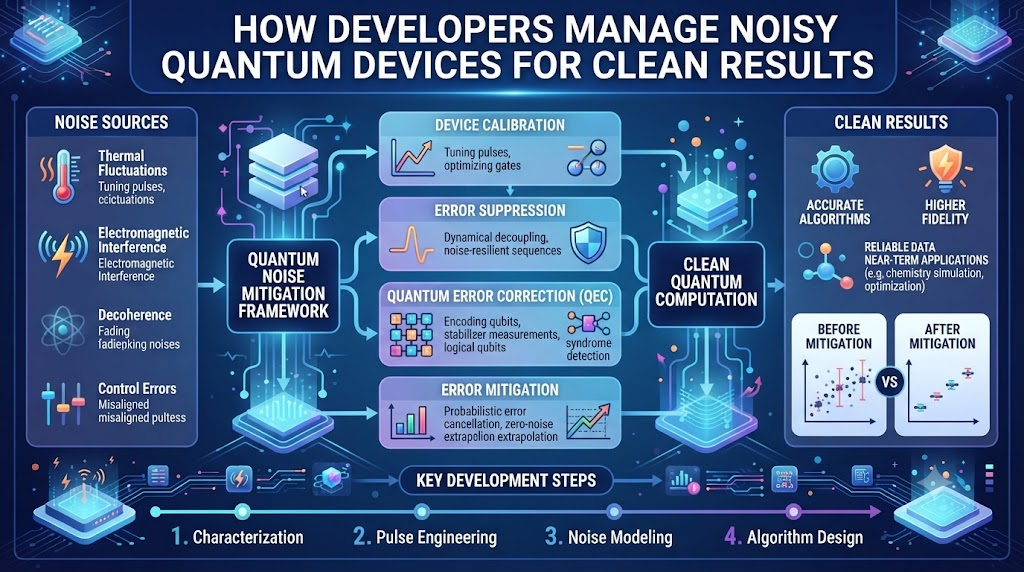
Imagine writing software where every second line of code randomly scrambles itself. Your program returns garbage instead of answers. This frustrating puzzle faces every engineer who runs code on modern quantum computers. These experimental machines suffer from constant electrical interference and tiny hardware flaws. You need smart management tools to clean up these messy signals. Experts at QuantumOpsSchool.com share advanced frameworks to keep your quantum tests running smoothly. Let us look at how modern teams tackle noise in these systems.
What Is the NISQ Era in Software?
We live in the NISQ era right now. This term stands for Noisy Intermediate-Scale Quantum computing.
These computers feature anywhere from fifty to a few thousand physical qubits. They are powerful, but they lack complete error correction to protect data.
Without full error correction, stray energy ruins delicate quantum states very fast. You must learn to work around these hardware limits as a software developer.
Smart software layers help bridge the gap between messy chips and clean math. This approach lets you get useful answers despite the physical flaws.
The Core Challenge of Qubit Decoherence
Decoherence is the biggest enemy of every quantum software engineer. It happens when a qubit interacts with its outside environment.
The fragile quantum state collapses into ordinary random bits. When this occurs, your calculations fall apart instantly.
You only have a tiny window of time to run your logic gates. If your code takes too long, decoherence destroys all the data.
Speeding up your gate operations helps reduce exposure to this harmful environmental static. Every microsecond matters when you handle live quantum chips.
Measuring Gate Fidelity and Error Rates
Gate fidelity tells you how well a quantum gate performs its job. High fidelity means your logic operations succeed most of the time.
Low fidelity introduces tiny mistakes into every single calculation step. These errors pile up quickly as your circuit grows larger.
Engineers run constant benchmark tests to measure these error rates. Knowing your exact hardware flaws helps you adjust your software parameters.
You can bypass weak physical qubits and route tasks through healthier paths. This smart routing keeps your overall error rate as low as possible.
Error Mitigation Versus Full Error Correction
Full error correction requires thousands of physical qubits to protect one logical qubit. We do not have enough hardware capacity for that yet.
Instead, we use error mitigation to fix results mathematically. This method runs tests multiple times with different noise levels.
You then extrapolate the clean data points back to a zero-noise baseline. It is a clever trick that saves hardware resources while improving accuracy.
QuantumOps automates this math so you do not have to do it manually. Your workloads run faster and deliver much cleaner answers.
How QuantumOps Automates Calibration Schedules
Quantum hardware shifts its physical properties throughout the day. Temperature swings and stray magnetic fields cause gradual performance drift.
If you do not recalibrate the chip, your error rates skyrocket. Doing this by hand wastes valuable lab time and slows down research.
QuantumOps schedules automated calibration checks between major computing jobs. The system tweaks microwave pulses to keep qubits in optimal shape.
This proactive upkeep ensures your afternoon runs match your morning precision. Consistency is the key to reliable quantum experimentation.
Circuit Optimization and Depth Reduction
Long quantum circuits give noise more time to ruin your data. You need to shrink your code to make it run faster.
Circuit optimization tools analyze your logic gates and remove redundant steps. They combine adjacent operations to shorten the total path.
Shorter circuits finish execution before decoherence has a chance to strike. Your success rate jumps up immediately after you flatten the depth.
Writing clean code is just as important in quantum physics as it is in web development. Less code always means fewer places for errors to hide.
Mitigating Readout Errors at Scale
Reading the final state of a qubit is a tricky physical process. Detectors sometimes misread a zero as a one by mistake.
Readout errors skew your final histogram results and ruin data analysis. You must correct these misreadings using calibration matrices.
The system measures known states before your main job starts. It calculates the exact probability of detector mistakes on that day.
It then applies an inverse matrix to clean your final output data. You get crisp, trustworthy results ready for scientific review.
Managing Quantum-Classical Hybrid Loops
Most NISQ applications use a hybrid quantum-classical setup. The quantum chip handles heavy math, while a normal computer updates the variables.
This back-and-forth loop creates unique operational bottlenecks. Network lag or slow data transfers can stall the entire pipeline.
QuantumOps streamlines this communication using fast local data pipes. The classical optimizer feeds new parameters to the quantum processor instantly.
This tight loop keeps utilization high and cuts total experiment runtime. Your research team saves hours on every complex optimization task.
Handling Thermal Fluctuations in Cryostats
Quantum processors must stay super cold to maintain their delicate states. They live inside large dilution refrigerators cooled near absolute zero.
Even tiny temperature spikes inside the fridge can scramble your qubits. Monitoring these thermal conditions is a critical part of infrastructure management.
Sensors track every millikelvin change inside the cooling chamber continuously. If heat rises, the system pauses workloads until temperatures stabilize.
Protecting your hardware from thermal stress prevents sudden catastrophic job failures. Good hardware care protects your expensive research investments.
Building Resilient Quantum Pipelines
Running a single quantum experiment is easy, but running thousands is hard. You need robust pipelines to manage batch queues and retries.
Resilient systems automatically catch failed jobs caused by sudden hardware drops. They resubmit tasks to backup QPUs without human intervention.
This automation turns experimental physics into a smooth production service. Your engineers can focus on algorithm design instead of babysitting servers.
Reliable workflows turn noisy hardware into a dependable business asset. That is the ultimate goal of modern quantum operations management.
Real-World Case Studies
- Case Study One: A financial firm ran portfolio optimization tests on a fifty-qubit device and faced massive noise interference. They applied automated error mitigation to cut calculation variance by half.
- Case Study Two: A chemical research lab simulated small molecule bonds using hybrid quantum algorithms. Circuit depth reduction helped them finish runs before decoherence ruined the qubit states.
- Case Study Three: A logistics company tested route planning on a cloud quantum processor. Automated calibration routines kept error rates steady during busy afternoon computing hours.
- Case Study Four: An academic research group analyzed readout errors on a superconducting chip. Using calibration matrices, they improved their measurement accuracy by thirty-five percent.
- Case Study Five: A cybersecurity startup built automated queue managers for their cloud quantum workloads. The system cut job failure rates significantly during unexpected hardware temperature spikes.
- Case Study Six: An energy provider optimized power grids using noisy intermediate-scale hardware. Smart qubit routing bypassed broken paths and delivered usable operational insights.
- Case Study Seven: A telecommunications team reduced circuit gate counts to save valuable coherence time. Their updated code finished execution with zero runtime timeout errors.
- Case Study Eight: A materials science team tracked daily qubit drift using automated telemetry tools. Early maintenance alerts saved their fragile hardware from unexpected calibration failure.
- Case Study Nine: A cloud service provider scaled up their multi-tenant quantum access portal. Automated software layers managed user jobs fairly without crashing the physical fridges.
- Case Study Ten: A manufacturing firm tested hybrid variational solvers on real hardware. Fast data loops between classical servers and quantum chips accelerated their design cycles.
Sensor Type and Operation Comparison Table
| Approach | Primary Mechanism | Pros | Cons |
| Error Mitigation | Mathematical post-processing | Uses fewer physical qubits | Requires many sample runs |
| Error Correction | Redundant physical qubits | Provides absolute protection | Needs thousands of qubits |
| Circuit Optimization | Logic gate reduction | Lowers exposure to noise | Complex compiler logic needed |
| Automated Calibration | Hardware pulse tuning | Keeps base error rates low | Pauses compute job queues |
Common Mistakes and Pitfalls
- Mistake One: Ignoring daily hardware calibration drift before big jobs. Solution: Schedule automated calibration checks between every major experimental run.
- Mistake Two: Writing long quantum circuits that exceed coherence limits. Solution: Use circuit optimizers to reduce total gate depth before execution.
- Mistake Three: Skipping readout error correction on final measurement results. Solution: Apply calibration matrices to clean up your output histograms.
- Mistake Four: Forgetting to monitor internal cryostat temperature changes. Solution: Set up live thermal sensors with automatic job pause triggers.
- Mistake Five: Routing tasks through dead or low-fidelity physical qubits. Solution: Use dynamic map builders that route jobs through healthy hardware paths.
- Mistake Six: Sending massive data payloads over slow classical network links. Solution: Keep your classical optimizers close to the quantum control hardware.
- Mistake Seven: Assuming all quantum chips share the exact same noise profile. Solution: Tailor your mitigation strategies to match each specific QPU.
- Mistake Eight: Overlooking power supply stability in your server racks. Solution: Install clean uninterruptible power supplies for all control electronics.
- Mistake Nine: Failing to log error rates over long historical timeframes. Solution: Build a central database to track hardware performance trends weekly.
- Mistake Ten: Testing complex algorithms without running small baseline checks first. Solution: Validate your code logic on local simulators before hitting real hardware.
Step-by-Step Implementation Roadmap
- Step One: Audit your current quantum software stack to find where noise impacts results most.
- Step Two: Connect your development environment to cloud quantum management platforms.
- Step Three: Set up automated calibration routines to run before your daily shifts begin.
- Step Four: Integrate circuit optimization tools into your standard code deployment pipeline.
- Step Five: Apply error mitigation wrappers to your primary mathematical functions.
- Step Six: Configure readout error correction matrices for your target hardware chip.
- Step Seven: Build automated telemetry monitors to track cryostat temperatures and fridge health.
- Step Eight: Set up dynamic job routing to bypass failing physical qubits automatically.
- Step Nine: Run test workloads to measure performance gains and verify output accuracy.
- Step Ten: Train your engineering team on how to read hardware telemetry dashboards.
Frequently Asked Questions
1. What does NISQ stand for in quantum software?
NISQ stands for Noisy Intermediate-Scale Quantum, describing current hardware without full error correction.
2. Why is quantum noise such a big developer challenge?
Noise destroys fragile quantum states before calculations finish, rendering output data completely useless.
3. How does error mitigation differ from error correction?
Error mitigation uses smart math to fix results without needing thousands of extra physical qubits.
4. What causes qubit decoherence during a software run?
Interactions with the outside environment cause the delicate quantum state to collapse into random bits.
5. Why do quantum chips need regular developer calibration?
Temperature shifts and stray magnetic fields cause physical performance properties to drift over time.
6. How do circuit optimizers improve success rates?
They remove redundant gates to shorten execution time before decoherence strikes the system.
7. What are readout errors in quantum systems?
Readout errors happen when detectors misread a final qubit state by mistake.
8. How do hybrid algorithms work on NISQ devices?
Quantum chips handle heavy math loops while normal classical computers update the variables.
9. Why must quantum processors stay super cold?
Extreme cold near absolute zero is required to protect delicate physical qubits from heat.
10. Where can I find more advanced quantum operations guides?
You can explore in-depth engineering articles and frameworks on QuantumOpsSchool.com.
Final Recommendation and Next Steps
Begin your noise management journey by testing error mitigation on a single small circuit. Compare your raw output data against your mitigated results to see the immediate accuracy boost.
Keep your calibration logs organized so you can spot hardware wear and tear early. Small software adjustments will turn your noisy quantum trials into reliable, repeatable engineering victories.