Introduction
Quantum computing is attracting global attention because it introduces a new way of processing information. Instead of using only ordinary bits like classical computers, quantum computers use qubits that can represent complex probability-based states. For beginners, the most important step is not jumping directly into advanced quantum algorithms. The better path is to first understand the core concepts: qubits, superposition, entanglement, quantum gates, measurement, and interference. QuantumOpsSchool is an educational learning resource for students, developers, researchers, and technology professionals who want to understand quantum computing in a structured and practical way. You can explore more learning resources at QuantumOpsSchool.com. In this article, you will learn real-world examples of quantum computing concepts, how these concepts connect to practical applications, and why quantum technology matters across industries such as healthcare, finance, logistics, cybersecurity, materials science, and artificial intelligence.
What Is Quantum Computing?
Quantum computing is a type of computing that uses principles from quantum physics to process information. It works with qubits instead of classical bits.
A classical computer stores information as either 0 or 1. A quantum computer uses qubits, which can exist in a combination of possible states before measurement.
In simple words, quantum computing allows certain problems to be explored in a different way than classical computing. It does not make every task faster, but it may offer strong advantages for specific types of problems.
Difference Between Classical Computing and Quantum Computing
Classical computers are excellent for everyday tasks such as browsing websites, running software, storing files, processing transactions, and managing databases.
Quantum computers are designed for specialized problems where many possibilities need to be explored, compared, or optimized.
For example:
- A classical computer checks possibilities using fixed logical steps.
- A quantum computer can represent probability-based possibilities using quantum states.
- A classical computer uses logic gates.
- A quantum computer uses quantum gates.
- A classical computer gives predictable binary results.
- A quantum computer gives results after measurement based on probabilities.
Why Quantum Computing Matters
Quantum computing matters because some real-world problems are extremely complex. Classical systems may take too much time to explore every possible solution.
Quantum computing may help in areas such as:
- Drug discovery
- Material design
- Financial modeling
- Optimization problems
- Machine learning
- Cryptography research
- Scientific simulations
- Energy system modeling
It is important to understand that quantum computing is not a replacement for classical computing. It is more like a powerful specialized tool for selected problem types.
Core Terminology
Here are a few beginner-friendly terms:
- Bit: The basic unit of classical information, either 0 or 1.
- Qubit: The basic unit of quantum information.
- Superposition: A qubit’s ability to exist in multiple probability states before measurement.
- Entanglement: A connection between quantum states where one state is related to another.
- Quantum Gate: An operation that changes the state of a qubit.
- Measurement: The process of reading a quantum state and getting a classical result.
- Interference: A quantum effect used to increase useful outcomes and reduce less useful ones.
Fundamental Quantum Computing Concepts
Before studying real-world examples, beginners should understand the basic building blocks of quantum computing.
Qubits
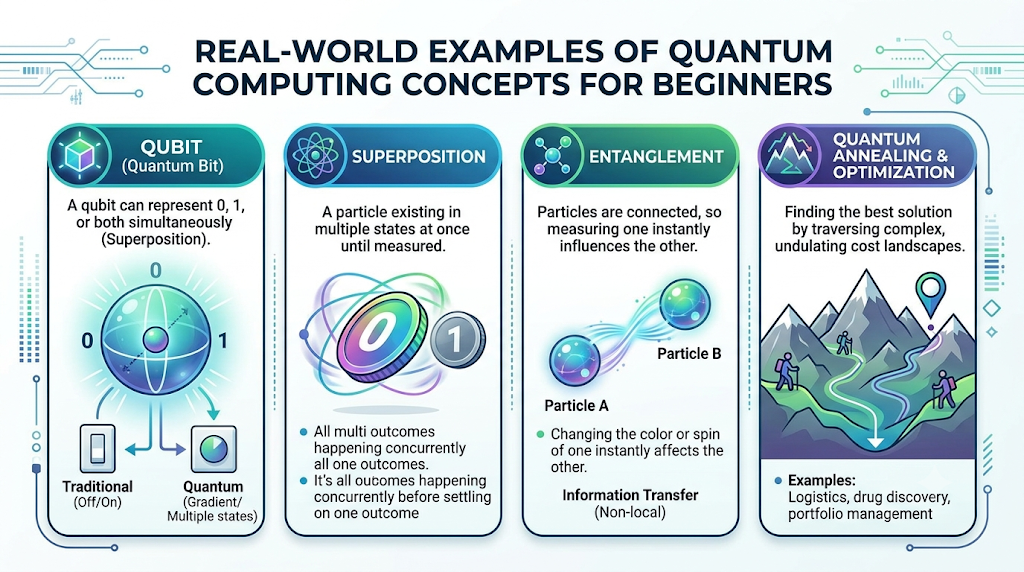
A qubit is the quantum version of a bit. A normal bit can be 0 or 1. A qubit can be in a state that has probabilities of both 0 and 1 before it is measured.
A simple analogy is a spinning coin. While it is spinning, it is not clearly heads or tails. When it lands, you see one result. A qubit is more advanced than a spinning coin, but the analogy helps beginners understand probability-based states.
Superposition
Superposition means a qubit can represent multiple possibilities before measurement.
In everyday terms, imagine planning a trip and keeping many routes open at the same time before choosing the best one. A classical system may test routes one by one. A quantum system can represent many possible states during computation.
Superposition is important in quantum algorithms because it helps quantum computers explore large solution spaces in a different way.
Entanglement
Entanglement is one of the most powerful quantum concepts. It happens when two or more qubits become connected in such a way that the state of one is related to the state of another.
A simple analogy is a pair of linked decision cards. When one card is revealed, the other card’s relationship becomes meaningful. In quantum computing, entanglement helps build strong connections between qubits during computation.
Entanglement is useful in quantum communication, quantum algorithms, and quantum information processing.
Quantum Gates
Quantum gates are operations applied to qubits. They change the state of qubits during computation.
In classical computing, logic gates process bits. In quantum computing, quantum gates process qubits.
For example:
- Some gates create superposition.
- Some gates create entanglement.
- Some gates rotate or transform quantum states.
- Some gates help prepare a system for measurement.
Quantum gates are the building blocks of quantum circuits.
Quantum Measurement
Measurement is the process of reading a quantum state. When a qubit is measured, it gives a classical result such as 0 or 1.
Before measurement, the qubit may exist in a probability-based state. After measurement, we get one result.
This is why quantum computing often involves running an experiment many times. By observing repeated results, we can understand the probability pattern.
Interference
Interference is used to strengthen correct or useful outcomes and reduce incorrect or less useful outcomes.
A simple analogy is sound waves. Some waves combine and become stronger. Other waves cancel each other out.
In quantum computing, interference helps guide the computation toward useful answers. This is one reason quantum algorithms must be carefully designed.
Real-World Examples of Quantum Computing Concepts
Quantum computing concepts become easier to understand when connected to real-life applications. Below are practical examples that show how quantum ideas may apply across industries.
1. Route Optimization
Route optimization is about finding the best path among many possible routes. This is important in delivery services, airlines, public transport, emergency response, and logistics.
A delivery company may need to send vehicles to hundreds of locations. The challenge is to reduce travel time, fuel cost, delays, and vehicle usage.
Quantum concepts involved:
- Superposition: Helps represent many possible routes.
- Interference: Helps increase the probability of better route choices.
- Quantum operations: Help transform and compare possible route states.
In simple terms, route optimization is like asking, “What is the best path when there are too many paths to check manually?”
Quantum computing may support this type of problem because optimization often involves a large number of possible combinations.
2. Drug Discovery
Drug discovery is one of the most discussed quantum computing applications. Creating a new medicine requires understanding how molecules behave and interact.
Molecules follow quantum rules naturally. Classical computers often approximate molecular behavior, but complex molecules can become very difficult to simulate accurately.
Quantum concepts involved:
- Qubits: Can represent quantum states of molecules.
- Entanglement: Helps model relationships between particles.
- Quantum simulation: Helps study molecular behavior.
A beginner-friendly analogy is building a detailed model of a lock and key. The disease target is the lock, and the drug molecule is the key. Scientists need to understand whether the key fits well, safely, and effectively.
Quantum computing may help researchers explore molecular structures, chemical reactions, and material interactions more naturally.
3. Financial Portfolio Analysis
Financial portfolio analysis involves choosing investments while balancing risk and return. Investors may need to compare thousands of possible asset combinations.
A portfolio manager may ask:
- Which assets should be selected?
- How much should be invested in each?
- What is the expected risk?
- What is the expected return?
- How will market changes affect the portfolio?
Quantum concepts involved:
- Superposition: Represents many portfolio combinations.
- Quantum gates: Transform investment scenarios.
- Measurement: Helps identify useful probability-based outcomes.
This does not mean quantum computers can predict markets perfectly. Markets are affected by human behavior, economic events, and uncertainty.
However, quantum computing may help with complex optimization and simulation tasks inside financial modeling.
4. Supply Chain Optimization
Supply chains involve suppliers, factories, warehouses, transport routes, inventory levels, and customer demand.
A company may need to decide:
- Where to store products
- Which supplier to use
- How much stock to keep
- Which transport route is best
- How to reduce delays
- How to manage sudden demand changes
Quantum concepts involved:
- Superposition: Represents many supply chain configurations.
- Interference: Helps reduce weak options and strengthen better ones.
- Measurement: Converts quantum results into practical decisions.
A simple analogy is solving a giant puzzle where every piece affects another piece. Changing one supplier may affect cost, speed, quality, and delivery reliability.
Quantum computing may help organizations solve complex supply chain planning problems when classical methods become too slow or limited.
5. Weather and Climate Modeling
Weather and climate systems involve many interacting factors such as temperature, pressure, wind, humidity, ocean movement, and atmospheric chemistry.
These systems are difficult to model because small changes can affect large outcomes.
Quantum concepts involved:
- Quantum simulation: Helps model complex physical systems.
- Qubits: Represent probability-based states.
- Quantum operations: Help process complex interactions.
A simple example is predicting how air movement changes when temperature and pressure shift across regions. Classical computers already perform weather modeling, but quantum computing may support certain advanced simulation problems.
Quantum computing may not replace existing weather systems, but it may become useful for specialized modeling and scientific research.
6. Materials Science
Materials science studies how materials behave at the atomic and molecular level. This field is important for batteries, semiconductors, solar cells, aircraft materials, and medical devices.
Scientists may want to design:
- Stronger lightweight materials
- Better batteries
- More efficient solar materials
- Advanced superconductors
- New industrial catalysts
Quantum concepts involved:
- Entanglement: Helps represent relationships between particles.
- Quantum simulation: Helps study atomic behavior.
- Measurement: Helps evaluate possible material properties.
A practical analogy is trying to design the perfect building material before physically manufacturing it. If scientists can simulate material behavior more accurately, they can reduce trial-and-error experiments.
Quantum computing may help discover materials with better strength, conductivity, efficiency, or durability.
7. Machine Learning
Machine learning uses data to find patterns, make predictions, and support decision-making. Quantum machine learning studies how quantum computing may improve certain parts of machine learning workflows.
Possible areas include:
- Pattern recognition
- Data classification
- Optimization of models
- Feature mapping
- Sampling complex probability distributions
Quantum concepts involved:
- Superposition: Helps represent many possible states.
- Quantum gates: Transform data representations.
- Interference: Helps guide useful outcomes.
A simple analogy is searching for patterns in a very large library. Classical machine learning reads and processes data using classical methods. Quantum methods may help in selected tasks where probability, optimization, or high-dimensional patterns are important.
Quantum machine learning is still a developing area, but it is important for future AI research.
8. Cybersecurity
Cybersecurity is strongly connected to quantum computing because quantum algorithms may affect some existing encryption methods.
Classical encryption protects data by making certain mathematical problems difficult to solve. Some quantum algorithms could challenge specific cryptographic systems.
Quantum concepts involved:
- Quantum algorithms: May solve selected mathematical problems faster.
- Entanglement: Supports quantum communication research.
- Measurement: Plays a role in quantum key distribution concepts.
This does not mean all cybersecurity will fail. It means organizations need to prepare for quantum-safe security methods.
A simple analogy is changing the lock system before a more powerful key becomes available. Quantum computing encourages researchers to design stronger future-ready cryptographic methods.
QuantumOpsSchool.com Guide to Practical Quantum Computing Concepts
QuantumOpsSchool.com can be presented as a learning resource for people who want to move from basic theory to practical understanding. Beginners often struggle because quantum computing sounds abstract. A structured learning approach makes the subject easier.
Learning Qubits Step by Step
The first step is to understand how qubits differ from classical bits.
Students should begin with:
- What a bit is
- What a qubit is
- Why qubits use probability
- How qubits are measured
- Why measurement changes the result
A strong foundation in qubits makes advanced topics easier.
Understanding Superposition Through Analogies
Superposition should be learned through simple examples before mathematical notation.
Useful analogies include:
- A spinning coin before it lands
- Multiple route options before choosing one
- A decision tree with many open possibilities
- A search space where many candidates exist
These analogies are not perfect, but they help beginners build mental models.
Exploring Entanglement Without Complex Mathematics
Entanglement can feel confusing at first. Beginners should focus on the idea of connected quantum states.
A practical way to understand it is to think about linked outcomes. When qubits are entangled, their states are not fully independent.
Students should first understand:
- Why entangled qubits are connected
- How entanglement supports quantum circuits
- Why entanglement matters in quantum communication
- How it helps in selected quantum algorithms
Building Conceptual Understanding Before Programming
Many learners want to start coding quantum circuits immediately. That is useful, but conceptual understanding should come first.
Before programming, learners should understand:
- What qubits represent
- What gates do
- Why measurement is probabilistic
- How circuits are built
- Why quantum results are interpreted statistically
This prevents beginners from treating quantum programming like ordinary software programming.
Practicing with Quantum Simulators
Quantum simulators allow learners to practice quantum circuits on classical computers.
They help students:
- Build simple circuits
- Apply quantum gates
- Observe measurement results
- Understand probability patterns
- Compare expected and actual outcomes
Simulators are valuable because real quantum hardware can be limited, noisy, or difficult for beginners to access.
How Quantum Concepts Work Together
Quantum computing concepts do not work separately. They work together inside a quantum computation process.
Information Encoding
The first step is encoding information into qubits. This means preparing quantum states that represent the problem.
For example, in an optimization problem, different qubit states may represent different possible solutions.
Computation
Quantum gates are applied to qubits to transform their states. During this process, superposition, entanglement, and interference may be used.
This is where the quantum circuit performs meaningful operations.
Measurement
After computation, the quantum state is measured. Measurement converts the quantum state into classical information.
Because results are probability-based, the same circuit may be run many times.
Result Interpretation
The final step is interpreting the results. A quantum computer may produce patterns of outcomes. These outcomes must be analyzed and translated into useful answers.
For example, in route optimization, the result may suggest a route with lower cost or shorter travel time.
Classical Computing vs Quantum Computing
| Feature | Classical Computing | Quantum Computing |
|---|---|---|
| Information Unit | Bit | Qubit |
| State | 0 or 1 | Multiple probability states before measurement |
| Processing Style | Sequential and parallel computing | Quantum operations on quantum states |
| Typical Strength | General-purpose tasks | Specialized computational problems |
| Logic Type | Boolean logic | Quantum probability and linear transformations |
| Output Style | Deterministic for most standard tasks | Probabilistic measurement-based results |
| Common Use | Applications, databases, web systems, business software | Optimization, simulation, cryptography research, advanced modeling |
| Hardware Maturity | Highly mature and widely available | Developing and specialized |
| Error Behavior | Easier to detect and manage | Sensitive to noise and decoherence |
| Best Role | Everyday computing | Solving selected complex problems with quantum advantage potential |
Industries Expected to Benefit from Quantum Computing
Quantum computing has potential across many industries. The value depends on the problem type, data structure, hardware progress, and algorithm design.
Healthcare
Healthcare may benefit from quantum computing in drug discovery, protein interaction research, molecular simulation, and medical data analysis.
Quantum simulation may help researchers understand complex biological and chemical systems.
Banking and Finance
Finance may use quantum computing for portfolio optimization, risk analysis, fraud detection research, pricing models, and complex simulations.
Quantum computing may support decision-making where many possible scenarios must be evaluated.
Manufacturing
Manufacturing may benefit from better material design, production scheduling, quality optimization, and process simulation.
Factories with complex workflows may use quantum-inspired or hybrid methods for planning and optimization.
Logistics
Logistics is one of the most practical areas for optimization. Route planning, fleet scheduling, warehouse placement, and delivery timing can involve many variables.
Quantum computing may help solve difficult logistics problems with many possible combinations.
Artificial Intelligence
Quantum computing may support selected machine learning tasks, such as optimization, sampling, and pattern representation.
Quantum machine learning is still developing, but it is an important research area for advanced AI systems.
Scientific Research
Scientific research may benefit from quantum simulation, high-energy physics modeling, chemistry, materials science, and complex system analysis.
Quantum computers naturally align with certain scientific problems involving quantum behavior.
Energy
Energy companies may use quantum computing for battery research, grid optimization, material discovery, and energy storage modeling.
Better materials and better optimization can support more efficient energy systems.
Telecommunications
Telecommunications may benefit from quantum communication research, network optimization, signal processing studies, and security improvements.
Quantum-safe communication is also an important area of future security planning.
Challenges of Applying Quantum Computing
Quantum computing is powerful in theory, but practical use still faces major challenges.
Hardware Stability
Quantum hardware is very sensitive. Qubits must be controlled carefully. Small disturbances can affect results.
Stable quantum hardware is necessary for reliable computation.
Decoherence
Decoherence happens when a quantum system loses its quantum behavior due to interaction with the environment.
This is one of the biggest challenges in quantum computing because qubits must maintain their states long enough to perform useful operations.
Error Correction
Quantum systems are noisy. Errors can happen during gates, measurement, and state preparation.
Quantum error correction is needed to build reliable large-scale systems, but it requires advanced design and many physical resources.
Limited Quantum Hardware
Current quantum hardware is specialized and limited. Not every learner or company can easily access powerful quantum machines.
This is why quantum simulators and cloud-based quantum platforms are important learning tools.
Specialized Skills
Quantum computing requires knowledge from multiple areas:
- Computer science
- Linear algebra
- Probability
- Physics concepts
- Algorithms
- Hardware basics
Beginners do not need to master everything at once, but they should follow a step-by-step learning path.
Common Beginner Misconceptions
Quantum Computers Replace Classical Computers
Quantum computers do not replace classical computers. They are designed for specialized problems.
Classical computers will continue to handle everyday computing tasks.
More Qubits Always Mean Better Performance
More qubits do not automatically mean better performance. Qubit quality, error rates, connectivity, stability, and algorithm design also matter.
A smaller reliable system may be more useful than a larger noisy one.
Quantum Computing Solves Every Problem
Quantum computing does not solve every problem. It may provide advantages for selected areas such as optimization, simulation, and certain mathematical problems.
Many tasks are still better handled by classical systems.
Quantum Computing Is Only for Physicists
Quantum computing is not only for physicists. Software developers, engineers, mathematicians, data scientists, cybersecurity professionals, and researchers can all contribute.
Beginners can start with concepts, simulators, and simple circuits.
Best Practices for Learning Quantum Computing
Learning quantum computing becomes easier when students follow a structured path.
Best practices include:
- Learn classical computing fundamentals.
- Understand basic probability concepts.
- Master quantum terminology step by step.
- Study qubits before studying algorithms.
- Practice using quantum simulators.
- Learn simple quantum gates first.
- Build small circuits before complex ones.
- Study simple quantum algorithms gradually.
- Avoid rushing into advanced mathematics too early.
- Connect every concept with practical examples.
A good beginner approach is to learn one concept, see one analogy, practice one small circuit, and then connect it to a real-world use case.
Career Opportunities in Quantum Computing
Quantum computing is creating new career paths for learners from technology, science, engineering, and research backgrounds.
Quantum Software Engineer
A quantum software engineer builds quantum circuits, writes quantum programs, works with simulators, and helps develop quantum applications.
This role is suitable for software developers who want to expand into quantum programming.
Quantum Research Scientist
A quantum research scientist studies new quantum theories, algorithms, systems, and experimental methods.
This role often requires strong academic and research skills.
Quantum Algorithm Developer
A quantum algorithm developer designs algorithms for quantum systems.
This role focuses on problem-solving, mathematics, optimization, and quantum information science.
Quantum Hardware Engineer
A quantum hardware engineer works on physical quantum systems, control devices, sensors, and hardware stability.
This role is more closely related to physics, electronics, and engineering.
Quantum Information Specialist
A quantum information specialist works with quantum data, quantum communication, quantum cryptography concepts, and information theory.
This role connects computing, mathematics, and security.
Future of Quantum Computing Applications
Quantum computing is still developing, but several important directions are shaping its future.
Scalable Quantum Systems
Scalable systems are needed to solve larger and more useful problems. This requires better hardware, better control systems, and better error management.
Hybrid Classical-Quantum Computing
Hybrid computing combines classical computers with quantum processors.
In many practical systems, classical computers will manage data, workflow, and control, while quantum processors handle selected complex tasks.
Fault-Tolerant Quantum Computing
Fault-tolerant quantum computing means building systems that can continue working correctly even when errors occur.
This is important for reliable large-scale quantum applications.
Quantum Cloud Platforms
Quantum cloud platforms allow learners, researchers, and companies to access quantum tools remotely.
This makes quantum learning and experimentation more accessible.
Enterprise Quantum Adoption
Businesses may start with research, proof-of-concept projects, simulators, and quantum-inspired optimization before using large-scale quantum systems.
Enterprise adoption will likely grow as hardware, tools, and skills improve.
FAQ Section
- What is the simplest meaning of quantum computing?
Quantum computing is a way of processing information using qubits and quantum principles. It is useful for selected complex problems involving optimization, simulation, and probability-based computation. - What is a qubit in simple words?
A qubit is the basic unit of quantum information. Unlike a classical bit, it can hold probability-based states before measurement. - What is superposition in quantum computing?
Superposition means a qubit can represent multiple possible states before it is measured. It helps quantum systems explore many possibilities during computation. - What is entanglement used for?
Entanglement connects quantum states so they are related to each other. It supports quantum algorithms, communication research, and advanced quantum information processing. - Are quantum computers faster than normal computers?
Quantum computers are not faster for every task. They may be better for selected problems such as molecular simulation, optimization, and certain mathematical computations. - Can beginners learn quantum computing without physics expertise?
Yes. Beginners can start with simple concepts, probability, basic computing knowledge, and quantum simulators before studying advanced physics or mathematics. - What are real-world examples of quantum computing applications?
Examples include drug discovery, route optimization, financial modeling, supply chain planning, materials science, machine learning, and cybersecurity research. - What is quantum measurement?
Quantum measurement is the process of reading a quantum state and getting a classical result, usually 0 or 1. The result depends on probability. - Why are quantum simulators useful for learning?
Quantum simulators let learners practice quantum circuits on classical computers. They are useful for understanding gates, measurement, and probability patterns. - Is quantum computing a good career field?
Yes, it can be valuable for learners interested in advanced computing, research, algorithms, cybersecurity, AI, hardware, and scientific applications.
Final Summary
Real-world examples of quantum computing concepts help beginners understand why this field is important. Concepts such as qubits, superposition, entanglement, quantum gates, measurement, and interference may seem abstract at first, but they become clearer when connected to practical applications. Route optimization shows how quantum systems may explore many possibilities. Drug discovery and materials science show how quantum simulation can help study natural quantum behavior. Finance, supply chains, machine learning, and cybersecurity show how quantum computing can support specialized problem-solving. The most important lesson is simple: quantum computing is not magic, and it does not replace classical computing. It is a specialized approach for selected complex problems. Beginners should build strong conceptual foundations before moving into advanced algorithms or programming.